Heart-beat. Beat. Rhythm -- music in life!
| Date :02-Dec-2023 |
By Vijay Phanshikar
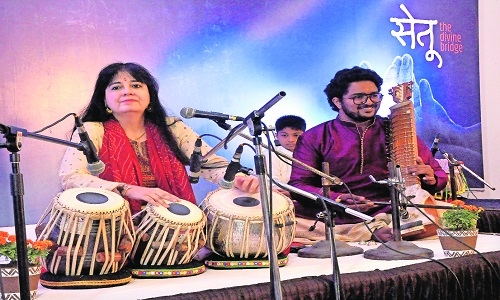
There is rhythm -- of its own -- in everything, she chimed. Her face aglow in art’s glee, her long hair cascading down her shoulders, her eyes as if searching in the distance the soul of the music she was presenting on a pleasant winter morn, Tabla virtuoso Pandita Anuradha Pal unraveled for the capacity-packed audience at the International Principals’ Educational Conference (IPEC) 2023, how life pulsates in everything, offering universal musical potential for “us to understand and benefit from”. The two-and-a-quarter-hour session at the Chitnavis Centre was certainly entertaining, to say the least, but it was far more educating and enlightening than anybody in the elite educational audience could possibly imagine. In the end, everybody emerged triumphant in the thought that he/she was a far more enriched person than he/she was before the session -- enriched in not just musical comprehension of whatever level, but also in the universality of rhythm that actually offers a backdrop to the celestial configuration. “The first sound with which one gets introduced to is in the mother’s womb -- of the mother’s rhythmic heart-beat, dhak-dhak-dhak ... for the full stay in that haven as life starts assuming shape and size. That heart-beat is the little life’s constant companion. That is the most familiar sound the little one gets so used to that one remains fascinated not just by the sound of that beat but also whatever mother’s heart represents -- love, kindness, pardon, accommodation ...!” Vidushi Anuradha Pal said.
Presenting her thoughts on a conference sub-theme of importance of art, music in education, Anuradha Pal supplemented her statement with practical demonstration of the tabla. As the only woman multi-percussionist in the top league of tabla players in the world, she used her instrument -- and her skill as a tabla nawaaz -- in the most entertaining manner. “Let us imagine we are travelling from Mumbai to Nagpur by train. The train starts, first slowly, and gathers speed, all the time making its typical sounds of the wheels on the track. Then it reaches a bridge, and the nature of sound changes. Each variation of the sound can be captured in tabla beats. Listen to this ...” And the audience joins Anuradha Pal on the train journey -- in raptures, clapping incessantly, laughing, heads dancing to the beats. And then the train comes to a slow-slower-very slow stop -- indicated so richly by the tabla-beats. The audience suddenly freezes in its response. To the stunned audience, Anuradha Pal then asks, “Didn’t I say, everything has its own beat! That is how you understood how the tabla can capture the sounds of the train almost completely. And now let us bring up from memory of a school child being woken up early in the morning by the mother. The kid is sleepy, unwilling to get up and go to school. Their conversation, too, has its own rhythm, its own beat -- which we can capture on the tabla”.
Then follows that urgent -- even angry -- takkk dhina dhin of the mother, and the lazy taaak dheeenaaa dheeen of the child, eliciting peels of laughter from the audience. Similar was the response when the virtuoso presented the sounds of a huge bus lazily coursing its way through a busy street, with light and bumpy auto-rickshaws screaming and screeching their weave through the traffic -- all on tabla beats. As she kept reading the contents of her paper, too, interspersed with musical breaks, Anuradha Pal shared with the audience the experiences of how she conducted various programmes for schools and elderly people, helping them realise an altogether different type of mental calm and spiritual elevation -- in the process offering amazing details of her 16-18-hour days serving the larger social cause.
Her appeal in the end was to the school community: Explore how music can be used as a very great educational complement to the process of learning to be better human being -- which also was an aim of education. The IPEC meets have hosted previously music virtuosos such as great vocalist Devaki Pandit, legendary flutist Ronu Mazumdar, the iconic Rudra-Veena exponent Vishwa Mohan Bhat -- drawing fantastic audience response not just in terms of art but also in terms of art’s use as an educational tool.