Dadasaheb Khaparde: Multi-faceted patron of Vidarbha
| Date :26-Feb-2023 |
By Kartik Lokhande :
Khaparde led the Indian delegation to England to meet the Viceroy to suggest reforms in Indian affairs. Taking cognizance of wit and art of expression in his speeches, the British newspapers of the time compared him to Mark Twain
Ganesh Shrikrishna alias Dadasaheb Khaparde was among the stalwarts of Vidarbha who played a key role in supporting freedom struggle for India’s independence from the British Rule. He was a staunch follower of Lokmanya Bal Gangadhar Tilak. His contribution was not restricted to political activities only, but he was also active in social, cultural, and economic spheres of life. Born on August 27, 1854 at Hingoli to Shrikrishna Khaparde, who was a clerk in the Supply Department of the British Army, Dadasaheb spent his childhood years in Amravati and Nagpur as his father had a job that saw transfer from one place to another. Dadasaheb was a keen reader, and developed wider consciousness. He passed matriculation examination from Akola, and later on did his BA, LLB. While studying law, he also acquired proficiency in various languages including English, Urdu, Persian, Sanskrit, Gujarati apart from mother-tongue Marathi. After completing education in law, he joined the Government service as Extra Commissioner and served in that capacity till 1889.
Later, he quit the Government job and started practice of law. Soon, Dadasaheb became a widely-sought lawyer with his insight, sharp intellect and skills, and presence of mind required in a lawyer. As per the Marathi book ‘Swatantryapurva Kaalatil Amravatichi Gaurav Gatha’ (The Glorious Tale of Amravati in Pre-Independence Period) published by Azad Hind Mandal in 2015, the British Government had to amend several laws due to his in-depth knowledge of law-points. Dadasaheb Khaparde rose to eminence in public life too. He became the Vice-President of Amravati Municipal Council and served in that capacity for 16 long years. He was removed from the position by the British rulers as he became influenced by the legendary Lokmanya Tilak. Between 1889 and 1907, he was Chairman of the erstwhile District Local Board. In 1897, he was Chairman of Reception Committee formed for the Congress convention at Amravati. He actively participated in Congress party’s work from 1889 to 1920. Khaparde and Tilak first met in 1891 during Congress convention held at Nagpur. That time, a social conference was held during Congress convention due to initiative of Justice Mahadev Govind Ranade. In 1891, Khaparde chaired that conference. During a discussion, Khaparde and Tilak had a heated exchange of words. However, that proved to be a starting point of a bond that would be remembered for a long time to come. Due to their strong friendship, Khaparde travelled across the length and breadth of the undivided India. In 1907, it is said, Khaparde’s effective oratorical skills led to Tilak group dominating Congress convention held at Surat.
When Lokmanya Tilak was arrested on charges of sedition, Dadasaheb Khaparde went to England and made all efforts for Tilak’s release. In 1914, Tilak started Home Rule Movement after his release from prison. Khaparde was among the founding members of the movement. He travelled in nook and corner of Vidarbha (known as Berar at that time), Central Provinces, and other parts of the country and popularised the movement. One can gauge the eminence that Dadasaheb Khaparde had earned in national politics from the fact mentioned in the book ‘Swatantryapurva Kaalatil Amravatichi Gaurav Gatha’ that he led the Indian delegation that had gone to England to meet the Viceroy to suggest reforms in Indian affairs. During his stay in London from May 1919 to January 1920, he delivered several speeches.
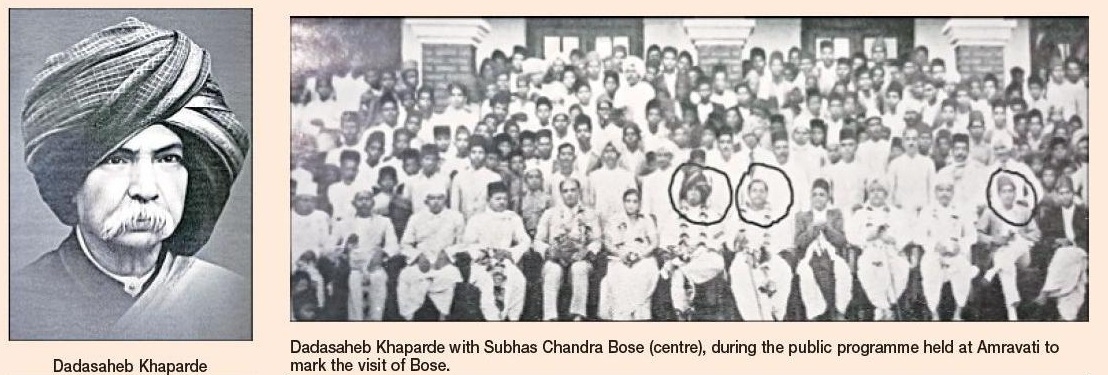
Taking cognizance of the wit and art of expression in his speeches, the British newspapers of the time compared him to Mark Twain. Due to the strong stand taken by the delegation, it is said, Montague Chelmsford Reforms Law came into being. Dadasaheb was elected as member of Viceroy’s Council of State from 1918 to 1933, and actively participated in the proceedings. Following Tilak’s initiative, Dadasaheb started ‘Ganeshotsav’ in 1900 and ‘Shiv Jayanti Utsav’ in 1905 in Amravati. He founded Rashtriya Shala (National School) in Amravati to ensure that the students got education with Indian values. He came under the scanner of the British for helping freedom fighters including Swatantryaveer V D Savarkar, Chafekar brothers, Bhide, Rangnath Tikhe. He also hosted almost all the Indian national leaders of the time including Netaji Subhash Chandra Bose. He was a known philanthropist of the time. During the drought that hit the region from 1896 to 1900, Dadasaheb Khaparde had started ‘Annachhatra’ (free food service) at his house. He had taken initiative to open the famous Amba Devi Mandir of Amravati to Dalits. Many give him credit for recognising the talent in legendary artiste Narayan Rajhans, popularly known as Balgandharva. As per the book ‘Swatantryapurva Kaalatil Amravatichi Gaurav Gatha’, Dadasaheb paid from his pocket to ensure that Balgandharva received training in Classical Vocal from music world stalwarts including Rahimat Khan, Pt Namdev Buwa, Pt Natthu Buwa. In fact, the autobiographies or biographies of legendary artistes like Balgandharva, Ganpatrao Joshi, Chintramanrao Kolhatkar mention about the patronage of Dadasaheb Khaparde. Dadasaheb’s patronage to the theatre was so immense that he became the Chairman of the first Akhil Bharatiya Marathi Natya Sammelan held in 1905. Dadasaheb was a spiritual man too. He had hosted many a saint including Sai Baba of Shirdi, Sant Gajanan Maharaj of Shegaon, Sant Gulabrao Maharaj of Amravati, Sant Narayan Maharaj and others.
Due to his riches and generosity, many people of the time referred to Dadasaheb Khaparde as ‘Nawab of Vidarbha’. Prior to India getting independence from the British Rule, the then Shankaracharya Dr Kurtkoti had awarded the title of ‘Bharat Ratna’ to him. Dadasaheb Khaparde, the man of many hues and eminence in multiple spheres of activity, passed away on July 1, 1938, at the age of 84 years, leaving behind a legacy and history to draw inspiration from. Sadly, the imprints of legends like him on the sands of time are fading. Will leadership of Vidarbha in particular and Maharashtra and India in general take some initiative so that younger generation gets to know about these legends?