The silent tumult, the palpable evolution -- of young minds
17 Mar 2023 08:59:53
By Vijay Phanshikar
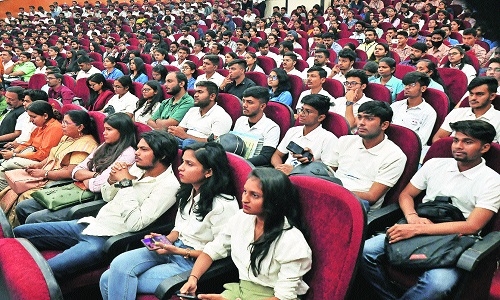
They were clueless -- to begin with, when the two celebrated speakers started talking about India’s helm-level involvement in G-20 and what the young people could do in the global multilateral society. The capacity-packed Guru Nanak Bhavan auditorium of Rashtrasant Tukadoji Maharaj Nagpur University (RTMNU) was experiencing an altogether different level of conversation on a subject that appeared to be rather heavy for the college-level youngsters. It was all poetry or Latin or rocket science, as if, for most. Yet, a small number of the youths -- actually not so small, so to say -- felt the vibration of nuanced thinking on a fine subject. After two hours of intense but unstated give-and-take of ideas of the global India, many, many, many youngsters did feel a different throbbing hitting their chests from within. Their first-ever and very pronounced exposure to global thought made many in the audience to start thinking more deeply about India and the world, or India in the world.
This was how the young people of Nagpur began their tryst with the idea of G-20 leadership India has earned for itself -- out of thoughtful diplomacy, out of purposeful projection of what the country stood for ...! Watching from the sidelines this curious mix of thought, one could realise that the city’s youth is truly getting confronted by really big ideas. They may take time to absorb all that input, all right. But eventually, as the thought grew deeper, one did realise that the thought -- none the less -- will take root and sprout eventually.
Is this not the way how a society matures? Is this not the way how the youth start becoming genuine adults -- though without losing youngness? Former diplomat Dr Ajay Gondane was at his best explaining what the G-20 presidency meant for India and its people. He said, in effect, that the G-20 presidency was a metaphor of the beneath-the-surface strength India wove into its diplomacy over time. It was also an expression of how India projected its plus points such 65% of its population being young, of how India was gifted with terrific reserves of natural resources, of how India’s entrepreneurship had an amazing dynamism, of how India’s history affords a foundation for the leap into future ...!
The youngsters listened at first fidgetingly and later in rapt attention. They might have heard all that before -- from political speeches. But what Dr Ajay Gondane offered was nothing political; it was, at best, the most meaningful explanation of the identity of India as a sovereign nation in a complex world. They -- the youngsters -- realised that the speaker was showcasing India’s well-earned polar position in a multi-polar world order. At first, the young people in the room clapped tentatively. But as they understood the silent meaning of the extended metaphor, they realised that they belonged to a country that is making a terrific sense in the international arena. They may not verbalise all that understanding, all right. But one felt sure that they went back more enriched. For, honestly, they had not thought actively about all this Latin and Greek and vedic math! -- so to say.
But when Dr Jyoti Chandiramani, Director of the Symbiosis Schoool of Economics, stepped up to the podium, and told the young audience that it belonged to a multilateral world, their pondering -- though unspoken -- began once again. In their young -- and even small -- lives, they had never been exposed to multiple dimensions that bind -- and liberate -- their personae. Thanks to the limitations of our country’s terribly narrow class-room teaching process, the youngsters generally learn to live a unilinear life -- me, my family, my job, my salary, my home, my wife, my children ...! This understanding almost got bombed with the idea of the multilateral world in which the young people live and will keep living. So, dear young people, understand that unilateralism will only complicate matters
further. But if you evolve into the concept of the multilateral world, your minds would be broadened, your vision would be expanded, your power to accommodate others would be immensely enhanced --- she said, plunging the young audience into a maze of thoughts whose head and tail they could not actually fathom.
As the two speakers elaborated upon their chosen issues, there were multiple but silent conversations going on between each young person in the audience and the speaker. There were unasked questions. There were unanswered issues. There were dangerous doubts building up in thinking minds. And with all that tumult swirling in their heads, the young people went home. But, as they funneled into doors to leave, ‘The Hitavada’ asked many of them straight questions about what the young people had learned. They were clueless -- if one may say so. Yet, one could also sense a subterranean evolution taking place in each mind. This was not just a feigned positivism. Much to the contrary, this was the vibration of certain optimism one felt about the young people of India.