BITS & VNIT creating decision support system applying AI in soil management
| Date :24-May-2023 |
Staff Reporter
A LOT of research is going on across the world to find ways which can increase crop yield. One way that is widely experimented upon is changing crop pattern, like replacing cotton or soyabean crop with another to see if that benefits the farmer. However, to change the crop, one must know the property of the soil, its grain size, and its drainability, as different crops need different conditions. Scientists are, therefore, working on determining soil property, its capacity to pass and retain water.
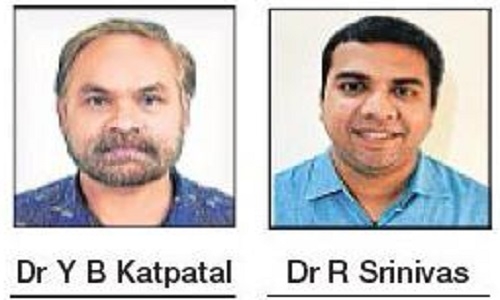
BITS Pilani and Visvesvaraya National Institute of Technology (VNIT) are jointly working on soil management for diversified agriculture through Artificial Intelligence (AI) under Space Technology Incubation Centre (STIC) project awarded by Indian Space Research Organisation (ISRO) under its Yukti Sanchita Scheme to VNIT. Dr Rallapalli Srinivas is the Principal Investigator of the project. Others in the team are Co-Principal Investigators Dr GSS Chalapathi and Dr Amit Singh, Yashwant Katpatal, Co-PI, VNIT, Dr Suresh Kumar (mentor, IIRS, Dehradun), and Dr Sreenivas K (co-mentor, NRSC, Hyderabad). The overall goal of the project is to develop an AI-enabled decision support system that can assist farmers in diversified agriculture and soil management in a costeffective manner. The objectives of the project include generation of Geospatial database of farm and farming system at block level/ region through Krishi Vigyan Kendra (KVK), deploying sensors, Unmanned Aerial Vehicle (UAV) and interaction with farmers (Geo-Farm); developing Smart Soil Management System for assessing soil fertility and crop productivity potential using soil sensors and Machine Learning/AI (Geo-Smart Soil); developing a cost-effective Smart Diversified Crop Planning System using Decision Criterion Method under different cropping seasons (Geo-Crop Diversification); multiple stakeholder (farmers, KVK team, ICAR team, etc.) interaction and periodic monitoring of agricultural farms through wireless sensor networks and notifying the farmers through a mobile application about cost-effective best management practices (BMPs) (On-ground implementation).
Dr Yashwant B Katpatal, Professor at VNIT and Co- Principal Investigator of the project, told ‘The Hitavada’ that the project was directly linked to the National Natural Resources Management System architecture. “The project deals with crops and soil resources. Statistics on these items are crucial for the government to plan for the storage of agricultural produce, its distribution, pricing, and procurement strategy. Geospatial data can be used for estimating crop yield, the area under cultivation, soil fertility information, and even cropping system followed by farmers in different regions.” The team working on this project will take soil samples, check the parameters of soil, the images will be processed, and then the soil samples will be analysed, Dr Katpatal added.
“LIDAR, which stands for Light Detection and Ranging, is a remote sensing method that uses pulsed laser to measure ranges (variable distances) to the Earth. We are using is LIDAR to get information on soil structure after interacting with material. We will also be using multispectral images, which will be captured through Drone Technology. This study will involve drainability assessment, composition assessment and based on drainability and composition, we can know the properties of soil,” he explained.
ISRO has been working on this application area since the eighties and the Crop Acreage and Production Estimation (CAPE) project is an example of its success. The Forecasting Agricultural Output using Space, Agro-meteorology and Land-based Observations (FASAL) project is also closely related to this project proposal. The existing projects have made use of geospatial data for estimation and analysis. This project aims to take it a step further and provide intelligent decisions to farmers based on data-driven AI models.