Stage set for opening of new Parliament building by PM today
| Date :28-May-2023 |
NEW DELHI :
PRIME Minister Narendra
Modi will on Sunday inaugurate the new Parliament building, equipped with state-ofthe-art technology, amid a
boycott by several Opposition
parties which insist that
President Droupadi Murmu
as head of the state should do
the honours.
On Friday, Modi said the
new Parliament building
will make every Indian proud
and shared a video of the new
complex.
With carpets from Mirzapur
in Uttar Pradesh, bamboo
flooring from Tripura and
stone carvings from
Rajasthan, the new Parliament
building reflects India’s
diverse culture.
‘Sengol’, a historical sceptre from Tamil Nadu which
was received by first Prime
Minister Jawaharlal Nehru to
represent transfer of power
from the British and was kept
in a museum in Allahabad,
will be installed in the new
Parliament building.
It will be placed near the
chair of Lok Sabha Speaker in
the House chamber.
But amid a boycott by 20
Opposition parties
of the inauguration
ceremony, the
Sengol too was
dragged into the political row.
Congress leader Jairam
Ramesh on Friday claimed
there was no documented evidence of Lord Mountbatten,
C Rajagopalachari and Nehru
describing the Sengol as a
symbol of transfer of power
by the British to India.
The Congress’ stand on the
Sengol evoked a strong reaction from Home Minister Amit
Shah who said the party needs
to “reflect” on its behaviour
as he denounced its claim that
there was no evidence of the
Sengol being a symbol of
transfer of power by the British
to India in 1947.
To mark the event, the
Government will issue a commemorative Rs 75 coin.
According to a
gazette notification
by Department of
Economic Affairs
under the finance
ministry, the
weight of this coin could be
34.65-35.35 gram.
One side of the coin will
bear the image of Lion Capital
of Ashoka Pillar in the centre
flanked by the word ‘Bharat’
in Devnagri script and‘INDIA’
in English, it said.
Rupee symbol ‘?’ and
denominational value ‘75’ in
international numeral will
also be inscribed below the
Lion Capital. The other side of the coin
shall bear the image of
ParliamentComplex,andthe
year ‘2023’ in international
numeral below the image.
ThenewParliamentbuilding, constructed by Tata
ProjectsLtd,willhaveagrand
constitutionhalltoshowcase
India’s democratic heritage,
a lounge for MPs, a library,
multiple committee rooms,
diningareasandampleparking space. The triangularshaped four-storey building
has a built-up area of 64,500
square metres.
The building has three
main gates -- Gyan Dwar,
Shakti Dwar, and Karma
Dwar. It will have separate
entrances forVIPs,MPs, and
visitors. The material used
forthenewbuildinghasbeen
acquired from various parts
of the country.
The teakwood used in the
building was sourced from
Nagpur in Maharashtra,
whiletheredandwhitesandstone was procured from
Sarmathura in Rajasthan.
The sandstone for the Red
FortandHumayun’sTombin
the national capital was also
knowntohave sourcedfrom
Sarmathura. The Kesharia
green stone has been procured from Udaipur, the red
granite from Lakha near
Ajmer and the white marble
has been sourced from
Ambaji in Rajasthan.
“In a way, the entire country came together to construct the temple of democracy, thus reflecting the true
spiritofEkBharatShreshtha
Bharat,” an official said.
The steel structure for the
falseceilingsintheLokSabha
and the Rajya Sabha chambershavebeensourcedfrom
theunionterritoryofDaman
and Diu, while the furniture
inthenewbuildingwascrafted in Mumbai. The stone
‘jaali’ (lattice) works dotting
the building were sourced
from Rajnagar in Rajasthan
and Noida in Uttar Pradesh.
The materials for the
Ashoka Emblem were
sourcedfromAurangabadin
Maharashtra and Jaipur in
Rajasthan, while the Ashok
Chakra donningthe massive
walls of the Lok Sabha and
the Rajya Sabha chambers
and the exteriors of the
Parliament building were
procured from Indore in
Madhya Pradesh.
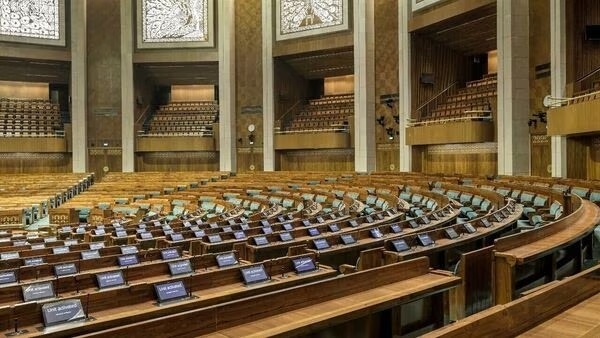
ThenewParliamentbuildingcancomfortablyseat888
members in the Lok Sabha
chamberand300intheRajya
Sabha chamber. In case of a
joint sitting of both the
Houses,atotalof1,280members can be accommodated
in the Lok Sabha chamber.