‘Oscillating pedal drive better for cycling’
| Date :07-May-2023 |
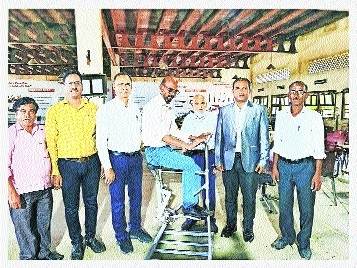
(From left) Workshop Instructor Sheshrao Sontakke, Workshop Superintendent Prof Rakesh Bandane, JES Director Prof S M Bang, Workshop Instructor Shashikant Ramteke, Technical Advisor, Dr J P Modak, JDCOEM Principal Dr Shrikant Sonekar, and Workshop Instructor Gopal Domke.
By Vikas Vaidya :
City professor flags several flaws in the conventional bicycle ride
As man progressed, so did his capacity and capability of innovations and discoveries. With the invention of wheel, a revolution happened in the transport industry.
Over the years, innovations in this sector led to many improvements, and the automobile sector grew by leaps and bounds. The humble bicycle also found itself in the list of products that got better and became far more user -friendly, making the ride a comfortable one. The introduction of gears in bicycles took them to another level. The journey went on becoming better and better.
While a lot of thought went into modifying the brakes, the gears, the seats, the tyres, no one gave a thought to the pedal system - the heart of the bicycle - which help the rider move forward. The process of riding a bicycle is simple - straddle the seat, put your feet on the pedal and push forward by rotating the pedals in a circular fashion. This is the conventional method.
But is this the only method? Dr JP Modak, who was awarded with a DSc for the exemplary work that he has done in Machine System in his field, espouses a different view. Working on a new model of pedalling since 1984, Dr Modak is of the opinion that the conventional pedal drive has several shortcomings, including use of unnecessary energy to move the cycle forward. The oscillating pedal drive that he has developed after years of research needs less energy to run the bicycle and it also increases the speed by 30% than that of rotating pedal drive. To simplify the meaning, the conventional average speed of the bicycle which is on an average 10 km per hour is likely to get raised to 13-14 km per hour. This is a big social advantage for those who are dependent on cycle transportation and pedal rickshawalahs.
Dr Modak, who is working as Advisor (Technical) with J D College of Engineering and Management, JDCOEM and ex- Professor, Mechanical Engineering, at Visvesvaraya National Institute of Technology (VNIT) along with his colleagues Prof. Rakesh Bandane, Assistant Professor, Mechanical Engineering and workshop superintendent at JDCOEM have analysed the conventional pedal drive and after comparing it with the oscillating method drawn a conclusion that oscillating is the better one. Dr Modak has amed his study as 'Development of oscillating pedal drive for conventional bicycle propulsion instead of continuously rotating pedal drive'.
While talking to 'The Hitavada' Dr Modak explained the mechanical system of conventional pedal drive, "The present style of pedalling brings into play several parts of the body and their respective functions. They include 1. Thigh i.e. distance between hip joint and knee joint, 2. Leg comprises the distance between the knee joint to the ankle joint, 3. Foot that is always in contact with the flat pedal provided at the end of the pedal rod, 4. Pedal rod which is about 16 to 18 cm in length, 5. Big chain sprocket wheel." The analysis revealed that during one pedal operation say of the right pedal through 180 degrees the effective utilisation of the force exerted through the leg is useful only for 40 degrees of angular travel of the pedal between rod and big chain sprocket.
There are several shortcomings of the presently adopted conventional bicycle drive. These shortcomings can be overcome by adopting an oscillating pedal drive instead of a completely rotating drive. The effective utilisation of force exerted through the leg on the pedal for rotation of a big chain sprocket should have an angle between the leg and pedal in the range from 45 degrees to 120 degrees.
This is only possible by proposing oscillating pedal drive. In this drive when the right pedal turns through 70 degrees rotation in vertical frame is provided to the big sprocket. However, after that, drive is required to be taken over by the left pedal in the same fashion. This amounts to arranging mechanical hardware in such a way that the right pedal oscillates through 70 degrees counter-clockwise while during the same period, the left pedal should be turned 70 degrees in a clockwise sense, is the analysis by the team under the leadership of Dr Modak.
This is possible by providing the drive system comprising two additional four-bar mechanisms - one is a cross four-bar chain and other is open four-bar chain. The design of the present axel box is required to be changed with the provision of two freewheels. The aforementioned system is developed by a group of faculty members and students of JDCOEM comprising Dr J.P Modak, Prof. Rakesh Bandane, Skilled fabricators Gopal Domke, Sheshrao Sontakke, Shashikant Ramteke. In addition Sukhdev Jamaiwar also extended suitable help. S L Kulkarni, ex-Sr. Vice President of Blowplast Ergonomics has also contributed in this development
Students involved are Sudhanshu R. Gaidhane, Ritik G. Gaikwad, Vicky G. Bokde, Sahil Gedam, Banti Rai, Tushar Raghuvanshi, Nikhil Yele.
The trials on this system are performed. It is observed that there is a significant increase in the number of rotations of the big chain sprocket wheel during 1 min which are around 28 as against around 16 revolutions per minute during the existing pedaling system.
Alternatively, it is evident that the expected bicycle speed is going to be approximately 30% more than the existing bicycle speed, said Dr Modak with firmness.
The group of people working on the project expressed their sincere thanks and gratitude towards Sanjay Goyal, Chairman of Jaidev Education Society that runs JDCOEM; Ajay Goyal, Secretary; Jayesh Goyal, Trustee; Prof. S. M. Bang, Director; Avinash Dorsatwar, Executive Director; Dr Shrikant Sonekar, Principal, JDCOEM.