Handover Telangkhedi Fountain show project: NMRDA to KCC
| Date :16-Jun-2023 |
Staff Reporter
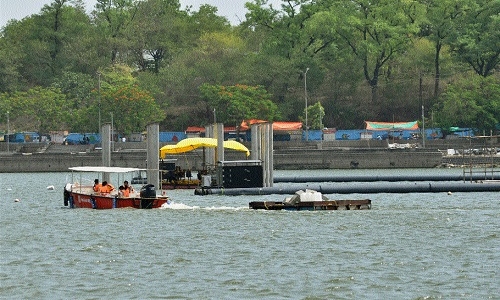
The Futala Fountains -- much hyped as a world class tourist attraction -- have stopped functioning for a rather bizzare reason. The underwater cables, which supply power to the fountains, have got damaged by insects. The cause of the damage reveals the lack of vision of the contractor, Khalatkar Construction Consortium (KCC), during the construction of the fountains. Taking serious cognizance of this issue, Nagpur Metropolitan Region Development Authority (NMRDA) has asked KCC to repair the damaged cables and hand it over to NMRDA. Dr Manojkumar Suryavanshi, Metropolitan Commissioner told ‘The Hitavada’, “When I visited the site, I was informed by KCC that some of the cables laid under water which supply power to the fountains have been damaged by insects and are entangled in the algae. The samples of water from relevant locations were sent for the testing.”
During his visit, Dr Suryavanshi instructed KCC to carry out necessary repairs immediately and handover the same to NMRDA within a month, so that the project could be inaugurated and opened for public. KCC has been asked to get the work checked by the technical committee of Visvesvaraya National Institute of Technology (VNIT) after the repair works are done. The NMRDA has warned KCC that failing to handover the project within the stipulated time would invite action against it. When ‘The Hitavada’ team visited the site to understand the issue, the people working there reasoned that the show has been stopped because the work of building a grand restaurant and other beautification works are on at the site. However, this doesn’t appear to be true. Also, the question of too much construction too close to the lake, that could hamper the aqua ecosystem, remains. A huge viewing gallery, fountains in the middle of the water body, and a vehicle parking system close to the road adjacent to Telangkhedi Lake are three major construction works which can affect the lake and its life.
Dr Anjan Chatterjee, former Additional Director General, Geological Survey of India (GSI) pointed out, “Whether the geotechnical feasibility studies were undertaken to ascertain the suitability of the visitors’ or viewing gallery construction over the embankment on the promenade of the Telenkhadi Dam or not, is not very clear. The geotechnical properties of a soil such as the grain-size distribution, plasticity, compressibility, and shear strength needed to have been assessed by proper testing in an accredited laboratory. Shear strength is the most important geotechnical property of soil that helps in stability of civil engineering structures on or below the earth. Moreover, geotechnical properties of underlying basement rocks below the embankment needed to have been ascertained by drilling boreholes and retrieving the drilled core samples of basement rocks for testing. The above cited geotechnical feasibility studies are essential for ascertaining the suitability of the earthen dam on the promenade and the basement to withstand the huge mass of the cement concrete structure being constructed.”
Along with viewing gallery, one more heavy construction being experienced by the lake is that of G+6 parking
for vehicles. It is coming up behind the road close to old Nageshwar Temple. This major construction is likely to disturb the water. It will become difficult for the aquatic life to survive in the lake laden by so much construction works. At present, the work has stopped for the last 2 and a half months. Noted Entomologist Dr Shikhin Kolhe pointed out, “Fountain should function in clear water without any aqua life under it. In most cases, chemicals are dropped which kill the life under water. What has happened in Telangkhedi is not known but insects or algae don’t eat cables. But they might have released some chemicals which can damage the wires.” According to the experts who spoke to ‘The Hitavada’, “The depth of fountain construction matters. If the fountain is deep inside the water and damaging the breeding spots of fishes then it is really a cause of concern. If it is not deep inside the lake, only then aeration would take place, helping the aquatic life in the lake.” Jayant Khalatkar of Khalatkar Construction Consortium, that has constructed the fountain, made it clear that he was not available for comments.