Western glasses of bias portray twisted picture of India
28 Jun 2023 11:30:19
BY KARTIK LOKHANDE
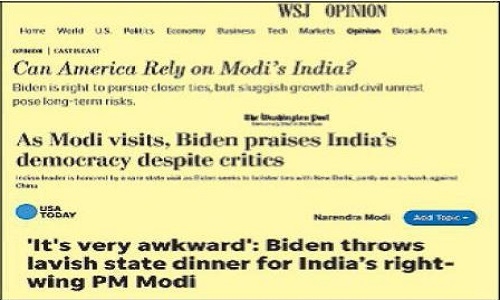
BY THE time Prime Minister Narendra Modi completed highly successful and celebrated State visit to the USA recently, several articles and reports and editorial or opinion pieces appeared in Western media including The New York Times (NYT), CNN, BBC, The Washington Post, USA Today, etc. All of them appreciated India’s growth story out of compulsion due to India’s stupendous rise in global economic order, but foxily cited certain perception-based (not reality based) indices and used stereotypes of bias to describe India as a country with ‘Hindu Nationalism’ dominating the scene and ‘democratic backsliding’. This is just another round of misuse and abuse of global reach of Western media to peddle biased narratives stemming out of tinted political opinion.
For instance, while the world media including the prejudiced Al Jazeera also were showing live the telecast of joint statement of Indian Prime Minister Narendra Modi and US President Joe Biden, BBC News as seen in India was showing a news about Kyiv. Though BBC later published on its website the report ‘Joe Biden and Narendra Modi hail ‘defining’ US-India partnership’, it remarked, “However, not everyone was celebrating,” and also used biased expression ‘his Hindu Nationalist government’.
A day earlier, American news channel CNN gave more weightage to other news instead of what the US President called as the coming together of world’s greatest democracies. Soon after the joint statement of Biden and Modi, CNN carried its senior journalist’s statements with apparent bias against India in general and the Indian Prime Minister in particular.
USA Today unabashedly made prejudiced reference to Modi as ‘right-wing PM’, in its report published on June 22.
The same day, NYT Editorial Board Opinion piece titled ‘The India Quandary’ used stereotypical adjectives. Here is a sample: “Under Mr. Modi and his right-wing, Hindu nationalist Bharatiya Janata Party, India has witnessed a serious erosion of the civil and political rights and democratic freedoms guaranteed by the Indian Constitution.”
Similar NYT pieces have quoted previously some recent indices that projected India’s ‘perceived’ downslide in some rankings or scores. Interestingly, India’s Economic Advisory Council to the Prime Minister (EAC-PM) had published a paper ‘Why India does poorly on global perception indices’ authored by Sanjeev Sanyal, Principal Economic Adviser to the Government of India, and Aakanksha Arora. It questioned the authenticity of such global indices and rankings. Sanyal even went on record saying that the opinion of some analysts could not be taken as objective truth.
“A common thread in all these indices is that they are derived from the perceptions or opinions of few experts. These institutions do not provide any transparency on how the experts were chosen or even their expertise or nationality...,” stated the report. There was another observation, “Another common feature of these indices is all these are based on a set of questions.
A reading of the questionnaire shows that most of the questions are subjective in nature, hence simply providing the same questions for all countries does not mean getting comparable scores for different countries as the generic questions can be answered very differently by experts.”
The EAC-PM report illustrated the case of three global (perception-based) indices -- Freedom in the World Index by Freedom House, Democracy Index by Economist Intelligence Unit, and V-DEM indices by the Varieties of Democracy Institute. These are the same reports used repeatedly by critics of India and Modi, in opinion pieces in so-called global media
outlets.
‘The Washington Post’ issue of June 21, 2023, published one photograph of Modi on inside page, and gave more space to opinion piece titled ‘Sorry, America. India will never be your ally’ that discussed India following the policy of ‘aggressive multilateralism’. The prejudiced approach of ‘The Washington Post’ was exposed by full-page advertisement that screamed ‘Press freedom is under attack in India’, with a sentence below it: ‘A public service initiative from The Washington Post to promote press freedom worldwide’.
‘Financial Times’ of June 22, 2023 carried a column by Edward Luce, which went a step further in bias and denounced Modi as ‘the most ruthless democratic backslider’.
Sadly, the Western world that boasts of championing democratic values, objectivity, and human rights has proven to have resorted to double standards to suit own convenience. It looks at India from the lens of bias and prejudice. A study ‘An analysis of global media coverage of events in India’ by Amol Parth, published in the ‘Communicator’ journal of Indian Institute of Mass Communication (IIMC) exposed Western media biases. “The words/language that these publications have used the most in context of India are negative, divisive, outrageous, full of contempt and ridicule for India,” it pointed out. After studying 3,000-plus India-related articles in NYT, The Washington Post, Wall Street Journal, Time, and The Guardian over the last decade, Amol Parth found that the most used words in context of India in these Western media outlets were ‘fear, hate, violence, riot, Hindu, Muslim, Kashmir, cow, mob, and protest’.
He observed for global media, “The values they hold while reporting about events in their own countries; they don’t abide by the same values in their reportage on similar events in India.”
Dr S Jaishankar, External Affairs Minister of India, also had lashed out at the Western bias not long ago, “If you read foreign newspapers, they use words like Hindu nationalist government. In America or Europe, they won’t say Christian nationalist or whatever... These adjectives are reserved for us.”
The so-called global media and websites’ coverage of India is deep-rooted in their shallow understanding of India’s complex realities and rich diversity with functional Constitutional democracy. They mischievously call lawful action against political leaders in Opposition in India, as ‘nuisance litigation’. They are biased in the realm of films also as reflected in an article on ‘Vox’ web portal that dubbed ‘RRR’ as a ‘casteist Hindu wash of history and the independence struggle’, while ignoring that the whole world was dancing to the tunes of ‘Natu Natu’ from the popular movie.
Western media outlets exhibit their inherent bias, prejudice, and hypocritical approach towards India and Indian leadership. It is time for Indians to have in place own mechanisms to rank even these ‘holier than thou’ Western colonialist mindsets on several aspects ranging from education to healthcare to slavery to democratic values to religious biases to media biases. It is time for Indians to counter their narratives with facts and studied opinions. It is time to stand up to Western prejudice, and tell India story to the world in a deservingly positive and confident way. n