Odisha train crash, a possible sabotage: Rlys
| Date :05-Jun-2023 |
NEW DELHI,
THE railways on Sunday virtually ruled out driver error and system malfunction, indicating a possible “sabotage” and tampering of the electronic interlocking system behind the triple train accident that claimed at least 275 lives in Odisha. Railway Minister Ashwini Vaishnaw said the “root cause” of the accident and the “criminals” responsible for it have been identified. “It happened due to a change made in the electronic interlocking and point machine,” he told reporters at the site of the accident in Balasore district. Here in Delhi, top railway officials explained how the point machine and the interlocking system function. They said the system is “error proof” and “fail safe” but did not rule out the possibility of outside intervention.
“It is called a fail safe system, so it means that even if it fails, all the signals will turn red and all train operations will stop. Now, as the Minister said there was a problem with the signalling system. It could be that someone has done some digging without seeing the cables. Running of any machine is prone to failures,” Jaya Verma Sinha, Member of Operation and Business Development, Railway Board, said. A senior railway official who did not want to be identified said this kind of tinkering with the “logic” of the AI-based electronic interlocking system can only be “intentional” and ruled out any malfunction in the system. The Minister also said that the Commissioner of Railway Safety has completed an investigation and the report is awaited. The senior railway official said, “It could be a case of tampering or sabotage from within or from outside. We have not ruled anything out.”
At least 275 people were killed and around 1,175 injured in the accident. The Odisha Government on Sunday revised the triple train accident’s death toll to 275 from 288, and put the number of injuries at 1,175. According to Chief Secretary P K Jena, some bodies were counted twice. “After detailed verification and a report by Balasore District Collector, the final toll has been fixed at 275,” he said. Jena said the injured are being treated in different hospitals in Soro, Balasore, Bhadrak and Cuttack.
“So far, 793 passengers have been discharged and 382 are being treated at Government cost,” he said. Jena said 88 bodies have been identified so far and 78 handed over to their families while 187 were yet to be identified. The Chief Secretary said proper identification of the bodies was the biggest challenge. “DNA sampling will be done and photographs of the deceased will be uploaded on Government websites,” he said. Jena said 9 teams of NDRF, 5 ODRAF units and 24 fire services teams were engaged in the rescue operations, which are now complete. He said arrangements have been made for night surgeries and more than 100 medical teams with paramedical staff have been deployed. Officials on Sunday also gave the driver of the Coromandel Express (Coromandel Express) a clean chit by stating that he had the green signal to move forward and he was “not over-speeding”.
A preliminary report also indicated that a tampering could have occurred stating that the signal was “given and taken off for the up main line for train number 12841 (Coromandel Express), the train entered the loop line, dashed the goods train and derailed. In the meantime, train number 12864 passed through the down main line and two of its coaches derailed and capsized.” Explaining how the two components mentioned by the Minister are key to train operations, Sandeep Mathur, Principal Executive Director of Signalling, Railway Board, said that these two work in coordination to show the driver whether the track is clear to move forward.
“Signal is interlocked in such a manner that it will show if the line ahead is occupied or not. It will also be known whether the point is taking a train straight or towards loop line. “When the point shows straight and the track ahead is not occupied then the signal is green and if the point is taking the train on loop and track is clear then signal is yellow and the route is shown of a different direction,” he said. He said that the interlocking system is a safe way to guide a train out of a station.
A point machine is a vital device for railway signalling for quick operation and locking of point switches and plays an important role in the safe running of trains. Failure of these machines severely affects train movement. Sinha said that the direction, route and signal were set for the Coromandel Express. “Green signal means that in every way the driver knows that his path ahead is clear and he can go forward with his permitted maximum speed. The permitted speed at this section was 130 kmph and he was running his train at 128 kmph which we have confirmed from loco logs,” she said. The Bengaluru-Howrah Superfast Express train was running at a speed of 126 kmph.“In both the trains there was no question of over-speeding. Preliminary finding has found that there is a signalling issue,” she said.
“Only one train was involved in the accident, it was the Coromandel Express. The Coromandel Express crashed with the goods train and its coaches went on top of the goods train. It was an iron ore train, a heavy train, therefore entire impact of the collision was on the train,” she said. It was a fraction of a second that last two coaches of the Bengaluru-Howrah train crashed with the coaches of the Coromandel Express, she said. The root cause of the three-train crash in Odisha’s Balasore district and the people responsible for it have been identified, Railway Minister Ashwini Vaishnaw said on Sunday. He also said the Railways is aiming to restore normal services on the affected tracks by Wednesday. The Railway Minister said the issue is of electric point machine, a vital device for railway signalling, and electronic interlocking.
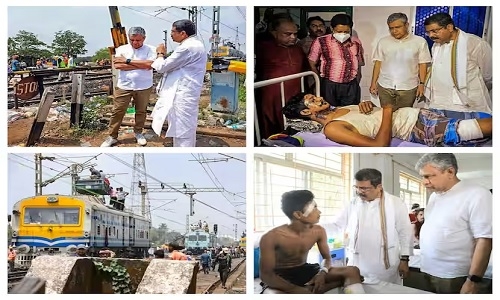
The change that was made to electronic interlocking which led to the accident has been identified, Vaishnaw said while denying that the incident had anything to do with the anti-collision system “Kavach”. “The enquiry into the accident has been completed and as soon as the commissioner of railway safety (CRS) provides his report all the details will be known. He also said the kin of around 300 accident victims have been provided compensation. “We met the patients and doctors at Soro Hospital. Special trains are being run from Hyderabad, Chennai, Bengaluru, Ranchi, Kolkata and other places so that patients can reach homes after treatment.” Vaishnaw said restoration work was being carried out on a war footing and tracks have already been laid on one of the main lines. “We have mobilised all resources. I also want to say that Kavach has nothing to do with the accident. This accident occurred due to changes to the electronic interlocking system. The remarks of (West Bengal chief minister) Mamata Banerjee is not true,” Vaishnaw said.
“The setting of the point machine was changed. How and why it was done will be revealed in the probe report,” he told PTI. An electric point machine is a vital device for railway signalling for quick operation and locking of point switches and plays an important role in the safe running of trains. Failure of these machines severely affects train movement and deficiencies at the time of installation can result in unsafe conditions.
Vaishnaw, who is on ground zero since Friday night, supervising rescue and relief operations as well as the railway track restoration efforts, said the railway aims to complete restoration work on tracks by Wednesday. The rescue and relief at the accident site is complete, he said. Over 1,000 workers are working round-the-clock for early restoration. It has deployed more than seven Poclain Machines, two accident relief trains, and three to four railway and road cranes for the resumption of rail traffic. The work on repairing tracks and overhead electric lines is in progress.
Earlier in the day, the railway tracks were cleared of wrecked coaches. In a statement, the South Eastern Railway zone said, “All 21 coaches which capsized and derailed have been grounded. Now the site is being cleared of bogie/ wheels sets and other components. Three goods wagons and locomotive grounding work is going on. Track linking and overhead electric work is going on in parallel.”