Battery of bolts scares the daylights out of Nagpurians
28 Jul 2023 08:11:01
Staff Reporter
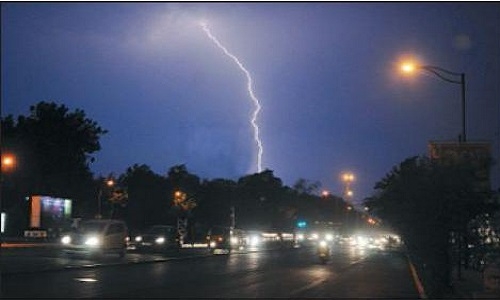
THE intervening night of Wednesday and Thursday will go down in the collective memory of Nagpurians as a frightening one. For, in several areas, electricity supply was out, but the scene outside their homes was a scary one with lightning dominating the sky. Around midnight, people were shaken out of their sleep with thunder. Lightning after every few seconds did not let them sleep at least for an hour. On Thursday, the hot topic being discussed by Nagpurians with each other was lightning and the fear it evoked. When ‘The Hitavada’ spoke to experts, in a bid to get scientific and technical explanation to understand the phenomenon oflightning,they revealedthat there indeed was observed increase in lightning strikes across the country. In fact, increase in lightning is directly related to climate change due to atmosphere becoming hotterdue to urbanisation and other factors. For every one degree rise in temperature, there is generally 7-12per cent increase in lightning occurrences. Gelling well with common observation, the phenomenon of increase in lightning incidences is more prominentinCentralIndiaand arid parts of the country. Col Prof Sanjay Srivastava, Chairman, Climate Resilient Observing-SystemsPromotion Council (CROPC), responded to the queries from ‘The Hitavada’ in this regard.
Asked if there was anincrease in lightning strike occurrences in the country in the past few years, he replied that there was an observed increase in lightning across the country. As per the Annual Lightning Reports published by CROPC and India Meteorological Department (IMD),for last three years,overall increase in frequency of occurrenceinlightning till 2022 has been more than 60 percent, he pointed out. “The intensity, that is, the surge of atmospheric electricity/current has goneupby60-70percent.This can be understood from the fact that earlier average of 40- 80 kilo ampere during 1979- 2011, has gone beyond average current of 110-150 kilo ampere. This makes lightning more lethal and the impact is widely felt causing more deaths,” he said. Even is 2023, the increase in both frequency and intensity are being observed, said Col Prof Sanjay Srivastava, Professor of Practice at TERI School of Advanced Studies, and Convener, Lightning Resilient India Campaign. According to him, increase in lightning has ‘direct relation with climate change’. As per CROPC reports, India has registered sharp increase in temperature at 34 per cent, and 11 per centinyears 2020-21 (with reference to 2019-20), and 2021-22 (with reference to 2020-21) respectively. But, he added,this increase isnotuniform.
He explained,“It is more prominent in Central and arid parts of India. Due to global warming, there is increase in evaporation. The areas with hightemperatures, thus, actas hotspots. As per a study by University of California, with every1degree rise in temperature,there is 12 per centoverloading of moisture and correspondingly 12 per cent rise inlightning.Withvariousstudies in India and abroad, it has been established that with every1degree Celsius rise in temperature, there is general 7-12 percent rise in lightning.” Asked about factors behind Central Indian region being morepronetolightningstrikes than other parts of the country, Col Sanjay Srivastava listed multiple factors. According to him, this region has grown hotter due to urbanisation, deforestation, encroachment ofwaterbodies, highpollution and environmental degradation.Correspondingly, there is more rise in lightning. Till a decade ago, he added, Central Indian region used to getrains during south-west monsoon. But, in recent times, they are exposed to multiple weather systems. Besides south-west monsoon, western disturbances have been periodically affecting them bringing unseasonalrainsandlightning, he elaborated. “Even cyclonic events now impact Central India. In September 2021, Cyclone Gulabcriss-crossedIndiafrom Bay of Bengal in east to west and re-emerged as Cyclone ShaheeninArabianSea.These extreme behaviour of weather brings enough moisture and instability to generate higher frequency and intensity of lightning,” saidCol Srivastava.
The Chairman of CROPC stressed that there was a need for detail ed re search on weather pattern sin this region for better early warning, and also to under take ad equateand time lymitigationm easures against extremehazardslikelightning. Dr Sreekanth T S, ScientistD and Head of DWR Nagpur, Regional Meteorological Centreat Nagpur, IMD, offered technical explanation behind the lightning occurrences in Nagpur. According to him, during the summer monsoon season, the sub-cloud layer is warm, which results in relatively subdued updrafts within the Cumulonimbus (Cb) clouds responsible for convective rain and lightning. “As a consequence, the formation of large hail becomes less frequent,whiletheconcentration of graupel (small ice particles) experiences an upsurge. The increased abundance of graupel enhances the process of electrical charging within the Cb clouds, leading to a substantial increase in the frequencyoflightningstrokes,”he observed.