Chandrayaan-3: Lander, Propulsion Modules to begin separate journeys
| Date :17-Aug-2023 |
BENGALURU :
Chandrayaan-3 completes its last Moon-bound manoeuvre After separation, the lander is expected to undergo a deboost to place it in an orbit, from where the soft landing on the south polar region of the Moon will be attempted on August 23
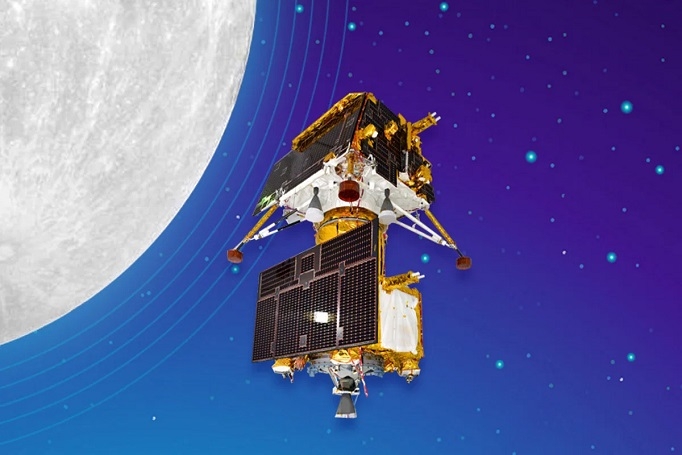
INDIA’S ambitious Chandrayaan-3 mission hit another mark on Wednesday when its spacecraft successfully underwent a fifth and final lunar-bound orbit manoeuvre, which brings it even closer to the surface of the Moon. With this, the spacecraft has completed all of its Moon-bound manoeuvres, and it will now prepare for separation of the Lander Module -- comprising the lander and rover -- from the Propulsion Module.
“Today’s successful firing, needed for a short duration, has put Chandrayaan-3 into an orbit of 153 km x 163 km, as intended. With this, the lunar-bound manoeuvres are completed. It’s time for preparations as the Propulsion Module and the Lander Module gear up for their separate journeys,” ISRO said in a post on X.
Separation of the Lander Module from the Propulsion Module is planned for
August 17, it said. Following its launch on July 14, the Chandrayaan-3 spacecraft entered into lunar orbit on August 5, following which orbit reduction manoeuvres were carried out on August 6, 9 and 14.
As the mission progressed, a series of manoeuvres were conducted by ISRO to gradually reduce Chandrayaan-3’s orbit and position it over the lunar poles.
After separation, the lander is expected to undergo a “deboost” (the process of slowing down) to place it in an orbit where the Perilune (closest point to the Moon) is 30 kilometres and Apolune (farthest point from the Moon) is 100 km. From this orbit, the soft landing on the south polar region of the Moon will be attempted on August 23, ISRO has said. ISRO Chairman S Somanath recently said that the most critical part of the landing is the process of bringing down the velocity of the lander when it begins its descent from a height of 30 km to the final landing (position), and that the ability to transfer the spacecraft from horizontal to vertical direction is the “trick we have to play” here. Over five moves in the three weeks since the July 14 launch, ISRO lifted the Chandrayaan-3 spacecraft into orbits farther and farther away from Earth.
Then, on August 1 in a key manoeuvre -- a slingshot move -- the spacecraft was sent successfully towards the Moon from Earth’s orbit. Following this trans-lunar injection, Chandrayaan-3 escaped from orbiting the Earth and began following a path that would take it to the vicinity of the Moon, and eventually into Moon’s orbit.
The Propulsion Module, other than carrying the lander and rover configuration till about 100 km lunar orbit, carries the Spectro-polarimetry of Habitable Planet Earth (SHAPE) payload to study spectral and polarimetric measurements of the Earth from lunar orbit.
Expressing happiness over Chandrayaan-3 mission going successfully so far, former ISRO Chairman K Sivan, who was heading the space agency during the second lunar mission, said the lander’s touch down on August 23 “is a great moment we are looking forward to.”
The mission objectives of Chandrayaan-3 are to demonstrate safe and soft landing on the lunar surface, to demonstrate the rover operating on the Moon, and to conduct in-situ scientific experiments. The lander will have the capability to soft land at a specified lunar site and deploy the rover that will carry out in-situ chemical analysis of the Moon’s surface during the course of its mobility.
The lander and the rover are carrying scientific payloads to carry out experiments on the lunar surface.