Chandrayaan-3 touchdown offers real payoff for India
| Date :22-Aug-2023 |
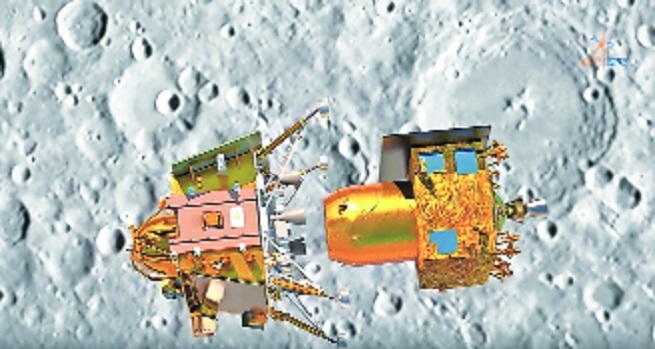
Artist’s image shows ‘Vikram’ Lander Module of Chandrayaan-3 mission getting separated from the Propulsion Module. (ANI)
By Daniel Ricardo
MELBOURNE,
Not just national pride, the success of Chandrayaan-3 could have a very real impact on India’s economy. India’s space economy is expected to be worth USD 13 billion by 2025
(360info)
MORE than national pride will be on the line when India undertakes its second attempt to land on the Moon later this week. On August 23, India’s Chandrayaan-3 will attempt to land on the Moon — an event with the potential to unlock real economic benefits.
Chandrayaan-3 is the third lunar exploration mission by the Indian Space Research Organisation and if it’s successful, India will become the fourth country after the United States, the former Soviet Union (now Russia) and China to achieve a soft landing on the lunar surface.
After Chandrayaan-3 lands, the plan is for it to then deploy a rover on the Moon and explore the lunar South Pole.
But it’s not just national pride on the line for this spacefaring nation: the success of Chandrayaan-3 could have a very real impact on India’s economy. The world has already seen everyday benefits from previous space efforts like accessibility to clean drinking water with water recycling on the International Space Station, near-global Internet access provided by Starlink for education, advances in solar power generation and health technologies.
With an increasing demand for global data of satellite imaging, positioning and navigation, multiple reports indicate that the world is already in an exponential growth phase of the space economy.
A report by Deloitte highlights how since 2013, over USD 272 billion has been raised by private equity into 1,791 companies. In their annual report, the Space Foundation noted that the global space economy has already reached a value of USD 546 billion in the second quarter of 2023. This represents a 91 per cent increase in value over the past decade. For many countries, participating in the nascent space economy has the potential to have huge downstream benefits for their own economies, as well as inspiring their citizens to engage in the new space age.
India’s space economy is expected to be worth USD 13 billion by 2025.
By comparison, the Australian Civil Space Strategy 2019–2028 aims to triple the sector’s contribution to GDP to AUD 12 billion and create an additional 20,000 jobs by 2030. A successful Moon landing will also speak to India’s technological prowess.
Although NASA did successfully put humans on the Moon during the Apollo Programme more than 50 years ago, many seem to have forgotten the incremental steps and huge amounts of money it took to get there.
There were also many unknowns, including real worries that the lunar surface was so soft and dusty due to billions of years of meteorite bombardments that spacecraft would sink into the surface like quicksand — a concern that luckily proved unfounded.
But even with 21st century advanced computing and cutting-edge technology, the difficulties of spaceflight remain the same — can your system maintain stable communications and operate autonomously under a wide variety of extreme conditions?
India’s first attempt to reach the Moon with Chandrayaan-1 succeeded in almost all of its mission objectives and scientific goals, including detecting evidence of water on the lunar surface for the first time.
But the Indian Space Research Organisation lost contact with the spacecraft after only 312 days of its intended two-year mission.
Nonetheless, Chandrayaan-1 is considered by many to be a phenomenal success, having achieved awards from the National Space Society and the American Institute of Aeronautics and Astronautics.
On September 6, 2019, India again attempted to reach the Moon with the Vikram lander carrying the Pragyan rover as part of the Chandrayaan-2 mission. However, 2.1km above the lunar surface contact with the lander was lost, and images taken by NASA later confirmed it had crashed into the surface.
Issues with onboard software and autonomous landing sequences have also resulted in the failure of two other countries’ attempts to land on the Moon in the past three years.
On April 11, 2019 the Israeli Beresheet lander attempted a soft landing in the northern part of the Mare Serenitatis, but an Inertial Measurement Unit gyroscope failed during the braking procedure resulting in the loss of communications 2.1km above the surface.
On April 25, 2023, the privately funded Japanese company iSpace attempted a soft landing of their Hakuto-R lander carrying the United Arab Emirates Rashid rover.
Analysis by iSpace engineers later confirmed that the onboard computer was programmed to ignore the laser radar altimeter if it conflicted with the predicted position of the spacecraft.
Taking the lessons learned from Chandrayaan-2, Chandrayaan-3 has several improvements from its predecessor. The intended landing zone has been increased to an area of 4.2km long and
2.5km wide, meaning the spacecraft has a higher margin of error rather than the risk of choosing a single point and drifting, as occurred with Chandrayaan-2. Chandrayaan-3 will also have four engines with adjustable throttle and slew (orientation) as well as a Laser Doppler Velocimeter, meaning it can control its attitude and orientation in all phases of descent- unlike Chandrayaan-2.
If Chandrayaan-3 is successful, it will highlight how space is becoming more accessible, and demonstrate India’s continued perseverance and tenacity in achieving difficult missions.
It also bodes well for India’s participation in the new space race to build permanent infrastructure on the Moon.
(The author is a faculty at Swinburne University of Technology in Melbourne)