Chandrayaan-3 gets ready to make history
| Date :23-Aug-2023 |
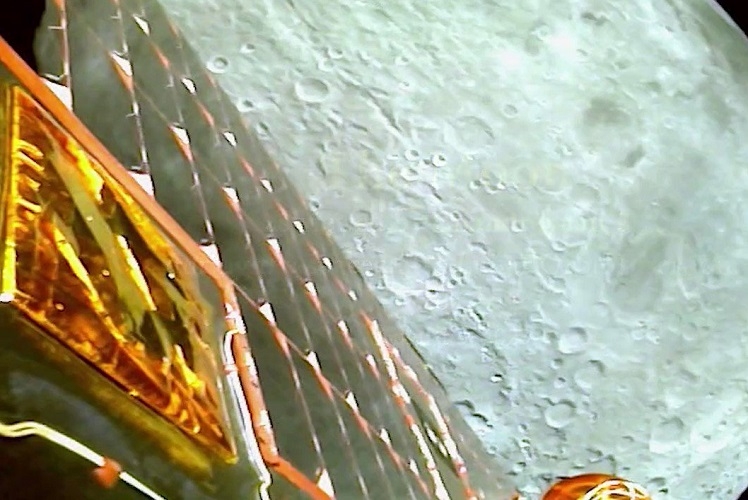
The Indian Space Research Organisation (ISRO) on Tuesday, shared stunning glimpses of the Moon captured by Chandrayaan-3’s Lander Image Camera 4 on August 20, 2023.
(Screengrab (Twitter/@ISRO)
BENGALURU :
Chandrayaan-3 mission is on schedule, confirmed ISRO on Tuesday India will become the 4th country to master technology of soft-landing on the lunar surface
ISRO’s ambitious third Moon mission Chandrayaan-3’s Lander Module (LM) is all set to land on the lunar surface on Wednesday evening, as India eyes to become the first country to reach the uncharted South Pole of Earth’s only natural satellite.
The LM comprising the lander (Vikram) and the rover (Pragyan), is scheduled to make a touch down near the South Polar region of the Moon at 6:04 pm on Wednesday.
If the Chandrayaan-3 mission succeeds in making a touchdown on Moon and in landing a robotic lunar rover in ISRO’s second attempt in four years, India will become the fourth country to master the technology of soft-landing on the lunar surface after the US, China and the erstwhile Soviet Union.
Chandrayaan-3 is a follow-on mission to Chandrayaan-2 and its objectives are to demonstrate safe and soft-landing on the lunar surface, roving on the Moon, and to conduct in-situ scientific experiments. Chandrayaan-2 had failed in its lunar phase when its lander ‘Vikram’ crashed into the surface of the Moon following anomalies in the braking system in the lander while attempting a touch down on September 7, 2019.
Chandrayaan’s maiden mission was in 2008.
The Rs 600 crore Chandrayaan-3 mission was launched on July 14 onboard Launch Vehicle Mark-III (LVM-3) rocket, for a 41-day voyage to reach near the lunar South Pole. The soft-landing is being attempted days after Russia’s Luna-25 spacecraft crashed into the Moon after spinning out of control.
After the second and final deboosting operation on August 20, the LM is placed in a 25 km x 134 km orbit around the Moon.
The module would undergo internal checks and await the sunrise at the designated landing site, ISRO has said, adding that the powered descent -- to achieve soft-landing on the Moon’s surface -- is expected to be initiated at around 5:45 pm on Wednesday.
A day before the scheduled touch-down, ISRO on Tuesday confirmed that the Chandrayaan-3 mission is on schedule.
The space agency said the Mission Operations Complex (MOX), located at the ISRO Telemetry, Tracking and Command Network (ISTRAC) here, is buzzing with energy and excitement.
“The mission is on schedule. Systems are undergoing regular checks. Smooth sailing is continuing,” ISRO said in an update this afternoon, adding that the live telecast of the landing operations at MOX/ISTRAC begins at 5:20 pm on Wednesday.
ISRO’s Space Applications Centre Director Nilesh Desai said, “If any health parameter (of the lander module) is found abnormal on August 23, then we will delay the landing by four days to August 27.”
The critical process of soft-landing has been dubbed by many including ISRO officials as “17 minutes of terror”, with the entire process being autonomous when the lander has to fire its engines at the right times and altitudes, use the right amount of fuel, and scan of the lunar surface for any obstacles or hills or craters before finally touching down.
After checking all the parameters and deciding to land, ISRO will upload all the required commands from its Indian Deep Space Network (IDSN) at Byalalu near here, to the LM, a couple of hours before the scheduled time touchdown...
According to ISRO officials, for landing, at around 30 km altitude, the lander enters the powered braking phase, and begins to use its four thruster engines by “retro firing” them to reach the surface of the Moon, by gradually reducing the speed. This is to ensure the lander doesn’t crash, as the Moon’s gravity will also be in play.
Noting that on reaching an altitude of around 6.8 km, only two engines will be used, shutting down the other two, aimed at giving the reverse thrust to the lander as it descends further, they said, then, on reaching an altitude of about 150-100 metres, the lander using its sensors and cameras, would scan the surface to check whether there are any obstacles and then start descending to make a soft-landing.
ISRO Chairman S Somanath had recently said the most critical part of the landing will be the process of reducing the velocity of the lander from 30 km height to the final landing, and the ability to reorient the spacecraft from horizontal to vertical direction. “This is the trick we have to play here,” he said.
“The velocity at the starting of the landing process is almost 1.68 km per second, but (at) this speed (the lander) is horizontal to the surface of the Moon. The Chandrayaan-3 here is tilted almost 90 degrees, it has to become vertical. So, this whole process of turning from horizontal to vertical is a very interesting calculation mathematically. We have done a lot of simulations. It is here where we had the problem last time (Chandrayaan-2),” Somanath explained.
After the soft-landing, the rover will descend from the lander’s belly, onto the Moon’s surface, using one of its side panels, which will act as a ramp.
The lander and rover will have a mission life of one lunar day (about 14 earth days) to study the surroundings there. However, ISRO officials do not rule out the possibility of them coming to life for another lunar day.
ISRO releases images of Moon
captured from 70 km altitude
BENGALURU :
ISRO on Tuesday released images of the Moon captured by the Lander Position Detection Camera (LPDC) of the Chandrayaan-3 mission from an altitude of about 70 km on August 19, and by Lander Imager Camera 4 on August 20.
LPDC images assist the Lander Module (LM) of the mission, scheduled to make a soft-landing on the Lunar surface on Wednesday, in determining its position (latitude and longitude) by matching them against an onboard moon reference map, the Bengaluru-headquartered national space agency said.
The ISRO on Monday released images of the Lunar far side area captured by the Lander Hazard Detection and Avoidance Camera (LHDAC).
This camera that assists in locating a safe landing area
-- without boulders or deep trenches -- during the descent is developed by Ahmedabad-based Space Applications Centre (SAC), a major research and development centre of ISRO.According to ISRO, to achieve the mission objectives of Chandrayaan-3, several advanced technologies are present in the Lander.
A packed launch schedule for ISRO after Chandrayaan-3 mission
BENGALURU :
A MISSION to study the Sun, and launching a climate observation satellite, a test vehicle as part of Gaganyaan human space flight
programme and an Indo-US synthetic aperture radar -- ISRO has a packed schedule ahead.
In addition, XPoSat (X-ray Polarimeter Satellite), the country’s first dedicated polarimetry mission to study various dynamics of bright astronomical X-ray sources in extreme conditions, is also ready for launch, an ISRO official said on Tuesday. Aditya-L1, the first space-based Indian observatory to study the Sun, is getting ready for the launch, most likely in September first week.
According to ISRO Chairman, Somanath S, the space agency has also lined up the launch of a climate observation satellite
INSAT-3DS.
ISRO may postpone landing on Moon to Aug 27 depending on health of Lander Module: Official
CHENNAI :
AS SCIENTISTS at ISRO gear up for the soft
landing of the much-awaited Chandrayaan-3 spacecraft on the surface of the Moon, the space agency may postpone the touchdown to August 27 in the event that health parameters of the Lander Module are found to be “abnormal”, a senior official has said.
According to ISRO Space Applications Centre Director Nilesh Desai, the focus of the scientists would be on reducing the speed of the spacecraft above the lunar surface.
Earlier in the day,
ISRO said the mission is
on schedule and it is smooth sailing for the spacecraft.
“The mission is on schedule. Systems are undergoing regular checks. Smooth sailing is continuing,” ISRO said. Chandrayaan-3 lander module’s soft landing on lunar surface would put India in the elite club of countries that have achieved the feat of reaching the Moon’s surface -- the United States, the erstwhile Soviet Union and China.