Centre for One Health, on lines of NIV, to be functional in Nagpur soon
| Date :26-Aug-2023 |
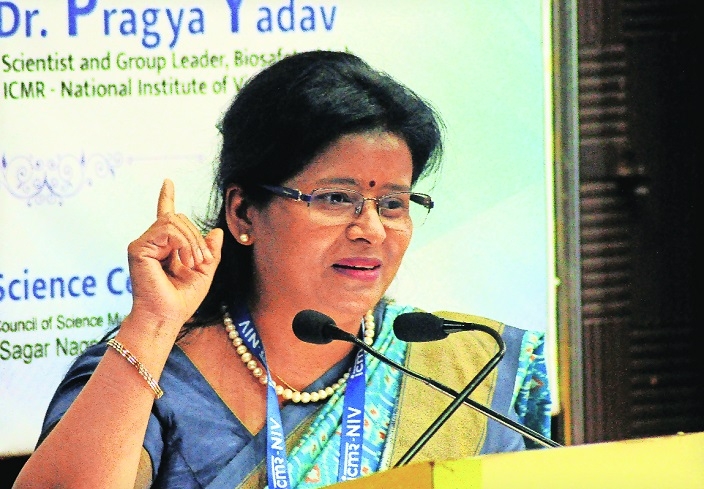
Dr Pragya Yadav, interacting with mediapersons at Raman Science Centre, on Friday. (Pic: Satish Raut)
Staff Reporter :
Centre for One Health -- a Satellite Centre planned in Nagpur on the lines of National Institute of Virology (NIV), Pune, is going to be functional in the next one-and-half years.
Maharashtra Animal and Fisheries Science University (MAFSU) will be the knowledge partner of the lab to be set up by the Indian Council for Medical Research (ICMR). The laboratory will be established on a four hectare land located opposite Nagpur Veterinary College at Seminary Hills.
Dr Pragya Yadav, Scientist at NIV, Pune, while interacting with mediapersons at Raman Science Centre, on Friday, said, “Initially, NIV, Pune, will mentor the Biosafety Laboratory at Nagpur, before it starts functioning independently. Similar laboratories are being developed at Jabalpur and other locations in North-Eastern states.”
Dr Yadav was in Nagpur to deliver lecture on ‘COVID-19: A Turning Point in Vaccination Efforts’ at Raman Science Centre under Popular Science lecture series.
Refuting the general belief, that people died or suffered from some major diseases after taking the vaccine, Dr Yadav pointed out, “There is no proof of people dying or suffering heart attacks because of the vaccine.
They simply might have been affected by the severity of COVID-19. The vaccination programme was monitored very effciently. People were reluctant to take the vaccine.”
Replying to a query, Dr Yadav explained, “Nobody claimed that the vaccine would cure novel coronavirus or kill it. The relatively healthy population, not co-morbid, which took the vaccine shot, when tested positive for novel coronavirus, but did not have to be admitted. Vaccine brought down the severity of the disease. We all have witnessed this during the wave of Omicron.” There were a lot of cases, but the hospitalisation was very low, and no fatality was reported; this happened because of the vaccination, she added.
Dr Yadav elaborated upon the Universal Vaccine Programme of the Central Government.
Under this programme, 23 communities have been identified to know the prevalence in families.
The vaccine will be prepared in a way to make it effective for several diseases.
Earlier, in her address to the students, Dr Yadav explained about the beginning of corona virus and then pandemic situation all over the world. Worldwide efforts to develop vaccines at pandemic level to save population worldwide. She gave an idea about how samples are collected, how that sample was brought to laboratory, and the process of isolation of virus, its chemical treatment and development of vaccine, primary trial, clinical trials and then roll out of vaccines. She also answered the queries of students and motivated them to pursue science as a career and work for the development of the country. “Country develops with efforts of its people, so whichever profession you choose, work hard” said Dr Pragya Yadav
An International Travelling Exhibition ‘Vaccines Injecting Hope’ designed and developed jointly by National Council of Science Museums and Museums Group London with active support of British Council, Welcome, UK; Indian Council of Medical Research, National Institute of Virology, Pune, Serum Institute of India, CSIR, AIIMS, NIBMG, Kalyani and other research and scientific organisations in India, is on display at Raman Science Centre and Planetarium till December 31, 2023.