Indian monuments, archaeological sites connect human beings with the Almighty: J Ramanan
26 Aug 2023 10:55:07
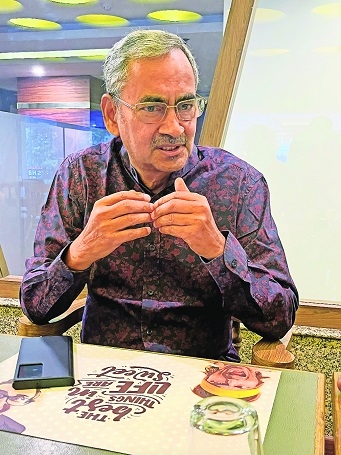
J Ramanan interacting with The Hitavada, on Friday.
By Niraj Chinchkhede :
Renowned architect J Ramanan, on Friday said that Indian temples built centuries ago have great cultural and spiritual significance. “These monuments and archaeological sites connect human beings with the Almighty. However, it is unfortunate to see that we are still unaware of the treasure,” he said while interacting with The Hitavada.
An outstanding professional, who takes on the multiple roles as a mountaineer, landscape photographer, exhibitor and author, J Ramanan is in the city to deliver a keynote address at the special function of the Nagpur Centre of The Indian Institute of Architects (IIA), celebrating culmination of its Golden Jubilee ‘Suvarna Siddhi’ on August 26.
Trichy-based J Ramanan further added that mere conservation of monuments and archaeological sites will not serve the purpose. “It is like preserving only the shell without knowing what’s there at its core.
We must understand the values and principles hidden in these structures built centuries ago,” he said.
According to him, all the ancient temples built in the country followed certain vedic principles meant for human upliftment. “But we set aside our rich cultural heritage and study structures in Italy, France and other countries. It is mainly due to the general perception created by the invaders that every Indian is not up to the mark. On the contrary, every art practiced in our country had cultural and spiritual connect,” J Ramanan, who has designed a variety of projects in many parts of South India, Sri Lanka, Australia and Singapore, highlighted.
He is a practicing architect, with a Bachelor’s degree in Architecture and a Master’s in Town and Country Planning from the University of Madras.
He approaches every architectural project as an artful endeavour. His belief is that all his projects, big and small, should be designed with social responsibility, taking into consideration economic and social challenges, human habitat and the heritage and cultural background of the city. This sheds light on his holistic understanding of environment.
J Ramanan, who was instrumental in starting the Department of Architecture in the National Institute of Technology, Trichy in 1980, also felt that students of Architecture should study the Indian temples and monuments in great detail and incorporate the findings while designing new buildings.
He has delivered many innovative works of architectural excellence in the diverse fields of hospitality, which include hotels and resorts, theme parks and clubs; hospitals; educational institutions and residences with lively, interesting and welcoming use of spaces, in India and abroad.