‘Aditya-L1 successfully undergoes third Earth-bound manoeuvre’
| Date :11-Sep-2023 |
BENGALURU :
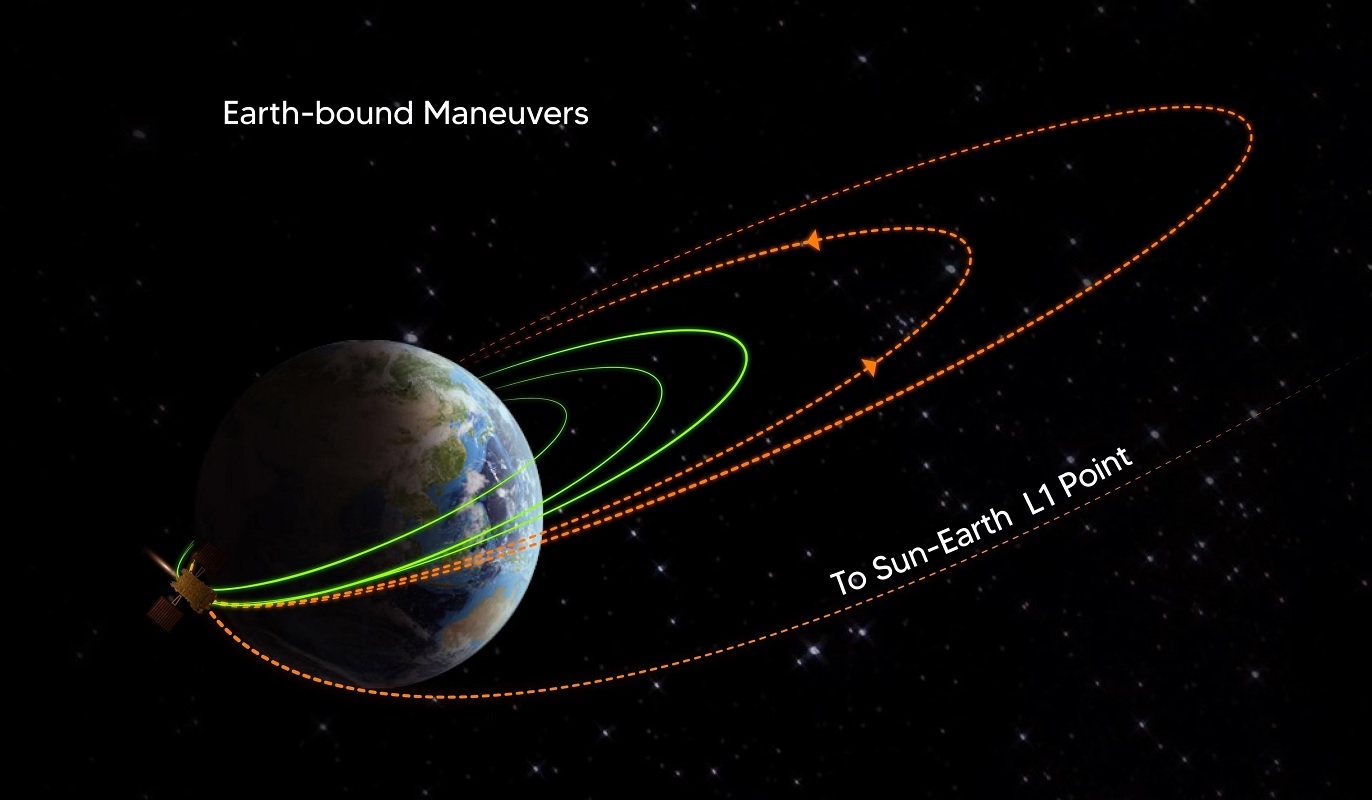
ADITYA-L1 spacecraft, India’s first space-based mission to study the Sun, successfully underwent its third Earth-bound manoeuvre in the early hours of Sunday, ISRO said.
The space agency’s Telemetry, Tracking and Command Network (ISTRAC) carried out the operation.
“The third Earth-bound manoeuvre (EBN#3) is performed successfully from ISTRAC, Bengaluru. ISRO’s ground stations at Mauritius, Bengaluru, SDSC-SHAR and Port Blair tracked the satellite during this operation,” the Indian Space Research Organisation ISRO) said in a post on social media platform X.
The new orbit attained is 296 km x 71767 km, it said, adding the next manoeuvre is scheduled on September 15, around 2 am. Aditya-L1 is the first Indian space-based observatory that will study the Sun from a halo orbit around the first Sun-Earth Lagrangian point (L1), which is located roughly 1.5 million km from the Earth.
The first and second Earth-bound manoeuvres were successfully performed on September 3 and 5, respectively. The spacecraft will undergo one more Earth-bound orbital manoeuvres before it is placed in the transfer orbit towards the Lagrange point L1.
The manoeuvres are required to be performed during the spacecraft’s 16-day journey around the Earth, during which it will gain the velocity necessary for its onward journey to L1. ISRO’s Polar Satellite Launch Vehicle (PSLV-C57) had on September 2 successfully launched Aditya-L1 from the Second Launch Pad of Satish Dhawan Space Centre, Sriharikota. The spacecraft is expected to arrive at the intended orbit at the L1 point after about 127 days, the space agency had said soon after the launch. According to ISRO, a spacecraft placed in the halo orbit around the L1 point has the advantage of continuously viewing the Sun without any occultation or eclipses. This will provide a greater advantage of observing solar activities and their effect on space weather in real-time. Aditya-L1 carries seven scientific payloads developed indigenously by the ISRO and national research laboratories, including the Indian Institute of Astrophysics, Bengaluru, and the Inter-University Centre for Astronomy and Astrophysics, Pune.
The payloads will observe the photosphere, chromosphere and the outermost layers of the Sun -- the corona -- using electromagnetic, particle and magnetic field detectors.