RTMNU Archaeology Department discovers prehistoric rock art site in Bhandara distt
| Date :03-Sep-2023 |
By Shirish Borkar :
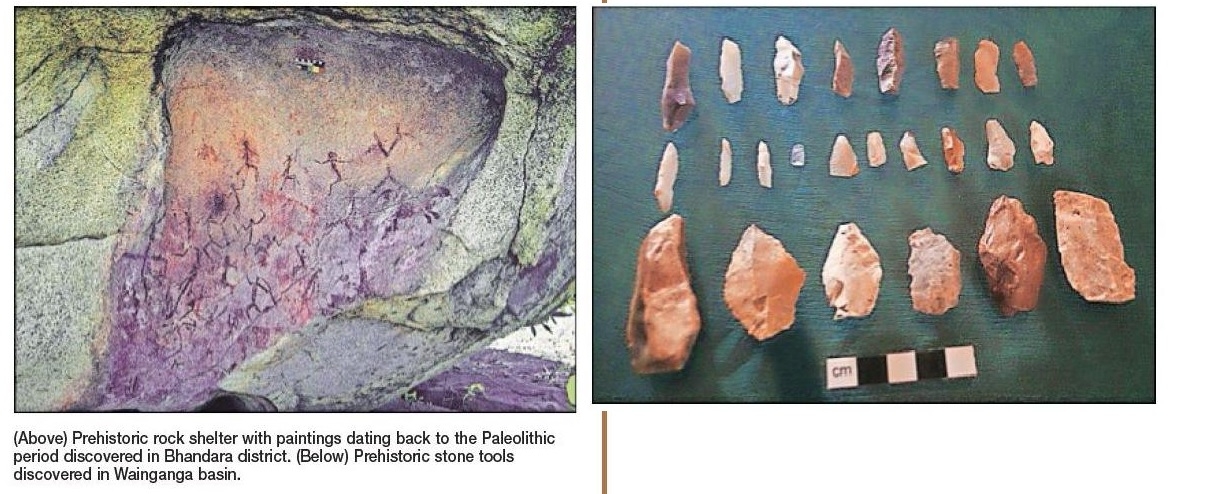
THE Post-Graduate Teaching Department of Ancient Indian History Culture & Archaeology, Rashtrasant Tukadoji Maharaj Nagpur University (RTMNU), has discovered a prehistoric rock art site in Wainganga basin of Bhandara district recently.
This is the second discovery of painted rock art boulders, including a couple of ancient rock shelters, from the Upper Palaeolithic period (40,000 years before the common era) to the Historical Period (4-5 century common era) in Vidarbha.

The first discovery of painted rock shelters in the region was reported in 2004 from the Parasgarh-Nagbhid hill ranges falling in the revenue jurisdiction of Chandrapur district. Locally known as Sitamai Dongari in the Waghai, the rock shelters were reported from Navtala and Dongargaon;
the latter having rock shelters
at Nagargota to the east and Pandubara to the south of the
village. All these shelters are
in Chimur tehsil of Chandrapur
district.
For the first time, rock art site is reported from the Bhandara district by research students --Vivek Raut, Shantanu Ingle and Pavin Meshram -- under the supervision of Dr Prabash Sahu, Professor and Head, Department of Ancient Indian History, Culture & Archaeology, RTMNU.
Situated in the North-Eastern side of Maharashtra, Bhandara district shares a border in the north with Balaghat district of Madhya Pradesh. The district falls under Wainganga basin. Wainganaga is the main river along with its tributaries like Bawanthadi, Chulbandh, Godera, and Sur.
A small occurrence of Vindhyan formation is found in the extreme southern part of the district. The formation consists of hard and compact quartzitic
sandstone. The inter-state irrigation project -- Rajiv Sagar Dam -- is constructed on Bawanthadi river. The rock art site is situated on both sides of a canal dug for irrigation purposes. The presence of rock art is in the naturally formed cavities in the sandstone boulders. Dr Sahu told ‘The Hitavada’ that there were 32 rock art boulders, including a couple of pre-historic shelters in Wainganga basin. The depictions on boulders comprise pictographs painted in burnt sienna, red ochre and white colour. The painted repertoire includes human and animal forms in various artistic renditions. Geometric motifs, palm impression, stick human figures, animals drawn in outline, x-ray and filled in body combined with superimposition of motifs on a few boulders speak of the continuity of the painting traditions from the Upper Palaeolithic to Historic period. On the basis of the style, along with the presence of stone tools made on crypto-crystalline materials found in the vicinity, the paintings may be assigned to the Upper Palaeolithic, Mesolithic, Chalcolithic, and Historical periods.
Dr Sahu informed ‘The Hitavada’ that one boulder also bore an inscription dating back to the first century common era on the paleographical ground. During exploration, the researchers also discovered various stone tools of the pre-historic period. Dr Sahu said, “Further studies would throw a new light on the pre-historic settlement in Vidarbha. The paintings on boulders and rock shelters would also help in the study of subsistence pattern of pre-historic era.” Some of the historians and researchers now have pointed out the urgent need for documentation and conservation of this newly discovered rock art site as it highlights traces of human vandalism in the form of graffiti.