Uncertain life, no peace of mind in Maoist fold: Radha
| Date :06-Sep-2023 |
By Kartik Lokhande
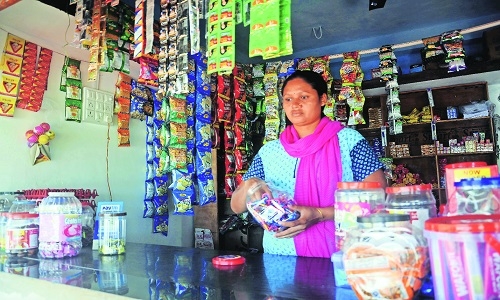
As a local resident calls out her name, Radha Majji steps out of her room and enters a small daily needs shop in the front portion of her house compound. She looks like an ordinary woman. Unless someone knowing her reveals, one may not be able to realise that till a few years ago, she was known as Moti, the wanted Divisional Commander of the proscribed terrorist organisation CPI (Maoist). As one starts a conversation with her, Radha Majji takes her time to respond out of a sense of disbelief, or, suspicion. But, when she is assured of the person in front, she speaks. Not only does she share her story but also the cause of her dejection with the Maoists, leading to her surrender. A resident of Bhatpar in Bhamragarh tehsil of Gadchiroli district of Maharashtra, Radha and her husband Deepak alias Manglu Suklu Bogami, a resident of Sukma district of Chhattisgarh, and himself a Divisional Commander of CPI (Maoist), both surrendered before the cops in 2019. The couple was on the ‘Most Wanted’ list of Maharashtra, Chhattisgarh, and Telangana police.
Deepak had joined the Naxalites in Jagargunda Dalam in 2001 and rose through the ranks to become Divisional Commander of Company-5 in North Bastar area. He was involved in 17 encounters with security forces and was wanted for 12 murders. He carried a reward of Rs 9.25 lakh declared by the Government. Radha alias Moti joined the Naxalites in 2004 in Bhamragarh Dalam. By 2017, she was Divisional Commander of Company-10 in North Bastar. She was involved in 15 police encounters and two murders and carried a reward of Rs 9.25 lakh. Asked why she joined the Naxalites, Radha replies, “Naxals used to visit our village, stay in Gotul (community hall), deliver speeches, followed by songs and dances. Like any other child, I too liked songs and dances. So, I developed a soft corner for them.” Gradually, she started listening to the speeches of ‘Dadas’. When they spoke about ‘Jal, Jangal, Jameen’, she felt as if they championed the cause of tribals. She joined them and underwent daily physical training and ideological indoctrination.
After the Naxal organisations merged to form CPI (Maoist), Radha Majji also met the seniormost leaders including Ganapathy, General Secretary of the banned organisation; and Basavraj, who succeeded Ganapathy as the topmost leader of ‘the party’. She participated in several activities. Impressed by her learning ability, the Maoist leaders transferred her to Kanker Battalion of the proscribed organisation in Chhattisgarh in 2011. There, she met Deepak. Soon, love blossomed between the two. Some years passed by. In 2016, Deepak and Radha decided to enter into a wedlock. After all, everyone wants family. “However, in the party, ‘no child’ policy is strictly implemented. To prevent child from being born out of relationships, the party asks cadres to sterilise themselves or to take pills. We were disappointed,” she recalls with pain. Both wanted to lead a normal life as husband and wife. Meanwhile, police started dominating the scene. The Maoists were facing reverses due to police action and mounting pressure. The situation changed. Finding it to be an opportune time, Deepak and Radha both decided to leave the Maoist fold. Harsh life of jungles also took its toll on their physical health, and diseases troubled them. So, they left the outlaws and first went to Deepak’s native place in Sukma district and stayed there for a while. But, she tells, Maoists kept visiting them and asking questions as to why they were staying away. Fed up with pressure in Sukma, the couple decided to come to Maharashtra and surrender before Gadchiroli Police in 2019.
Apart from the reasons mentioned above, Radha Majji feels that uncertainty in life, lack of stability, absence of peace of mind, constant fear, and inconvenience of jungle life are the prime reasons behind she and her husband leaving the Maoists. Besides, insistence of ‘the party’ leaders on documenting everything and every statement is a bit too much, she observes. After surrender, she got benefits under Maharashtra Government’s ‘Surrender Policy’. Today, away from the fear that haunts surrendered Naxalites like her at their remote native villages, she resides in a house in Gadchiroli and runs a small daily needs shop. She is happy being busy with her household chores, and attending to the local residents visiting her shop for daily needs items. The suspicion in her eyes still dominates the smile on her face, making one wonder if she has really left the troubled past, or it still haunts her somewhere within. Whatever might be the case, Radha Majji is finding her peace of mind back, albeit piece by piece, moment by moment.