Human-Centric Globalisation: Taking G20 to the Last Mile
07 Sep 2023 10:52:14
By Prime Minister Narendra Modi :
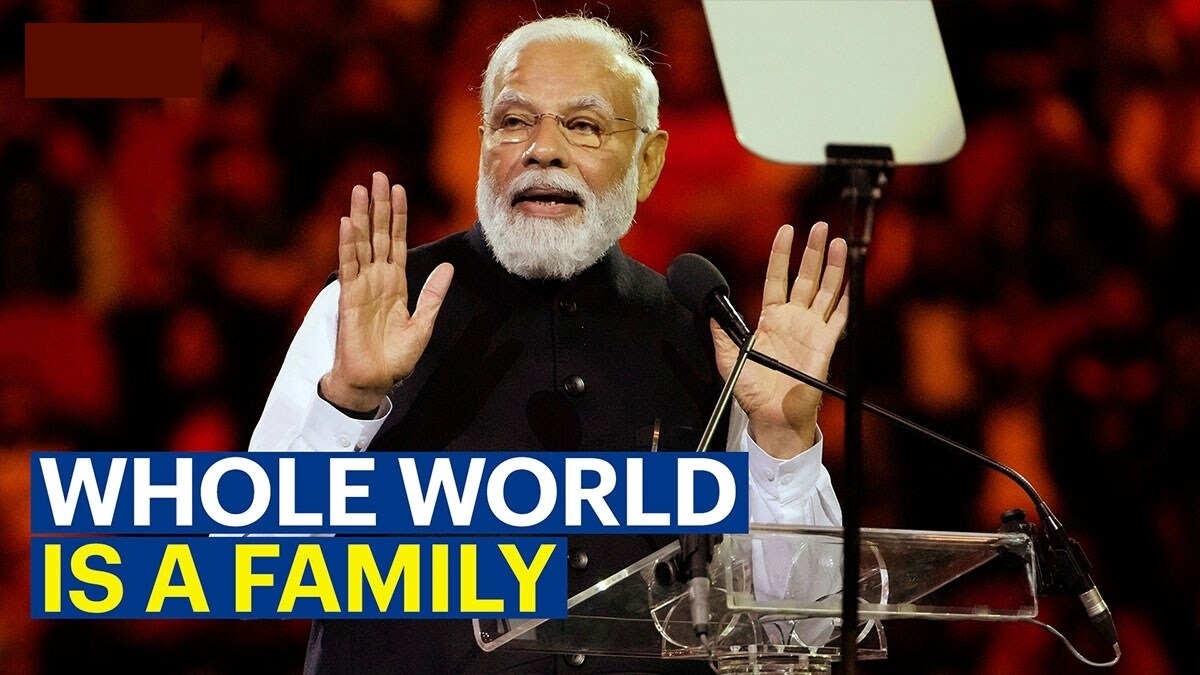
VASUDHAIVA KUTUMBAKAM –
these two words capture a deep philosophy. It means ‘the world is one
family’. This is an all-embracing outlook that encourages us to progress
as one universal family, transcending borders, languages, and ideologies. During India’s G20 Presidency,
this has translated into a call for
human-centric progress. As One
Earth, we are coming together to nurture our planet. As One Family, we
support each other in the pursuit of
growth. And we move together
towards a shared future - One Future
- which is an undeniable truth in
these interconnected times.
The post-pandemic world order is
very different from the world before
it.There are three important changes,
among others.
First, there is a growing realisation
that a shift away from a GDP-centric
view of the world to a human-centric view is needed.
Second, the world is recognizing
the importance of resilience and reliability in global supply chains.
Third, there is a collective call for
boosting multilateralism through the
reform of global institutions.
Our G20 Presidency has played the
role of a catalyst in these shifts.
In December 2022, when we took
over the Presidency from Indonesia,
I had written that a mindset shift
must be catalysed by the G20. This
was especially needed in the context
of mainstreaming the marginalized
aspirations of developing countries,
the Global South and Africa.
TheVoice of Global South Summit,
which witnessed participation from
125 countries, was one of the foremost initiatives under our Presidency.
It was an important exercise to gather inputs and ideas from the Global
South. Further, our Presidency has
not only seen the largest-ever participation from African countries but
has also pushed for the inclusion of
the African Union as a permanent
member of the G20.
An interconnected world means
our challenges across domains are
interlinked.
This is the midway year
of the 2030 Agenda and many are noting with great concern that the
progress on SDGs is off-track.
The G20 2023 Action Plan on
Accelerating Progress on SDGs will
spearhead the future direction of the
G20 towards implementing SDGs. In India, living in harmony with nature has been a
norm since ancient times and
we have been contributing
our share towards climate
actioneveninmoderntimes.
Many countries of the
Global South are at various
stages of development and
climate action must be a
complementary pursuit.
Ambitions forclimateaction
must be matched with
actions on climate finance
and transfer of technology.
We believe there is a need
to move away from a purely
restrictive attitude of what
should not be done,to a more
constructive attitude focusing on what can be done to
fight climate change.
The Chennai HLPs for a
Sustainable and Resilient
Blue Economy focus on keeping our oceans healthy.
A global ecosystem for
clean and green hydrogen
will emerge from our presidency, along with a Green
Hydrogen Innovation Centre.
In 2015, we launched the
International Solar Alliance.
Now, through the Global
Bio fuels Alliance,we will support the world to enable energy transitions in tune with
the benefits of a circular
economy.
Democratising climate
action is the best way to
impart momentum to the
movement. Just as individuals make daily decisions
based on their long-term
health, they can make
lifestyle decisions based on
the impact on the planet’s
long-term health. Just like
Yoga became a global mass
movement for wellness, we
have also nudged the world
with Life styles for Sustainable
Environment (LiFE).
Due to the impact of climate change, ensuring food
and nutritional security will
be crucial. Millets, or Shree
Anna,can help with this while
also boosting climate-smart
agriculture. In the
InternationalYear of Millets,
wehavetakenmilletstoglobal palates. The Deccan High
Level Principles on Food
SecurityandNutritionisalso
helpful in this direction.
Technologyis transformative but it also needs to be
made inclusive. In the past,
the benefits oftechnological
advancementshavenotbenefited all sections of society
equally. India, over the last
few years, has shown how
technology canbe leveraged
tonarrowinequalities,rather
than widen them.
For instance, the billions
across the world that remain
unbanked, or lack digital
identities, can be financially
included through digital public infrastructure (DPI). The
solutionswehave builtusing
our DPI have now been
recognised globally. Now,
through the G20,we will help
developing countries adapt,
build, and scaleDPItounlock
the power of inclusive growth.
That India is the fastestgrowing large economy isno
accident. Our simple, scalable and sustainable solutions
have empowered the vulnerable and the marginalised
to lead our development story. From space to sports,
economy to entrepreneurship,Indian women have taken the lead in various sectors.
They have shifted the narrative from the development
of women to women-led
development.
Our G20
Presidency is working on
bridging the gender digital
divide,reducing labour force
participation gaps and
enabling a larger role for
women in leadership and
decision-making.
For India, the G20
Presidency is not merely a
high-level diplomatic
endeavour. As the Mother of
Democracy and a model of
diversity, we opened the
doors of this experience to the
world.
Today, accomplishing
things at scale is a quality
that is associated with India.
The G20 Presidency is no
exception. It has become a
people-driven movement.
Over 200 meetings will have
been organised in 60 Indian
cities across the length and
breadth of our nation, hosting nearly 100,000 delegates
from 125 countries by the end
of our term. No Presidency
has ever encompassed such
a vast and diverse geographical expanse.
It is one thing to hear about
India’s demography, democracy, diversity and development from someone else. It
is totally different to experience them first-hand. I am
sureourG20delegateswould
vouch for this.
Our G20 Presidency strives
to bridge divides, dismantle
barriers, and sow seeds of
collaboration that nourish a
world where unity prevails
over discord, where shared
destiny eclipses isolation.As
the G20 President, we had
pledged to make the global
table larger, ensuring that
every voice is heard and every
country contributes. I am
positive that we have
matched our pledge with
actions and outcomes.