‘Have questions to find solutions’
| Date :23-Oct-2024 |
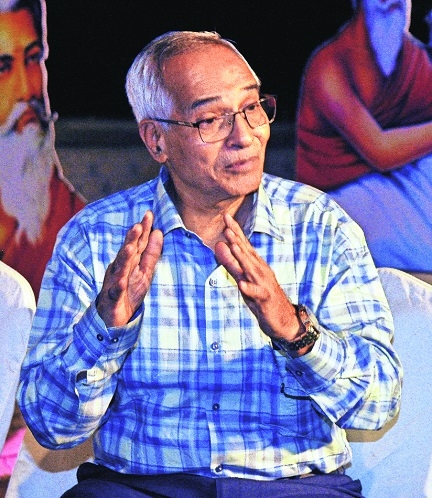
‘Padma Shri’ Dr Himmatrao Bawaskar in conversation with ‘The Hitavada’. (Pic: Anil Futane)
By Vaishnavi Pillay :
As a young doctor posted in a village in Konkan, he came across a case in which a mother was stung by a scorpion and she died while breastfeeding her six-months-old child who was crying. “How could this be? Is there no solution?” These questions haunted Dr Himmatrao Bawaskar. This triggered a tale of research, undaunted human determination, and today his work has brought down mortality rate from scorpion stings from 40 per cent to just 1 per cent.
Meet ‘Padma Shri’ Dr Himmatrao Bawaskar, an Indian physician and medical researcher, who has made significant contributions to the treatment of snake and scorpion bites and is credited with developing effective treatment protocols. Honoured with the ‘Padma Shri’ award in 2019, he was in the city to receive ‘Acharya Sushrut Puraskar’ in a function organised by Hindu Research Foundation. Speaking to ‘The Hitavada’ on the sidelines, Dr Bawaskar shared his insights on snakebite treatment, the current state of medical care in rural India, and the importance of public awareness.
Dr Himmatrao Bawaskar hails from Vidarbha and is an MBBS pass-out from Government Medical College and Hospital, Nagpur.
According to him, snakebites
are common in both rural and urban areas. Urban populations generally know where to seek treatment, whereas, in rural areas, people often rely on ‘tantrics’ before visiting health centre.
“Many
patients, before going to the primary health centre, used to go to tantric. Since 90 per cent of the snakes are non-poisonous, if patients went to a tantric, 90 per cent recovered, and 10 per cent did not,” he pointed out. However, this posed a severe threat to patients. To address the issue, he successfully pushed for Maharashtra Government to provide free anti-venom at primary health centres, and trained doctors there to manage these emergencies.
In India, around 80,000 people die from snakebites each year, which Dr Bawaskar finds unacceptable. The man who has risen from humble background to a researcher of global acclaim, emphasised that negligence and lack of education among victims and healthcare providers, contributed to this number. He highlighted the need for proper training of doctors in administration of the correct dosage of anti-venom.
“For poisonous snakes, we need to give 10 to 20 vials to start. They often give one or two vials. Patients should not be transferred unless a full dose is given, or they may face critical issues on the way due to allergic reactions,” he explained. He advised people to immediately seek medical attention after a snakebite. Improper first aid such as applying bandages could cause further harm.
In Maharashtra, he stressed, anti-venom should be freely available at rural hospitals. He said that he was unsure about the situation across India, where some patients are charged for anti-venom treatment that many poor people cannot afford.
According to Dr Bawaskar, adequate stocks of anti-venom, intravenous fluids, oxygen, ventilators, intubation equipment, and emergency drugs were necessary at primary health centres. His team makes people aware about how to avoid snakebites by wearing shoes, using torches at night, carrying sticks, and avoiding overgrown areas such as grass or fields.
The journey of this researcher started off with disturbing questions, and it still continues. For, he concludes, “You must have questions as they drive research for betterment of humanity.”