The Glory of Guru Nanak Devji
15 Nov 2024 11:38:42
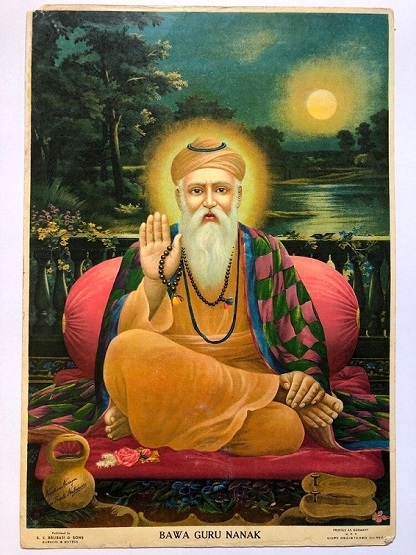
By Minashu Masta :
“Ik Onkar, Satnam, Karta Purakh, Nirbhau, Nirvair, Aakaal Murat, Ajooni se bhang, Gur Parsaad.”
(There is one God, Eternal Truth is His Name, He is the Sole Creator. He knows no fear, is at enmity with no one, His Being is timeless and formless, He is not incarnate, He is self-existent. Attainable he is through the grace of the Guru, The Enlightener.)
Thus begins ‘Japji’ -- The ‘Mulmantra’, seminal composition of ‘Guru Nanak’, founder of ‘Sikhism’, the youngest religion in the world. He believed in existence of one, all-pervasive God and spent his lifetime preaching universal brotherhood among the creations of this very formless God.
He was born on April 15, 1469 to Kalu Bedi and Tripta at Rai Bhoen di Talwandi village (now Nankana Sahib in Sheikhupura district of Pakistan). However, his followers worldwide celebrate his birthday on full-moon night of the month of Kartik as ‘GurPurab’.
Pandit Hardayal who prepared the horoscope of the newborn announced that the child will spread the message of love, peace and brotherhood. The child was named ‘Nanak’. He had an elder sister called Nanaki, who cared for him like a mother. Nanak used to play and frolic around with other kids.
He had the habit of sharing things with his friends. When Nanak turned five, his father sent him to Pandha Gopal for elementary education. Though he did well, he did not show much inclination in learning mathematics and accounting, a traditional vocation of his family.
As young Nanak showed more interest in literature and started composing spiritual poems and hymns, he was sent to Pandit Brijlal. This exposed him to traditional learning contained in Sanskrit classics. Qutab-ud-Din, a local Maulvi, was engaged to teach Persian to Nanak. Within two years, Nanak was proficient in the two languages. To make his son worldly-wise, Nanak’s father charged him with the duty of grazing family cattle in nearby jungles of Talwandi.
This gave Nanak a lot of solitude to introspect, and also a chance to meet and interact with various mendicants and fakirs frequenting the jungles.
Nanaki, who was now married and settled in Sultanpur, expressed desire to meet his brother. Hence, Nanak went to Sultanpur and started working there as granary incharge. Nanaki then found a match for him -- Sulakhni. Both were married and settled in Sultanpur and had two sons named Srichand and Lakhmidas. During evenings, Nanak used to be surrounded by people discussing spiritual matters and singing hymns. Thus came in existence the concept of ‘Sangat’.
One morning, Nanak left home and returned after
three days. During this period, he is believed to have had a communion with the Supreme. Nanak knew that he had
to spread the sacred message of the Almighty and decided
to travel extensively.
He chose Bhai Mardana, his childhood friend and a Rabab player,
who was a Muslim. After seeking his parent’s blessings, Nanak left with Bhai Mardana in 1496. They travelled to various sacred centres important to both Hindus and Muslims within India and abroad. He visited Haridwar and Jagannath Puri, Baghdad and Mecca, climbed mount Kailash, and interacted with accomplished yogis.
Nanak made four such journeys exploring new geographies, spreading the message of brotherhood, humanity, unity of mankind and honest living. He returned to his family after each such tour, as he believed that one did not need to leave family and responsibilities to be unified with God. The basic dictum of Sikhs still remains ‘Kirat karo, Wand chhako, Nam japo’ -- engage in honest labour, share what you have, and recite the name of God.
After extensive travels across India and West Asia, Guru Nanak chose Kartarpur (Kartarpur Sahib, Pakistan) to formalise his teachings and settled down there in 1520 with his family to create a community based on equality, sharing and brotherhood. To promote casteless society, Guru Nanak introduced the concept of ‘Langar’ where anyone and everyone irrespective of caste or social status sat together and ate free food made in community kitchen.
Kartarpur became a centre of attraction for seekers of spirituality. One of the people who came to meet the Guru was ‘Lehna’, who eventually became his most ardent follower. For him, any wish of Guru was God’s own command. He also helped Guru in composing ‘Japji’ and ‘Asa di var’.
Forgoing his both sons, Guru Nanak chose Bhai Lehna as his successor as in him he found the requisite qualities of piety, humility and devotion. He named him ‘Angad’ (a part of oneself).
As the news of succession spread, people knew that Guru Nanak was preparing for his last journey and started to gather at Kartarpur in large numbers. The family and followers were emotional. Guru Nanak Devji asked them not to be sad and meditate instead. Guru Nanak then handed over his book of hymns to Guru Angad and left this world on September 7, 1539. He was seventy then.
Guru Nanak spent his entire life spreading the message of brotherhood among the creations of God that had existed before, God that is eternal, and whose creations we all are.