Out of 3 translocated tigers, 2 are untraceable by NNTR management
| Date :22-Nov-2024 |
By Kaushik Bhattacharya :
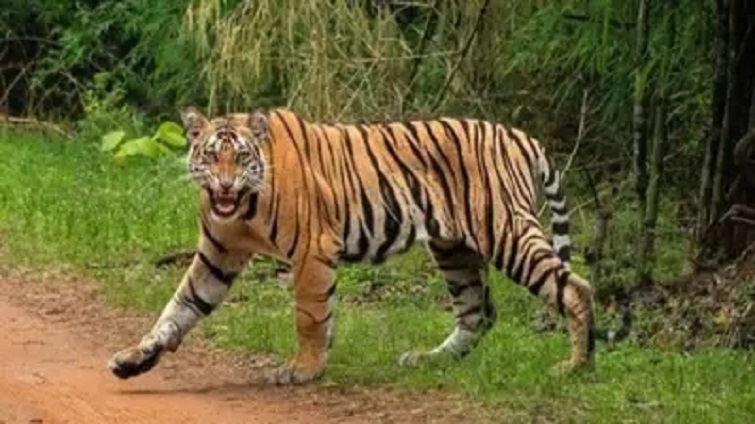
NT-1 tigress entered in Madhya Pradesh after a few days of its release, which is out of the reach of NNTR management. Management fails to track NT-2 tigress as it lost the radio collar.
Out of three recently translocated tigresses in Navegaon-Nagzira Tiger Reserve (NNTR), two big cats among them are untraceable by the Forest Department due to some technical reasons whereas one tigress is settled in the buffer area of NNTR.
Under tiger conservation translocation project, the Forest Department shifted three tigresses -- NT-1, NT-2, NT-3 -- from Tadoba-Andhari Tiger Reserve (TATR) to NNTR in the last one year. The Ministry of Environment Forest and Climate Change (MoEFCC) on September 15, 2022, had granted permission to translocate 4-5 tigers in NNTR. So far, three tigresses have been shifted in NNTR.
“We are unable to trace NT-1
that moved and settled down in
the NNTR-Kanha corridor as it is a dense forest and we are unable to reach it due to the presence of naxalites there. We tried to coordinate with
the Madhya Pradesh Forest Department but they also failed to trace the sub-adult tigress,” said Jayerame Gowda R, Field Director, NNTR to ‘The Hitavada’.
All the three tigresses were
fitted with radio collars before
being released in NNTR to locate their movement in the forest area. However, the NNTR management lost the
signals of the radio collar of NT-1
as it moved far from the recommended range, whereas another tigress
NT-2 has lost its radio collar due
to which it is also untraceable by
the management.
“We lost the signal of NT-2 as it dropped its radio collar in the buffer area. However, we are aware that the tigress is moving in the buffer and core areas of the tiger reserve.
Whereas, we are regularly monitoring NT-3 which first entered Madhya Pradesh for some time, then moved to the core of NNTR and has now settled in the buffer area,” claimed the Field Director.
As per the latest All India Tiger Estimation-2022, there are 11
tigers including three male and eight female residing in NNTR. There are also a number of cubs that are yet to be counted.
“The translocation of tigers in NNTR will definitely help in the progress
of forest growth. The recent translocation procedure was a learning process for our team as we worked along with the trained team from Simlipal Tiger Reserve of Odisha which was in Maharashtra for translocation of two tigers from Tadoba to Odisha,” said Gowda.
The work we did with the expert team of Odisha and TATR would
help us in tiger monitoring and the future translocation process, said the Field Director.
‘400 Chital, Sambar deer to be translocated to NNTR soon’
The management of Navegaon-Nagzira Tiger Reserve (NNTR) is planning to translocate about 400 Chital and Sambar deer from other tiger reserves to increase the number of herbivores in the forest area. NNTR, which is situated over 653.67 sq km area, has less number of herbivores due to which the population of carnivores is also less. Along with translocation of big cats in NNTR, their prey base is also needed. Therefore, the management will shift hundreds of Chitals and Sambars soon.
“We have prepared the proposal to translocate around 400 herbivores from TATR and other tiger reserves of the State. After the Assembly elections, we will table the proposal before the government and we are expecting that within a few months, we will get these deer,” said Jayerame Gowda. Despite dense forest in NNTR, the grasslands are very less in the tiger reserve. The grasslands are essential for tigers as well as for herbivores. The management is mitigating this issue by planting more grass species in the forest areas.