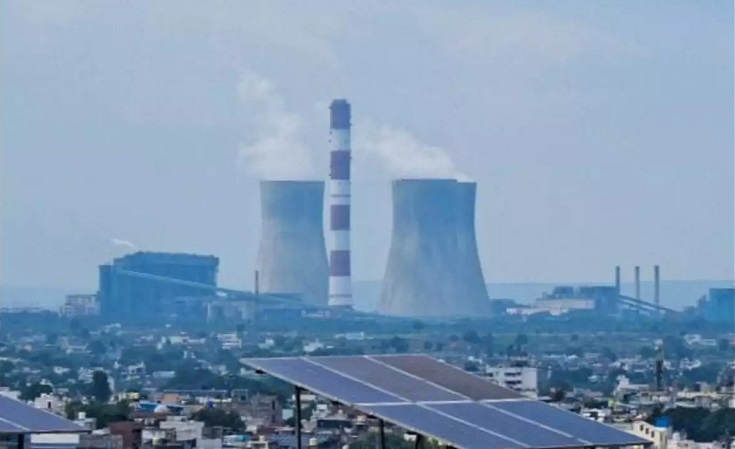
AIR POLLUTION Sulphur dioxide curbing measuresin Koradi, Khaperkheda thermalpower plants still incomplete
| Date :26-Nov-2024 |
By Kaushik Bhattacharya :
With FGD in all Coal-fired power plants in State, SO2 emissions may dip by 71%
DESPITE a timeline and instructions by the Ministry of
Environment Forest and Climate Change (MoEFCC), the installation of flue gas desulfurisation (FGD) systems, which is essential to suppress the sulphur dioxide (SO2
) emission from coalfired thermal power plants (CFPP), is just in construction stage
in Koradi and Khaperkheda Thermal Power Plants in Nagpur.
In April 2021, MoEFCC categorised CFPP into three groups,
each with specific timelines to install SO2 control technologies
by December 2024.
However, in September 2022, these deadlines were extended
to December 2026.
After the extension by the
Ministry, the FGD system
which is essential to suppress the SO2 emission from
CFPPs, only 8% of the total
CFPP electricity generation
capacity of the country has
installed FGD, revealed a
study conducted by Centre
for Research on Energy and
Clean Air (CREA) recently.
Nagpur district is a victim of air pollution with
high PM 2.5 level. Koradi
and Khaperkheda Thermal
Power Plants both cause air
pollution in Nagpur city.
Even after many protests
by green activists of Nagpur,
the FGD installation of both
thermal power plants are
yet to complete.
“The construction of
FGD is going on in all the
projects in Koradi and Khaperkheda.
It will take some time but
we are acting according to the guidelines of MoEFCC,” a senior officer of MahaGenco told The Hitavada on the condition
of anonymity The CREA’s study was based
on the collected satellite data,
in which it shows an increase
in SO2 levels in India in 2023
compared to 2019, with a
notable rise in regions dominated by CFPP, highlighting
the influence of power plant
emissions on air quality.
CREA mentioned that
Maharashtra state emitted the
highest 542 kilotonnes (kt) of
SO2 during the study period.
Maharashtra, Chhattisgarh,
Madhya Pradesh and Uttar
Pradesh have the highest
number of CFPP. Along with
Maharashtra, other three
states Chhattisgarh (509 kt),
Madhya Pradesh (470 kt) and
Uttar Pradesh (447 kt) also in
the top four list for emission
of SO2
.
Thermal power plants emit
277 kt of particulate matter
and 4,327 kt of SO2 over 10
times and 240 times higher,
respectively, than the 26.7 kt
of particulate matter and 17.8
kt of SO2 from burning 8.9 million tonnes of paddy straw.
While paddy straw burning
causes seasonal spikes, thermal power plants represent a
larger, persistent pollution
source year-round, underscoring the need for stricter
controls on thermal power
plant emissions.
Maharashtra also ranked
third with the highest particulate matter (PM 2.5) emissions with 29 kt just behind
Madhya Pradesh (34 kt) and
Uttar Pradesh (32 kt).
Nagpur and Chandrapur,
which are the power producing cities of the state, were
found to have the highest SO2
levels in the country along
with Biswanathpur and
Cuddalore, claimed the study.
According to the study,
Maharashtra has the highest
capability to decrease the SO2
emissions by 71%, from 542
kt to 158 kt. To reduce the SO2
level and to protect public
health, the study advised to
set binding timelines for FGD
installations across all sectors. Government should
impose penalty for delays to
ensure compliance and maintain transperancy and
accountability.
'Extend deadline
by 36 months’
Ministry of Power, Government of India urged the Ministry of Environment Forest and Climate Change (MoEFCC) to extend the deadline for installation of Flue Gas Desulphurisation (FGD) in all Thermal Power Plants in the coun- try for compliance of sulfur dioxide (SO2) emission norms recently. FGDs are essential to suppress the SO2 emission from coal-fired thermal power plants (CFPP) to reduce the
impact of air pollution at nearby cities and villages. CFPP categorised as A, B a nd C ( based on plant’s location) are required to be SO2 norm compliant by December 2024, December 2025 and December 2026 respectively. Meanwhile, all CFPPs have to install FGDs as per the given time period. Ministry of Power, in a m emorandum to MoEFCC, informed that out of 600 CFPPs in the country, FGD systems have been installed in only 44 units which produce 22,590 MW electricity. Similarly, bids are awarded in 233 units which generate 1,02,040 MW electricity.
The Ministry of Power also informed that significant constraints have been reported by CFPPs regarding installation of FGD systems. Central Electricity Authority (CEA) has also assessed reasons for delay in FGD system installation, it stated. The constraints are primarily related to, limited domestic manufac- turing capacity due to limited vendor base, dependence on imports (around 17% items - A gitators and Fans, are imported) and, a s udden growth in demand to meet the stipulated timelines, said Jitendra Mishra, Under Secretary, Ministry of Power, government of India in the mem- orandum.
The average time taken for FGD installation after award is around 36-40 months depending upon the vendor or site. The current annual installation capacity is around 16-20 MW per annum (33-39 units). These factors have also resulted in an increase in installation costs of FGD system, Mishra informed. Ministry of Power stated that CFPPs are unable to meet the time- line due to such constraints and limitations and it may result in impos- ing of environmental compensation charges. Therefore, MoEFCC should consider extension in timelines by 36 months beyond the timelines stip- ulated in MoEFCC notification, stated the memorandum