Small may be BIG in remote patient monitoring
13 Dec 2024 12:13:00
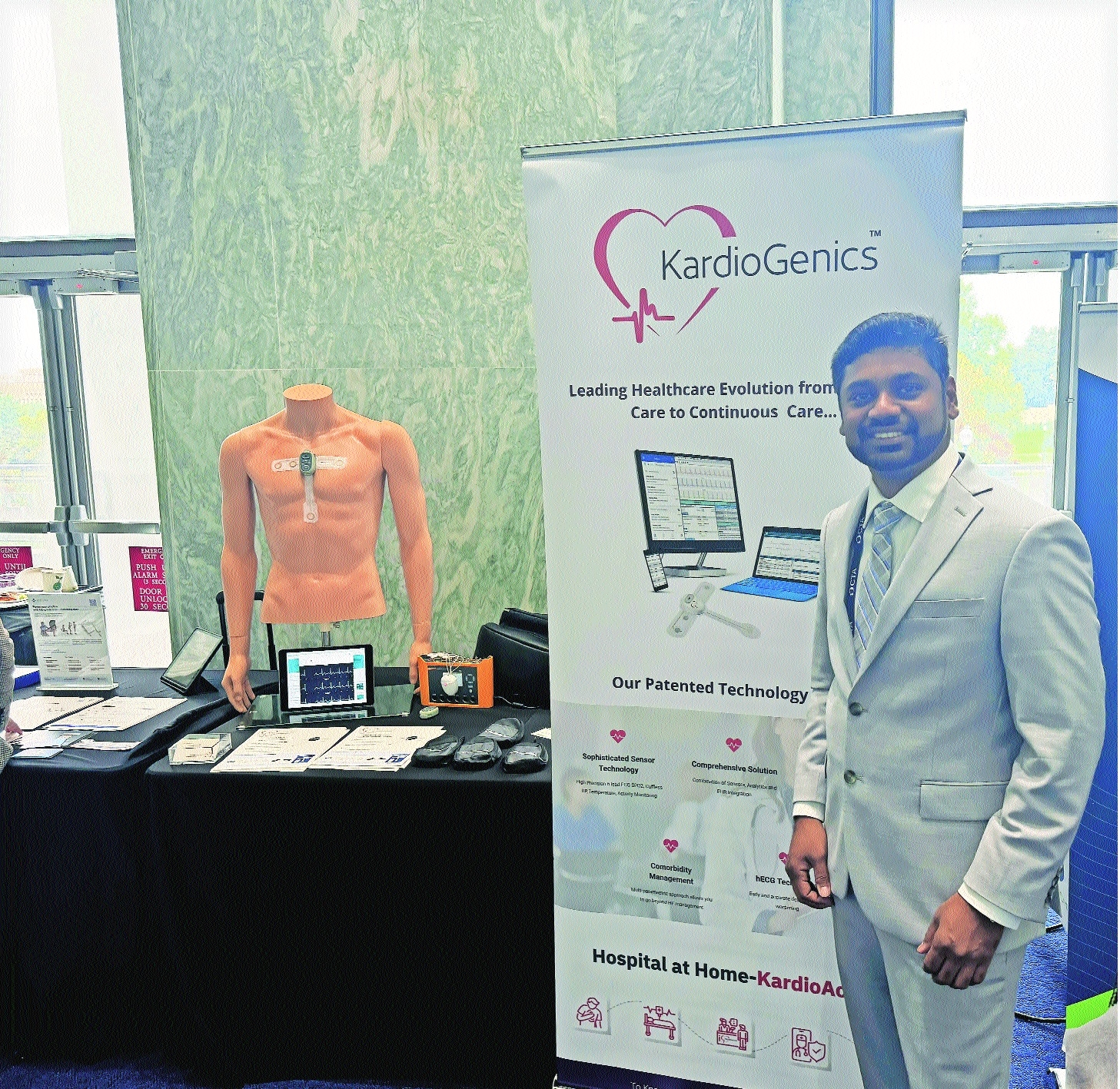
Dr Mahesh Galgalikar (left). (Right) A mannequin upon whose chest is mounted the wearable satellite ICU monitoring technology device.
By Kartik Lokhande :
INNOVATION
Dr Mahesh Galgalikar, a researcher from Yavatmal, makes waves in the US defense establishment. His innovation can convert any ward into a step-down ICU
Combat casualty care is always deprived of specialty care as battles are fought in remote environment. Soldiers injured in the battlefield are shifted to field hospitals offering only life-saving measures, and from there, airlifted to better equipped hospitals. From the point of injury to field hospital to more specialised hospital, there is significant time-delay during which a majority of casualties happen. But, a technological innovation of a researcher hailing from Yavatmal may prove to be a boon.
The innovation in the form of a small medical device the size of half-an-egg enables critical en-route life-saving care during evacuation from battlefield or remote locations.
An innovation of a researcher Dr Mahesh Galgalikar from Yavatmal in Vidarbha region of Maharashtra, this device can help doctors sitting in superspecialty hospitals to monitor the patient at a remote location or in transit and suggest appropriate action to stabilise his vitals. This device, which has been making waves in the US defense establishment, has potential to revolutionise healthcare. It can also be used to convert any ward in a hospital into a step-down ICU unit by way of providing a facility to monitor oxygen saturation, blood pressure, cardiac vitals,
etc.
The device is rechargeable and reusable with only the patch required to be replaced.
Recognising his research and entrepreneurial achievements, the US Government granted him permanent residency through the prestigious ‘Einstein Visa’ in 2017 and even offered him US citizenship. He has accepted permanent residency in the US but not citizenship. “I wish my innovation to benefit India. I am not after money. I am always thinking how to make this device available even to a General Physician sitting in Yavatmal so that his patients can be benefitted,” Dr Galgalikar told ‘The Hitavada’ over telephone. He is on a visit to Yavatmal at present.
The US has recognised the immense usefulness of the technology invented by Dr Galgalikar not only in combat casualty but also from the perspective of rural healthcare. He is working closely with the US Department of Defense in this regard.
A few years ago, Dr Mahesh Galgalikar had engaged in talks with Devendra Fadnavis, the then Chief Minister, regarding starting manufacturing of the device and related ecosystem in Maharashtra.
However, somehow, it did not materialise at that time. With the return of Fadnavis as the Chief Minister of Maharashtra now, he is hopeful of revival of the talks.
The man who specialised in Cardiac Arrhythmias, Inherited Cardiovascular diseases, and Sports Cardiology from Stanford Medicine, has named this device as ‘Kardio-Access’.
Though the device is the size of half-an-egg, it comes with an ecosystem comprising cloud technology, AI-driven decision-making etc.
At present, his startup is exploring potential of the technology in cardio-oncology, critical care, chronic care, apart from cardiovascular care where it’s currently being used. Diabetic care is also on the roadmap as it’s a co- morbidity. Given the fact that diabetes and cardiac diseases are the most common chronic conditions across the globe, he felt that his innovation could help monitor the condition of a patient from home and start treatment, by saving time taken in shifting a patient to hospital in case of an emergency. “In-transit consultation can be done as vitals of a patient are monitored. This can reduce the ‘Golden Hour’ period for a patient’s treatment in case of a stroke,” he added.
Shedding light on his journey of innovation, Dr Galgalikar said that critical care required shifting of a patient to big hospitals in bigger cities.
“So, I thought, why can’t we eliminate geographical constraints to provide critical care? The satellite ICU monitoring technology device is a product of that pursuit. It can live-stream the vitals of a patient from a remote site to the doctors at superspecialty hospital, and help doctors in suggesting proper treatment. The healthcare system is centralised now, but we are trying to create a kind of a virtual hospital,” said the engineer-doctor-researcher-entrepreneur.
Dr Galgalikar completed his degree in Electronics Engineering at an engineering college in Yavatmal. During his college years, he experimented with emerging technologies and authored several research papers. His research was recognised at an international conference in Singapore and the Indian Institute of Science, Bengaluru. He pursued further education at Rochester Institute of Technology and Stanford Medicine in the US, where he completed his MS between 2011 and 2013.
There, he became the first Indian to be honoured with the Distinguished Researcher Award in the University’s 150-year history. Soon after, he floated a startup focused on medical devices for remote patient monitoring and conducted various experiments. With a lot of promise in the research and development climate in India now, he is exploring the possibility of making the device in India to contribute to the cause of ensuring ‘Kardio-Access’ to various strata of socio-economic spectrum.