Supreme Court RESTRAINS courts from passing orderson religious places
| Date :13-Dec-2024 |
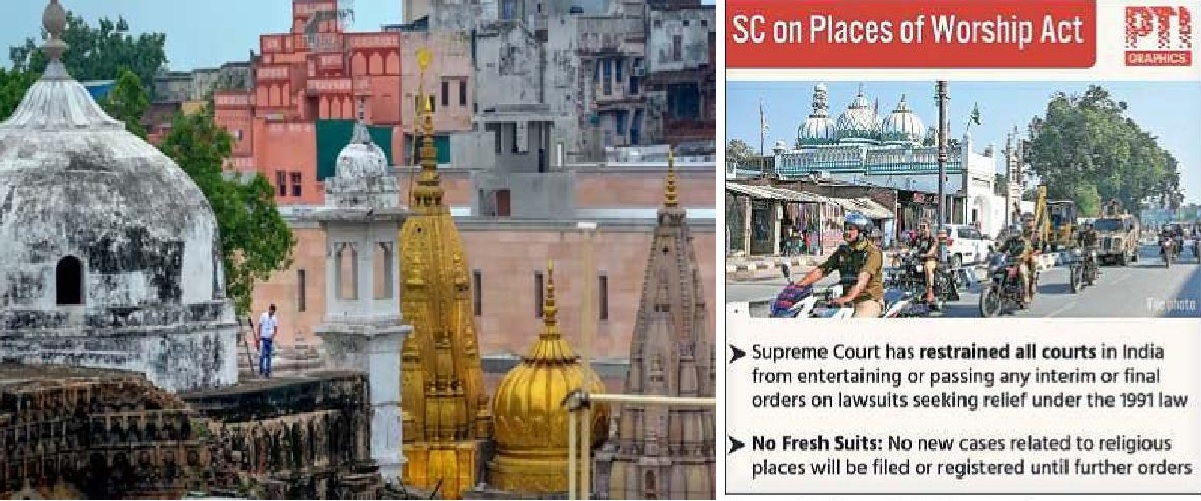
NEW DELHI :
IN AN important development,
the Supreme Court onThursday
restrained till further directions
the courts in the country from
entertaining fresh lawsuits and
passing any effective interim
or final orders in pending ones
seeking to reclaim religious
places, especially mosques and
dargahs (a muslim shrine).
“As the matter is sub-judice
in this court, we deem it appropriate that no fresh suit would
be registered and proceedings
are undertaken till further
orders of this court,” the CJIled bench said.
The direction of a bench comprising Chief Justice Sanjiv
Khanna and Justices Sanjay
Kumar and K V Viswanathan
stalls proceedings in about 18
lawsuits filed by various Hindu
parties seeking survey to ascertain original religious character of 10 mosques including
Gyanvapi at Varanasi, Shahi
Idgah Masjid at Mathura and
Shahi Jama Masjid at Sambhal
where four persons’ lives were
snuffed out in clashes.
The special bench was hearing about six petitions, including the lead one filed by lawyer
Ashwini Upadhyay, challenging various provisions of the
Places of Worship (Special
Provisions) Act, 1991.
The 1991 law prohibits conversion of any place of worship
and provides for the maintenance of the religious character of any place of worship as
it existed on August 15, 1947.
However, the dispute relating to Ram Janmabhoomi-Babri
Masjid at Ayodhya was kept out
of its purview. There are several cross petitions which seek
strict implementation of the 1991 law to maintain communal harmony and to preserve the present status of
mosques, sought to be
reclaimed by Hindus on the
groundthattheyweretemples
before invaders razed them.
The bench made itclear that
it would be examining the
“vires (legality), contours and
ambit” of the 1991 law and it
was imperative to ask other
courts to“stayofftheirhands”
tillitpassedanyfurtherorders.
“Inpendingsuits,thecourts
willnotpassanyeffectiveinterim or final order, including
order of survey, till further
orders,” the bench said.
Senior advocate J Sai
Deepak,appearingforaHindu
party, opposed the order
restrainingallothercourtsand
said the parties should have
beenheardbeforesuchadirection.
The CJI said it was quite
natural to ask courts to not to
passanyorderas theSupreme
Court was hearing the larger
issue. The bench said if parties insisted then, the matter
could be sent to a High Court.
“Can the trial courts overreach the Supreme Court,”
asked the bench and said the
apex court was already dealingwiththe validity ofthe law.
Observing the court couldn’t decide the matter without
theCentre’s response, it asked
thegovernmenttofileits reply
to the pleas and cross ones in
four weeks. It also granted a
further of four weeks to other
parties to file their rejoinder
after the Centre filed its reply.
Notably, the bench had
issuednoticetoparties,includingtheCentre,ontheleadpetition in September, 2022.