‘Mulugu earthquake reflects re-activation of Kaddam Lineament Fault fracture’
Date :06-Dec-2024
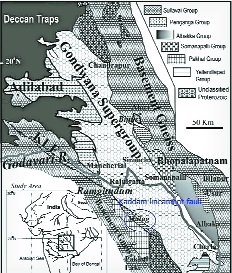
The geological map of the Mulugu area with tectonic features.
(Image courtesy: Dr S J Sangode
et al (Geological Society of India, 2013 publication)).
Staff Reporter :
The 5.3 magnitude earthquake with epicenter located at 40 kms below surface (shallow depth earthquake) in Mulugu in Telangana was owing to the ‘evident re-activation’ of the Kaddam Lineament Fault (KLF) fracture, says a city-based expert.
Mulugu is about 300 kms from Nagpur. Dr Anjan Chatterjee, former Additional Director General of the Geological Survey of India (GSI),
told ‘The Hitavada’ that “We, at Nagpur, may experience tremors due to the
KLF fracture’s further re-activation if ever, but need not panic.” But, he added, the Mulugu area at this juncture needs further earthquake related geoscientific studies and investigations to prepare a new and wider database for a better understanding of the seismicity of the area.
“I have worked in the coal-bearing Bhopalpalli area of the then Warangal district, which falls in the Gondwana Supergroup of rocks and is about 40 kms away from Mulugu district. Mulugu is also located over the Gondwana Supergroup of rocks (295 to 100 million years old). The older basement Proterozoic age rocks (2500 to 540 million years old) are also exposed in the area. The northwest-southeast KLF also traverses through Mulugu town as is evident from the map,” explained Dr Chatterjee. This northwest-southeast trending fault on Kaddam river, a tributary of the Godavari, was proved as active by a team of earthquake geologists led by Dr S J Sangode in 2013. The team deduced brittle to ductile deformations within the older Precambrian (geological time period from about 4000 million years to 542 million years ago) formation rocks to indicate its antiquity. This deformation indicates that tectonic activities have been prevalent since a long time.
This fault’s reactivation during Tertiary times, which lasted from 65.5 to 2.6 million years ago, was traced by the team.
Sharing with ‘The Hitavada’ the images with the courtesy of Dr Sangode, Dr Chatterjee said that the team had recommended further detailed work on the KLF and elsewhere in the peripheral regions of Deccan Volcanic Province where ‘active faults and old re-activated fractures can be encountered’. The northwest-southeast trending Godavari river fault was identified as early as 1881 by William King of the GSI, he added. Neo-tectonism (new activity) is detected through visibility of seismites (a kind of sandstone developed due to new tectonic fault activity) developed in the Quaternary age sediments (age 2.58 million years old till present day). The sediments are well exposed on many major river beds.