Ghorpad village, a hotspot for wildlife movement
18 Feb 2024 09:47:52
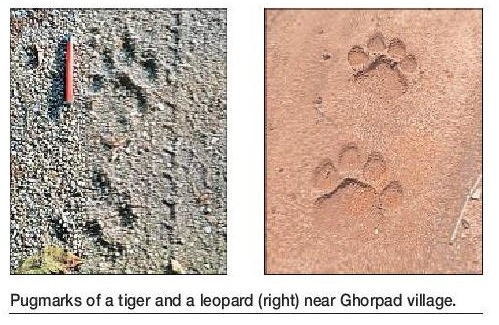
By Kaushik Bhattacharya :
Schedule I to IV animals and birds are frequenting the forest area while moving between Bor and Pench tiger reserves Ghorpad village situated about 4 kms from the notified corridor has highways passing through it
CONSERVATION of wildlife
corridors is a major concern for
the State Forest Department.
However, proper management
of corridors has become a big
challenge as human interference has increased drastically
in such corridors.
Katlabodi to Chameli wildlife
corridor under the Kondhali
forest range in Katol tehsil, is
a perfect example of high
human interference.The Forest
Department had declared the
area a wildlife corridor over a
decade ago, but due to construction of highways on both
sides of the corridor, wildlife
movement has shifted to
Ghorpad village situated about
4 kms from the notified corridor which connects Bor Tiger
Reserve (BTR) and Pench Tiger
Reserve (PTR).
Due to heavy traffic on the
roads, wildlife has restricted
their movement through the corridor and started frequenting the Ghorpad village.
Ghorpad village, situated in
Katol tehsil of Nagpur district,
has recently garnered attention as a biodiversity hotspot
in the region.
Located within
the picturesque forest area,
the village boasts an exceptional abundance of wildlife,
diverse species of flora and fauna, making it a safe haven for
nature enthusiasts and
researchers alike.
A recent study conducted by
Wildlife Institute of India (WII),
Dehradun, identified Ghorpad
village as a rich wildlife corridor which connects BTR and
PTR.WII installed camera traps
in the forest area and captured
movement of Schedule I to IV
wild animals listed under the
Wildlife Protection Act (WPA),
1972.
“Despite excess movement
of wildlife through Ghorpad
village, the forest department
has allowed tree felling on this
parcels of lands for commercial gains,” informed a source.
Recent camera trap data
from the census of wild animals
in Ghorpad village has provided valuable insight into the
diversity of wildlife presence.
The collected data highlights
the presence of an array of fascinating wild animal species
that calls the village their home.
Some notable species include
the elusive Bengal tigers, leopards, Indian wolf, Sambar deer,
sloth bear, langur, Malabar
hornbil, four-horned antelope,
spotted deer, wild boars, nilgais, wild dogs etc. These findings underscore the importance of Ghorpad Village as a
crucial habitat for these endangered and protected species.
The patches also have scheduled trees like mahua, teak,
haldu, etc. which have also
been marked for felling.
According to the source, “It
is the same area where the
renowned tiger Bajirao used to
inhabit and died in a road accident in 2017 near Bazargaon.”
“These dense woodlands
serve as a safe passage for various wild animals, facilitating
their movement between different ecosystems. Due to
excess traffic in the declared
corridor between Katlabodi
and Chameli section, the animals are using this forest patch
for their movement from one
forest to another,” said the
source.
In a recent camera trap photographed movement of sloth
bear with her cub, tigresses
with their cubs and leopards
are using the forest area frequently. Even, the seamless
connectivity between Ghorpad
village and neighbouring areas
has established it as a crucial
link in the conservation of biodiversity in the region, said the
person. There is a utmost need
to protect the forest area and
declare it as corridor for proper conservation of flora and
fauna, he added.