Can we Do away with footpaths?
11 Jun 2024 08:21:30
By Sagar Mohod
First the gardens started withering away. Then the open spaces to be left out for public utilities in residential colonies started disappearing. Thereafter, play grounds vanished in thin air. In the long list of disappearing public places now comes the number of footpath, an all essential need in the fast paced urban ethos which is now getting neglected due to administration’s apathy. Not that they are not available, but they just remain for namesake, as ingenious Indians known for their proficiency in jugad have put them to varied uses, most of them commercial. In short, personal interest has triumphed over public interest, leading to footpath being diverted to uses other than what they were designed in the first place. Footpaths have been grabbed and put to rampant commercial use across length and breadth of city, thanks to callous attitude of civic officials. So the question arises: Do we need footpath at all? As the name suggests, the footpath ideally is meant for pedestrians. But, in the city, pedestrians can hardly find a footpath free of encroachment as Nagpur Municipal Corporation (NMC) officials have no time to make sure that footpath remain available for walkers.
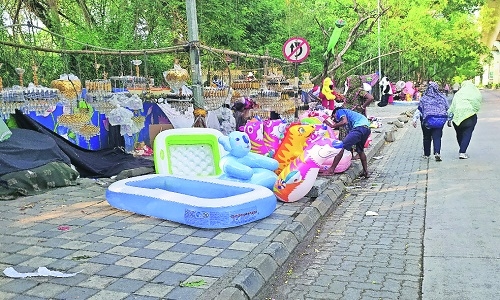
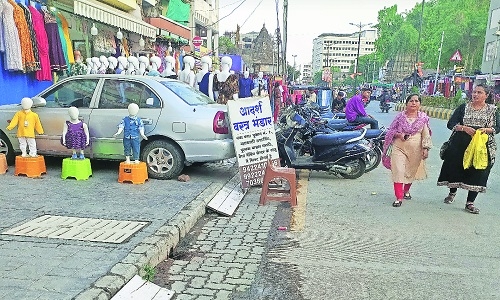
A report was published in ‘The Hitavada’ CityLine as to obstacles that block the path for pedestrians in the city, wherein a photograph showing four wheelers occupying the footpath was visible. ‘The Hitavada’ had raised a question with the city administration as to ‘Where is the space? - If we may ask!!!’ In response to that report, Yogesh Tripathi, a conscious citizen, came with the wild idea of doing away with the concept of footpath. He was anguished the brazen way in which pedestrians are being forcibly driven away from footpaths and proposed to authorities that they should simply remove them and the widened space can then be put to use for parking of vehicles. The available space would provide respite for harried citizens and offer them peace of mind as parking space would not be a problem in market places in city. As to pedestrians, let them walk on the road, as even otherwise owing to rampant misuse of walkways they are left with no other option, he added further. Tripathi’s frustration is quite plausible given the state of inertia in which the official machinery is functioning in the second capital of the State. In run-up to G-20 meet, footpaths on Wardha Road were given a new look and broadened to impress the visitors. Now post-summit, these widened and beautified pedestrian walkways are being converted into chowpatty’s right under the nose of the administration.
At most places, utilities have been placed on the footpath making it just impossible for citizens to use them. In other places, fruit-sellers have set up their shops. While in busy market places, due to congestion, footpaths are used for parking of two and four wheelers. So, Tripathi wonders where would the pedestrian go if rule of law does not prevail in the city. What's the way out of the mess? 'The Hitavada' broached-up the subject with few conscious citizens who opined that unless and until NMC earmark dedicated hawker zones the solution won't be in sight. Once hawkers are properly provided designated places, citizens to can have better time in making their purchases. This way both the purposes could be served, the humane problem of providing for livelihood of street-vendors as well as catering to needs of urban lifestyle and mostly restoration of footpath to pedestrians. Admitting the problem of encroachment on footpath, Leena Upadhaye, Chief Engineer, NMC, said the situation needs to be tackled forthwith. She said the official machinery time and again evicts the encroachers but they come again.
"The anti-encroachment squad is daily on job of clearing the footpaths and yet the problem resurfaces again and again" she said. She however was confident that the pedestrians would soon have their rights restored and hinted at policy action on that front. The NMC top brass is seized of the issue and some definite plan would soon be rolled out to ensure that walkways are restored back to pedestrians. Pramod Pande, Vice-President, Janmanch, a premier social organisation, opined that the idea is fraught with risk. "It's downright dangerous to think about removing pathways as the same would expose the pedestrians to hit-n-run incidents. Pedestrians coming down to carriageway are not at all advisable and said civic machinery needs to double down on encroachers and ensure that they are free of all obstacles," he said. Architect Sujit Rodge, President, Institute of Town Planners, India, Nagpur Branch, said in the first place local authorities do not follow uniform policy as to development of facilities for pedestrians. "There are well laid out norms as to height and width of walkways, it should be 150 mm at height from the carriageway at each of the main roads different pattern is visible. Even Indian Road Congress (IRC) has adopted the international norms as to footpaths but seldom they are implemented", he said.
Another factor that deters people from using the footpaths is lack of continuity as it breaks off at few meters to allow for entry and exit of any home or in market place for shops. "The saddest part in city is that almost every other footpath has been encroached upon by hawkers. Yes, admittedly the hawkers too need place to eke out their livelihood but why can't NMC establish food zones in different parts of city, questioned Ar Rodge. Indore has shown the way and one wonders why same cannot be replicated in city also," he added. Ashok Karandikar of Janakrosh, was of view that unless and until issue of hawkers is resolved footpaths cannot be restored for pedestrians. "Apart from that strict action is needed against any misuse of pedestrian walkway for product display or keeping material from the shop, he said. NMC, he felt should pro-actively set up 47 hawkers zones that it identified and then only footpath would be available to citizens. Karandikar was of view that to some extent society is also responsible for misuse of footpaths. "The issue of encroachment on footpaths can be resolved if people stay away from such hawkers. The problem is we the people patronise the street vendors that result in their mushrooming in every available vacant space by road side", he stated. The solution can even come by doing away with footpaths per se or as per consensus.