3,350 Snakebitecases per month!
| Date :26-Jun-2024 |
By Kartik Lokhande
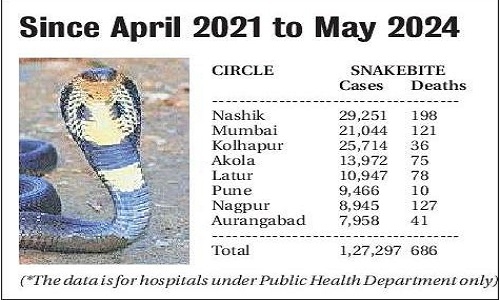
A man from Parseoni suffered snakebite at 2.30 pm. He chewed some herbs with ‘guidance’ of some locals. Later, as he started showing some symptoms, his family took him to primary healthcare centre. But, since poison was not detected in blood test, it was inferred that he was bitten by a non-poisonous snake. It was only after his situation deteriorated that an expert was consulted, who advised the family to shift the man to hospital at Nagpur. However, he was brought dead. It was one of the cases in which snakebite resulted in death of a person. If one goes by the official statistics with the Public Health Department, in the last 38 months (from April 2021 to May 2024), a whopping 1,27,297 snakebite cases and 686 deaths have been reported in the hospitals under the department across Maharashtra. This amounts to an average 3,350 snakebite cases per month in the State. On an average, more than one death/s due to snakebite is reported in the State every week.
Of these, 22,917 cases and 202 deaths have been reported in Nagpur and Akola circles in Vidarbha region. The number of cases in Nagpur and Akola circles constitutes 18 per cent of cases reported in the Public Health Department hospitals in entire Maharashtra. Similarly, the number of deaths due to snakebite in these two circles of Vidarbha constitutes 29.44 per cent of total deaths in the State. Though Nagpur circle has lesser number of snakebite cases among eight circles in the State, it has the second highest number of deaths (127), after Nashik (198). It must be stressed that these numbers are for Public Health Department hospitals only. These figures do not cover the data from other Government hospitals and private hospitals. Besides, many snakebite victims die at home and this number does not figure in the official data for Public Health Department. According to experts, there were certain causes behind deaths of snakebite victims apart from snake venom.
These include lack of awareness about proper treatment, delay in securing medical aid, and inadequate awareness among trained staff about looking for other snakebite symptoms if blood test does not detect snake venom. Nitish Bhandakkar, Secretary, Wildlife Welfare Society, told ‘The Hitavada’ that superstition that rituals cure a person of snakebite also results in deterioration of health of a person. “This practice is widely prevalent among villagers in adjoining State of Madhya Pradesh, and also in some rural areas in Nagpur district. They take a person bitten by a snake to local faith-healer. It is only when the situation deteriorates that they bring the snakebite victim to Government Medical College and Hospital, or Indira Gandhi Government Medical College and Hospital. By that time, it becomes difficult for doctors to save the victim,” he elaborated.
In certain cases, Bhandakkar said, even the staff at primary healthcare centres needed to be trained better in handling snakebite cases and administering anti-snakevenom injections as first precaution, instead of merely referring the victims to bigger hospitals at Nagpur. Further, he added, general awareness about snakebite needed to be increased among the people. People must be made widely aware that anti-snakevenom injections are available at Government hospitals, he said. Public Health Department data reveals that adequate stock of anti-snakevenom injections was available in its hospitals during the abovesaid period of 38 months.