Prerna Shrimali: There is no such thing as semi-classical in dance
| Date :29-Jun-2024 |
Staff Reporter
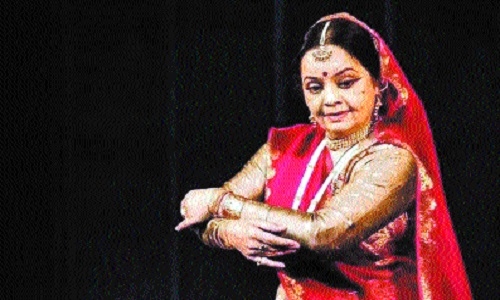
Prerna Shrimali is a major exponent of Kathak in the country. Coming from Jaipur Gharana (school of music), she learnt under Kundan Lal Gangani and has participated in several musical conferences in the country and abroad. She is versatile in her approach and is also accomplished as a guru. Recently, she came to the city to perform at the ongoing cultural extravaganza Pranati where ‘The Hitavada’ talked to her about Kathak and the future of Indian Classical Dance. Excerpts from the conversation:-
Q. There are many stories about the origin of Kathak. Some say that the dance form evolved in the court of the then Nawab of Lucknow, Wajid Ali Shah whereas some are of the opinion that it came from Banaras. Which of the stories is true or is there any other anecdote related to its origin?
A. Firstly, we have to understand that none of the kings or Nawab worked for the development of Kathak as an art form. Yes, they patronised it but didn’t work for it. The only exception in this category is the Chakradhar Singh of Raigarh gharana. It is also written in some books that the Nawab of Lucknow worked for the development of the dance form but this is wrong, though, he patronised the art. In the City Palace of Jaipur, there was a ‘Gunijan Khana’ (a place for artists) which is even in existence today and all the artists used to perform at the site. Various pieces including the one which I performed can still be heard in the Raja Rajeshwar temple of the City Palace in Jaipur. There, one can find the long traditions of Kathak and the families which continued with the support of the local kings. One such example is the guru of my guru Pandit Narayan Prasad who was the chief dancer of the kingdom and used to get a salary of Rs 2 at that time. So, it can be said that the origin of Kathak as a dance form lies in the state of Rajasthan.
Q. Noted classical singer Pandit Jasraj once said that the gharanas in music are being mixed. Does the saying also apply in the context of Kathak where four major gharanas can be found (Jaipur, Lucknow, Banaras and Raigarh)?
A. Gharanas are very important since they preserve the identity of the dance form and the artist. If everyone will drive the same car, then the world will become monotonous to look at. If you will see me and an artist from Lucknow, you will find the difference in the artistic techniques of Kathak. Coming to the question, the primary reason for the same is that now Kathak has become a performing art. Since, the dance is performed on stage, the other dancer knowingly or unknowingly certain aspects of the performer in his/her dance form. But, then also I will say that their identities are still there and this can be easily understood by someone who is avid with the language of art. If one knows the art form, he/she can differentiate between the schools of music in the context of how an artist treats the lays (beat) and plays with it throughout. Like in Jaipur, the beats of Pakhawaj whereas in Banaras, the art is primarily surrounded by the bols (beats) of dance. Such differences are many and lead us to believe in the independent existence of every gharana or school of music.
Q. What delves in your mind while performing?
A. I dance for myself not for anyone else. It may sound strange to people but this is what it is. Because I believe that if I am being happy by dancing for myself then that happiness will be transferred to the audience. So, I strictly believe and this is a very personal opinion of mine that an artist should dance for him/herself.
Q. What are the common myths regarding this dance form which you would like to bust?
A. One common myth that I encounter is ‘Katha Kahe so Kathik Kahave’ which means that the art that tells a story is Kathak. It has also appeared in some books and some artists are also working on it that Kathak is not related to Katha or storytelling. Both are different. For a long time, both these terms were not related to each other for a long time but later got connected with each other. This is a historical aspect and I can’t say much on the topic since this is not my subject but it can be said that it happened. We have to understand that Kathak has its language to tell. If the art form is just limited to storytelling then what about the other aspects of the dance which include ‘tode’, ‘tukde’ and others. This has to be taken into consideration by the people that when the language of the dance has no meaning of its own, then a certain type of meaning can be inserted in it through the use of bhavasand dance.
Q. As a guru, how do you see the future of Kathak and the influence of semi-classical dance forms on it? Also, will the budding artists be able to carry forward this legacy? To ask further, there is a dichotomy that prevails in art where an artist has the dual responsibility of preserving the original art form and to allow the students to unleash their creativity within the art form. How do you manage that?
A. Firstly, we have to be clear with the concept that there is no such thing called semi classical dance. Bollywood is an altogether different thing which should be excluded from this category. Music can be semi classical which includes Thumri and other vocal forms but in the case of dance, it is not. Dance can be classical or folk. Bollywood is not semi classical and is performed by the younger generation with much interest. There is no bad thing in that but it can’t be termed as semi classical. Bollywood based on Kathak is not semi-classical. Coming to the question tradition, I remember the lines of William Shakespeare where he says, ‘To be or not to be, that is the question’.
Tradition will only remain if it goes with the time and rejuvenates itself with the need of hour. Like, there is a possibility that the water of a still water body might deteriorate but this is not the case with a lake where the water is constantly moving. So, these traditions are alive because they have evolved with time. This is possible that an older artist coming from the past may object to us regarding the techniques we employ while dancing. So, I try to preserve the art that I inherited from my guru (teacher) and also ask my students to learn it as it is. This is another aspect of the coin that I may create few things from the learnt piece. So, the tradition has to be preserved with retaining the core and by giving certain space to the learners.
Q. How do you look at the culture of the city and state?
A. I have been visiting the city since my student days at Kathak Kendra. The time goes back to the early 80s. Several workshops and events were organised and the exponents of the dance art form used to meet at the place. There was a time when it was said that if an artist is coming to the city of lakes then he/she has some calibre and was believed to have some standard. After that, a long time has passed and the situations have also changed a lot. The state has given some of the stalwarts of music to the state including Pandit Ravishankar, Ustad Ali Akbar Khan, Vidushi Annapurna Devi and others. But at the same time, we have to also believe that the state is prosperous in terms of Indian Classical Music and instruments, not in dance forms.