Captive vultures attract wild ones in East Pench
| Date :11-Aug-2024 |
By Kaushik Bhattacharya :
PTR management detects around 50 nests of wild vultures near aviary in East Pench. To feed wild vultures along with the captive ones before releasing them into the wild
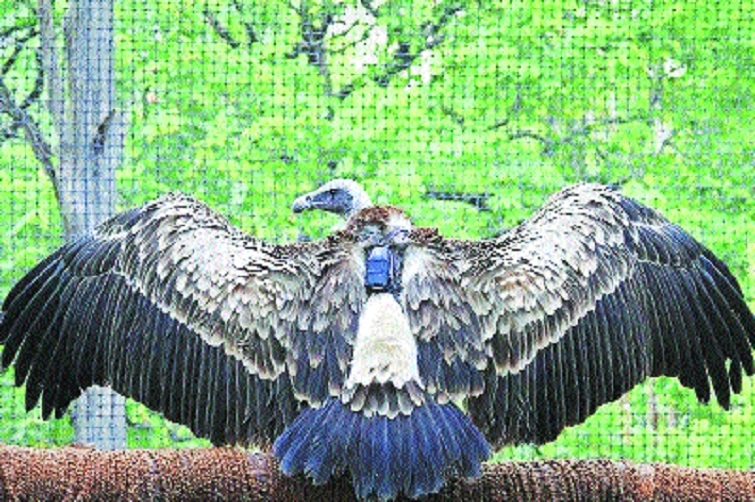
White-backed and long-billed vultures, which are among the critically endangered species world-wide, are getting attracted towards the captive vultures dwelling in aviary situated in East Pench range of Pench Tiger Reserve (PTR).
PTR management has initiated the process of releasing all 10 captive long-billed vultures into the wild. “We have started feeding our captive vultures inside the aviary and also the wild vultures outside the aviary. The wild vultures are getting closer to the aviary which is a good sign,” said Dr Prabhu Nath Shukla, Deputy Director, PTR.
“We attempted to release the captive vultures by placing food outside the aviary and allow them to mix with the wild vultures, but due to heavy rains it failed,” Dr Shukla said.
“When we constructed the aviary for breeding of vultures in East Pench there were around 13 nests of vultures in the area. However, the number of nests has increased by 50 in recent time. We have witnessed many wild white-backed and long-billed vultures near the aviary and fed them. Now, we want to release the captive vultures as the wild vultures are feeding outside the aviary. This way they will get mixed with the wild ones,”adds
Dr Shukla.
“It is difficult to say whether the number of vultures in Pench has increased because we do not have any previous data about their population. But the number of nests in East Pench has increased. After establishing the vulture aviary in East Pench we are planning to conduct a vulture census in the region soon,” said the Deputy Director.
“There is a need of documentation and location mapping of nests to record data of wild vultures in the area.
If the number of nests have increased then it is a good sign and the Forest Department should include all stakeholders to conduct a proper census of vultures not only
in Pench but all over the state,” said vulture expert Dr Ajay Poharkar. Forest Department, with the help of Bombay Natural History Society (BNHS) brought 10 vultures from Vulture Conservation Breeding Centre (VCBC), Pinjore to East Pench based vulture aviary for breeding last year. Government of India has established four Vulture Conservation and Breeding Centres at West Bengal, Haryana, Madhya Pradesh and Assam. These four VCBCs in the country achieved success in conservation and breeding 750 vultures of three species -- White-backed, Long-billed and Slender-billed -- from looming extinction.
Government of India has started releasing these vultures in wild since 2020. Eight critically endangered Oriental White-backed vultures were released into the wild for the first time in Haryana. Close to three years later, five survived and two have paired and successfully nested in the habitat of the Shivalik range in the foothills of the Himalayas. After the success story of Haryana, the Government released 31 Oriental white-backed vultures in batches in West Bengal in 2021. Thereafter, 20 captive white-backed and long-billed vultures brought to Pench and Tadoba Andhari Tiger Reserve (TATR) in which Pench management is planning to release their 10 vultures into the wild.