Teach them young Making children financially literate for a secure future
| Date :11-Aug-2024 |
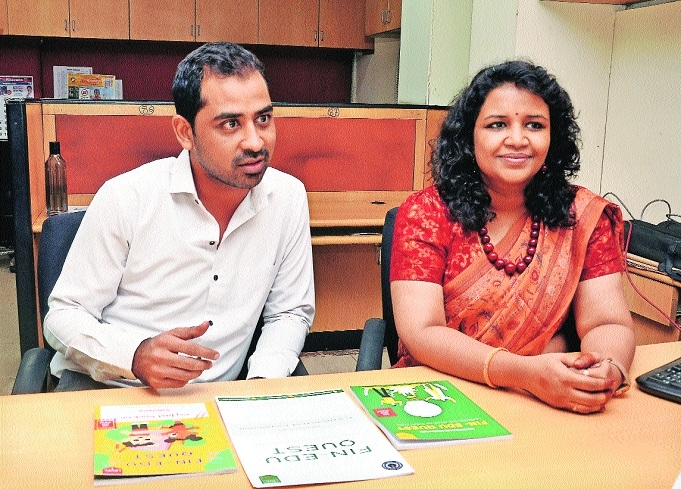
CA Aman Jain and CA Premlata Saboo in conversation with ‘The Hitavada’
on the need for financial literacy among youngsters. (Pic by Anil Futane)
By Vaishnavi Pillay :
Financial wisdom in childhood will ensure their financial independence: Experts
In a world where digital wallets are replacing physical cash, and complex financial tools and platforms dominate the news, the importance of financial literacy has never been more apparent than now. Understanding the language of money is not just about numbers, rather it is an essential skill-set that empowers one to make responsible choices, especially in the formative years.
A group of Chartered Accountants from the city, Premlata Saboo, Aman Jain and Nayan Gupta, who are also educators, young parents, and run FLQ Knowledge Foundation NGO, identified a critical gap in financial literacy among youngsters. Recognising the importance of early financial education, they came together to curate interactive student-friendly books that introduces young children to the world of money and finance, starting from Class I.
Speaking to the ‘The Hitavada’, Premlata Saboo states, “The seeds of financial wisdom sown in childhood grow into a mighty oak of financial independence, where they understand its power to create, not just consume”.
Saboo adds that money, for most kids, is a magical entity that appears when they ask for it, but in today’s time it is neccesary to inculcate money values at a very young so they make informed decisions independently later in their life.
Aman Jain suggested that financial concepts should be introduced as early as Class I rather than waiting until Class VI which he says is commonly practised in academic curriculums of schools. “Today’s children are smart and quick learners. Children at this age express desires for things like bicycles, toys, and snacks, an opportunity to introduce the concepts of needs versus wants,” adds Jain.
Saboo also adds that children often receive gifts in monetary form, so they can be taught about saving, budgeting, and delayed gratification, so they learn to wait for something they want.
The books they have curated employ child-friendly, storytelling approach to break down financial concepts into easily understandable information.
Saboo and Jain encourages parents to involve children in basic exposure of real-life financial situations and tasks such as going for grocery shopping, reading price tags, making them save money, making a budget for long-term goal, and letting child to make decision of need and want.
“Allow children to experience the impact of spending their own savings.
Parents should also ask their children to share money to buy household items, make them donate or do charity culminating a message of financial responsibility and empathy,” adds Jain.
Jain mentioned that the current generation is influenced by social media and often associate their identity with the brands they use, which leads to impulsive buying, overspending, and a distorted sense of needs. As a result, managing and reducing these inflated desires becomes increasingly challenging.
Saboo expresses that parents’ actions also play role in shaping their children’s financial outlook and adds that with the trend of smaller families with fewer children, parents often fulfill demands or resort to scolding, both ways can have negative impacts.
“Parents should maintain a balanced lifestyle, be disciplined in money matters, and mindful of conversations about money in front of children. Practising gratitude and humility, regardless of financial circumstances, is the key,” says Saboo.
The team shared their experience of introducing financial concepts to children during summer camps and received supportive response from parents who expressed that teaching such concepts from a young age at school-level would benefit a larger group. They are also planning to take forward their initiative by developing books in Hindi and Marathi language, and further in other regional languages too to ensure inclusivity and accessibility for children from diverse backgrounds.
Saboo highlighted the necessity for teachers to be well-equipped to deliver the financial concepts to students in a practical manner with fun activities rather than just focusing on theory.
The team envisions reaching out to more school, colleges and other educational institutions to guide young people with financial knowledge before they start earning.
“We also aspire to educate homemakers about financial management, because many of them still do not know how to operate their bank accounts and are unaware of family insurance policies,” adds Saboo.
Jain advises youngsters who are earning to start saving early and invest responsibly. “Even with minimal initial investments, individuals can build substantial wealth over time. Generally, the focus remains on earning without teaching how to manage and grow money,” adds Jain.
Just like one cannot learn swimming unless they are in water, true financial literacy and responsible money management require real-world experience.