Siachen defeat was a humiliation for Gen Musharraf: Lt Gen Kulkarni
| Date :15-Aug-2024 |
Staff Reporter :
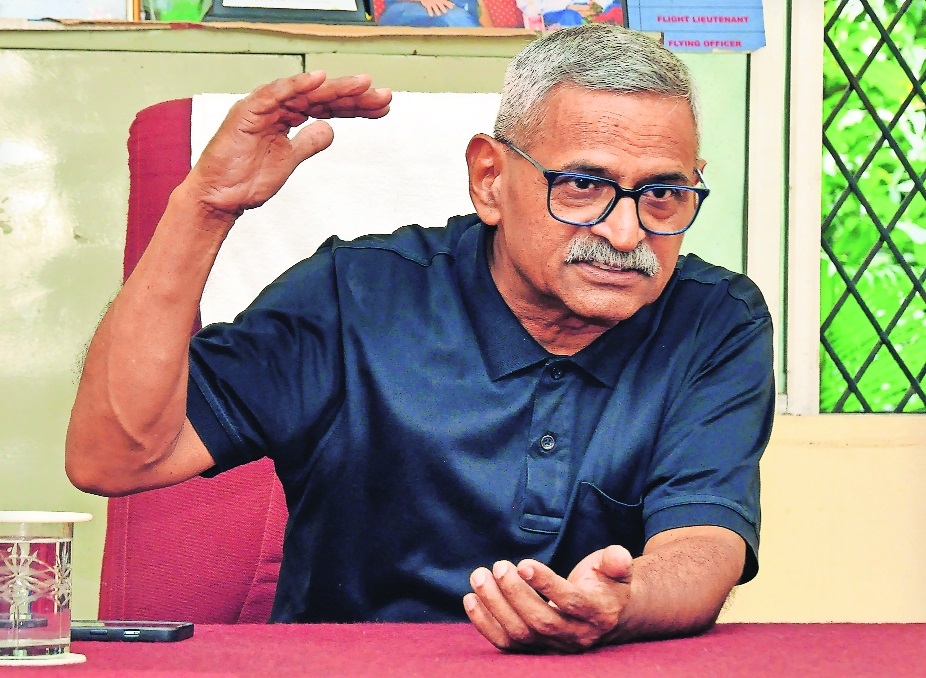
“The defeat of Siachen in 1984 was a sheer humiliation for General Pervez Musharraf and to get back the control of Siachen, he executed the Kargil conflict in 1999,” claimed Lt Gen Sanjay Kulkarni (Retd). Lt Gen Kulkarni PVSM, AVSM, SC, SM, VSM (Retd) made this statement during the interaction with media held at Prahar Samaj Jagruti Sanstha office, in Khamla here on Wednesday. Flt Lt Shiwalee Deshpande (Retd), Secretary, Prahar Samaj Jagruti Sanstha was prominently present.
“Gen Musharraf, in his book ‘In the Line of Fire’, admitted that Pakistan decided to induct their troops to Siachen on May 1, 1984, was a mistake because India anticipated their plan and they occupied Saltoro passes on April 13,” said Lt Gen Kulkarni.
On April 13, 1984, ‘Operation Meghdoot’ was launched with an aim to deny Pakistan aggressors a foothold and to allow them to take control of the Saltoro Ridge in the Siachen Glacier. In the summer of 1984, Pakistan planned to occupy defences on the Saltoro Ridge, overlooking the Nubra Valley, but the Indian Army predicted Pakistan intentions and the operation took place.
After launching the ‘Operation Meghdoot’ by the Indian Army, Lt Gen Kulkarni was the first man to land on Bilafond La on April 13, 1984.
“It was a race against time. Pakistanis had a much shorter distance to cover to reach Siachen even they could reach there in one day. Whereas for us it took seven days to be there. At Siachen, we had to defeat our enemies and the harsh, unforgiving terrain. We used our experience of operating on glaciers to our advantage. Our troops were fully acclimatised to operate at 20,000 feet. ‘Pet mein roti, haath mein soti aur chaal chhoti (Eat well, walk with a stick and take small steps)’ was the principle we followed,” explained the retired General.
“After we had de-inducted our troops in 1983, it was reported that a Pakistan Special Service Group (SSG) team had crossed into Siachen under the leadership of Gen Musharraf (the then Colonel). Unable to sustain the harshness of the terrain, the Pakistani team de-inducted, and it was then crucial who would induct first in 1984 and occupy the crucial passes of Bilafond La and Sia La,” he added.
“Having experienced Siachen very early in my career was a blessing in disguise. In 1983, I was nominated Second-in-Command of Patrol Polar Bear. On a routine patrolling to Bilafond La, I found soda wrappers with what we thought had Chinese marking and we immediately reported the matter to our Sector HQ,” said the Siachen hero.
Lt Gen Rawat, father of former CDS Gen Bipin Rawat PVSM UYSM AVSM YSM SM VSM ADC, visited us and enquired first-hand the sequence of events which had unfolded. We received confirmation that the inscription on the wrapper were not Chinese but Japanese, as both scripts are quite similar looking and the soda wrappers were left behind by the Japanese Expedition permitted by Pakistan. This incident was enough to confirm Pakistan’s intentions, explained the retired General.
Exactly four decades after he jumped from the Cheetah at Bilafond La, to signal the beginning of ‘Operation Meghdoot’, Lt Gen Kulkarni said, “I remember throwing a 25 kg flour sack to test the depth and hardness of the snow. Luckily it was quite hard. After checking the snow, I gave the signal to the pilot of my chopper for landing.”
“We were 30 people who landed there which was just 1 km far from the Bilafond La. We had instructions not to start our radio sets for five days. Due to extremely bad weather, within three hours of landing, we had to evacuate our radio operator who suffered High Altitude Pulmonary Edema (HAPE) despite being acclimatised. So, by May 1, out of 30, 22 got ill and sent back,” said Lt Gen Kulkarni.
Siachen hero’s talk today
Prahar Samaj Jagruti Sanstha has organised a talk of Siachen hero Lt Gen Sanjay Kulkarni (Retd) on Thursday at 10 am at Persistent Hall in IT Park, to mark Independence Day. Flt Lt Shiwalee Deshpande (Retd) appealed to the public to attend in large numbers.
‘Future wars may be fought over water’
Lt Gen Sanjay Kulkarni (retd), who was the first to land at Bilafond La in Siachen Glacier area marking the launch of ‘Operation Meghdoot’ by India, feels that the future wars might be fought over water.
“Tibet is the roof of the world as well as the source of water for several South East Asian countries. Siachen Glacier region is the largest source of fresh water, with rivers like Brahmaputra, Ganga, Indus, and Yangtse originating there. However, since the past some time, China has started controlling the flow of water from Tibet by constructing dams over major rivers. This may very well serve as the cause of geopolitical tensions. The future wars may be fought over water,” said Lt Gen Sanjay Kulkarni (retd), while speaking to ‘The Hitavada’ on Wednesday.
India had outsmarted Pakistan narrowly in occupying the heights in Siachen Glacier region in April 1984.
Since then, India has come a long way. Till 2003, when the ceasefire was announced between India and Pakistan, Siachen had earned the distinction of being the highest battlefield in the world. It gave rise to what came to be known as ‘Oropolitics’, that is, using mountaineering for political goals.
Asked about his take on ‘Oropolitics’ vis-a-vis Siachen, the most decorated officer of the Kumaon Regiment replied, “Heights are luring, but also suck troops. Though one can monitor an area with the help of drones and satellites these days, it is only physical occupation that amounts to possession and acts as deterrence to enemy forces. Once you dominate heights, and it becomes difficult to dislodge you from there. Besides, India is the only country with Line of Control with Pakistan, Line of Actual Control with China, Actual Ground Position Line in Siachen. Given the crucial significance of holding the heights, encouraging mountaineering and tourism is needed.”
However, mountaineering leads to tourism and tourism leads to opening of shops, increased human activity. These create ecological issues. Against this backdrop, some quarters have been demanding ‘demilitarisation’ of Siachen.
Lt Gen Sanjay Kulkarni opposed the idea. “Demilitarisation is possible only if there is trust. And, Pakistan’s past behaviour makes it untrustworthy. For the same reason, of Pakistan being untrustworthy, India is opposed to the idea of
declaring Siachen as ‘Peace Park’ as advocated by some,” he concluded.