GPR to map Vakataka era fort in Pench
Date :02-Aug-2024
By Kaushik Bhattacharya :
GPR to image the subsurface and detect underground utilities, geological features and other features with electromagnetic waves. Work on mapping to start in one week
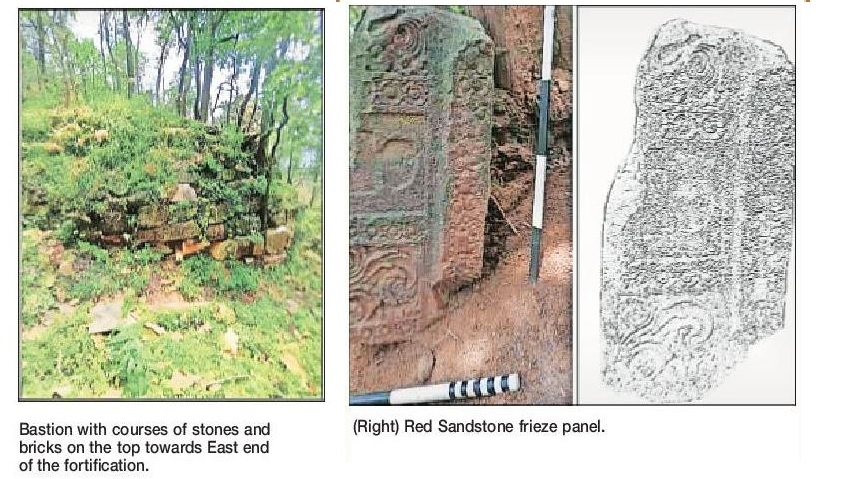
The recently discovered Vakataka era fort at Kolitmara area of Parseoni taluka near Nagpur by Department of Ancient History, Culture and Archaeology of Rashtrasant Tukadoji Maharaj Nagpur University (RTMNU) in association with Pench Tiger Reserve (PTR) management, have brought new clarity on the life, religious affiliations, and other practices of the Vakataka dynasty, which ruled parts of Central and South India centuries ago.
To get more details about the fort, RTMNU and PTR will use Ground Penetrating Radar (GPR) system in the vicinity to image the subsurface and detect underground utilities, geological features and other subsurface features with the help of electromagnetic waves.
“We have aquired the GPR from a private firm and the land mapping will start in a week to get more information about the fort which was studied by RTMNU last year,” said Dr Prabhu Nath Shukla, Deputy Director, PTR.
The fort has been a historic addition to the same area and remains of second and tenth century sculptures and artifacts conducted by the Department of Ancient History, Culture and Archaeology of Nagpur University. The study was held last year in August by Dr Prabash Sahu, Professor and Head of the Department and assisted by Dr Mohan Pardhi, K S Chandra and Alumni Shantanu Ingle on the invitation of the
Dr Prabhu Nath Shukla.
The team surveyed two localities -- Ghuggusgarh and Kolitmara.
The purpose of this survey was to assess the archaeological potential of the hitherto unexplored areas of the Tiger Reserve and to identify and document the structural remains and other artefacts noticed by forest officials from time to time. It was also intended to assess the feasibility and viability of further exploration or excavation in the area.
While survey the both sites, the team found a broken red sand rock freeze panel, decorative panel part, spiral floral design, long-eared face with horoscope, curly hairstyle featuring Buddhist sculptures (can be female or male in tribhangal) — dating from 3rd to 6th century. It also found broken pieces of black basalt mahishasurmardini, with a trident pierced around a cuddled buffalo’s neck and on the god’s left foot. Even though the top of the image is broken, head and shoulder marks can be seen on the broken pieces.
“The GPR will help to get the exact map of the area and more information about the fort which will help the experts to make decision about excavation of the site,” said Dr Shukla.