Quotawithin quota State Govts can sub-classifySCs, STs for quota, rules SC
| Date :02-Aug-2024 |
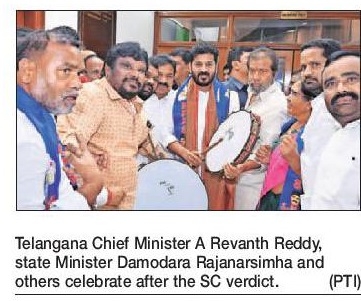
NEW DELHI :
IN A landmark verdict, the Supreme Court on
Thursday held that States are constitutionally
empowered to make sub-classifications within
the Scheduled Castes (SC), Scheduled Tribes
(STs), which form a socially heterogeneous class,
for granting reservation for the uplift of castes
that are socially and educationally more backward among them. The apex court, however, madeitclearthatstateshave to make sub-classification on the basis of “quantifiable and demonstrable data” of backwardness and representation in government jobsandnoton“whims”and asamatterof“politicalexpediency”. A seven-judge Constitution bench headed by Chief Justice D Y Chandrachud held by a 6:1 majoritythatthefurthersubclassification of Scheduled Castes (SCs) and Scheduled Tribes (STs)bythestatescan bepermittedtoensuregrant of quota to more backward castes inside these groups.
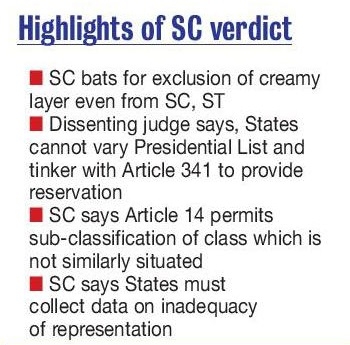
“The State in exercise of its power under Articles 15 (non-discriminationagainst any citizen on grounds of religion, race, caste, sex, placeofbirth)and16(equality of opportunity in public employment) of the Constitution is free to identify the different degrees of social backwardness and provide special provisions (such as reservation) to achieve the specific degree ofharm identified,” heldthe CJI in his 140-page judgement. “Historical and empirical evidencedemonstrates that the SCs areasocially heterogeneous class. Thus, the state in exercise of the power under Articles 15(4) and 16(4) canfurther classifythe SCs if (a) there isarational principlefordifferentiation; and (b) the rational principlehasa nexuswiththepurpose of sub-classification,” the CJI held. The six judgements, running into 565 pages, were penned on the contentious issue by the CJI, who wrote forhimselfandJusticeManoj Misra,andJusticesBRGavai, VikramNath,PankajMithal, Satish Chandra Mishra and Justice Bela M Trivedi.