ISRO’s SpaDeX satellites first to be built by industry on its own: Official
| Date :01-Jan-2025 |
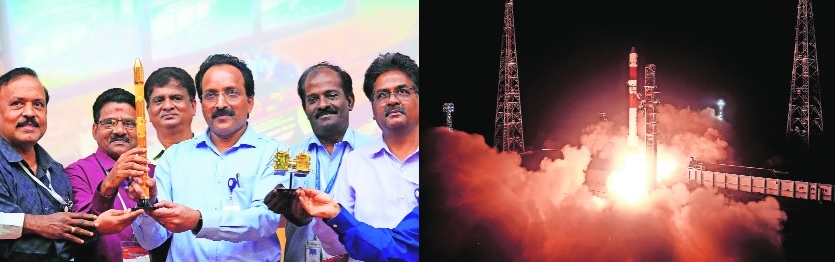
ISRO Chairman S Somanath with senior ISRO scientists and Directors of various centres during a press conference after successful launch (R) of the Space Docking experiment, in Sriharikota on Monday. (PTI)
NEW DELHI :
THE launch of two satellites for the space docking experiment (SpaDeX) also marked a first for the industry, which built the two spacecraft on their own under guidance from the Indian Space Research Organisation (ISRO) engineers.
The two satellites -- SDX01 (chaser) and SDX02 (target) -- each weighing 220 kg were integrated and tested by Ananth Technologies Limited (ATL), which has been associated with a number of ISRO projects for the past several years.
“So far, large satellites have not been released in the industry by themselves. This is the first time that the two satellites have been integrated and tested in the industry,” said U R Rao Satellite Centre (URSC) Director M Shankaran after the two satellites were placed in a 476 km circular orbit by the Polar Satellite Launch Vehicle (PSLV-C60) on Monday night.
Shankaran described the launch of the two satellites a “trailblazer” for the industry.
“We hope that this is going to be the first of the several such satellites done by the industry on their own,” he said.
The Assembly, Integration and Testing (AIT) of the satellites were conducted at ATL’s new state-of-the-art facility in the KIADB Aerospace Park, Bengaluru.
This 10,000 square meter facility is equipped to manufacture electronic subsystems and integrate up to four large satellites simultaneously. The SPADEX mission exemplifies India’s capability to achieve on-orbit docking, a critical technology for future manned and deep-space missions. It marks a significant milestone in India’s space exploration ambitions, with applications including human spaceflight, space exploration and supporting repair, refueling and upgrades for operational satellites.
The mission’s objectives include demonstrating autonomous rendezvous and docking, controlling one spacecraft using the Attitude Control System of the other in a docked configuration, formation flying and operating a remote robotic arm. “Being a part of this milestone mission highlights ATL’s commitment to India’s human space program and our evolving contributions from subsystem manufacturing to full satellite and launch vehicle integration,” said ATL Chairman and Managing Director Dr Subba Rao Pavuluri.
The docking of the two satellites is expected to take place in the fore-noon of January 7 next year, making India the fourth nation to master such complex technologies.
ISRO gears up for 100th launch from Sriharikota with GSLV mission
SRIHARIKOTA :
INDIAN Space Research Organisation (ISRO), is gearing up to achieve a significant milestone with a Geosynchronous Launch Vehicle mission scheduled in January set to become the 100th launch from the Sriharikota spaceport, a top official said.
The 99th launch from Sriharikota was Monday’s PSLV-C60 mission which successfully placed two spacecraft for conducting the Space Docking Experiment in a circular orbit, ISRO Chairman S Somanath said.
“So, all of you have seen the majestic lift-off and the launch of the SpaDeX (Space Docking Experiment) rocket, and for us, this is the 99th launch of any vehicle from Satish Dhawan Space Centre so, that is also a very important number.
So, we are going for the 100th launch at the beginning of the next year”, he said.
Somanath, also the Secretary, Department of Space, was talking to reporters after the PSLV-C60 mission successfully placed the Space Docking Experiment spacecraft A and B in a circular orbit.
On future launches planned by ISRO, Somanath said, “In 2025, we will have many missions to start with the GSLV launching the (navigation satellite) NVS-02 in the month of January.”
ISRO successfully placed a navigation satellite onboard the GSLV-F12/NVS-01 rocket in May 2023. This GSLV rocket successfully deployed the NVS-01 navigation satellite, weighing about 2,232 kg into a Geosynchronous Transfer Orbit (GTO).
The NVS-01 was the first of the second-generation satellites envisaged for the Navigation with Indian Constellation (NavIC) services.
On Monday’s PSLV-C60 mission, Somanath expressed hope that many more Space Docking Experiments would be taken up by the scientists in the coming days.
“It is really an important mission with (India’s) space sector reforms and expansion of space activities.
There will be many more SpaDeX varieties including complex missions of docking systems in the coming days,” he said.
Meanwhile, referring to the rescheduling of the PSLV-C60 rocket from the earlier planned 9.58 pm to 10 pm on December 30, Somanath said, scientists do a conjunction study to check whether a satellite going to an orbit comes very close to another satellite while travelling in the same orbit.
“If you find there is any close proximity (between satellites), then we have to move the current satellite a little bit. Either, we delay it (the launch) or make it early, so that this proximity condition does not occur,” he said. Scientists undertook time to fix the launch for the lift-off and decide on the best time which gives the maximum distance to be away from the other satellite in the orbit, he added.