AUSPICIOUS Maha Kumbh begins today
13 Jan 2025 11:07:08
W
PRAYAGRAJ (UP),
What’s special
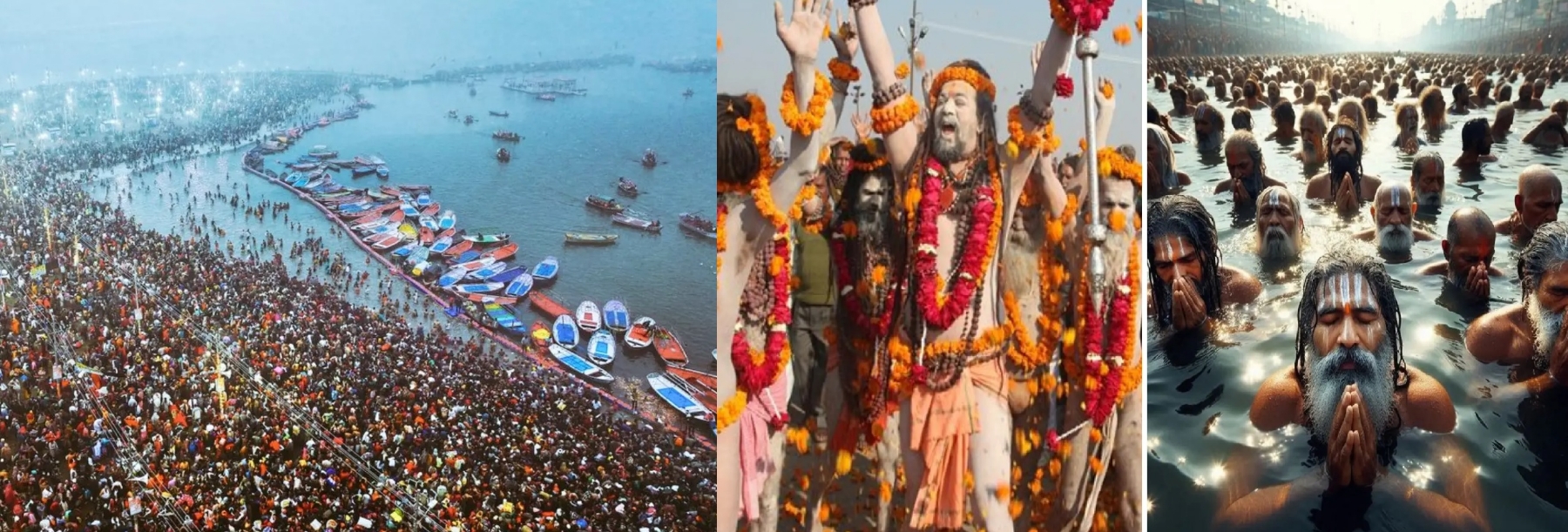
World’s largest gathering of humans. Over 35 crore pilgrims expected to attend the event. Rare celestial permutations and combinations are taking place after 144 years, making the occasion even more auspicious.
MAHA KUMBH 2025 -- a 45-day
event, from January 13 to
February 26, billed as the biggest
gathering of humans in one place
-- is all set to begin Monday with
the first major bathing ritual or
‘Shahi Snan’ on the auspicious
occasion of ‘Paush Pournima’ at
the Sangam, the confluence of
Ganga, Yamuna and the mystical Saraswati rivers here.
The present edition of the
Kumbh is being held after 12
years, though seers claim the
celestial permutations and combinations for the event are taking place after 144 years, making the occasion even more auspicious.
Perhaps that’s why the Uttar
Pradesh Government is confident of 35 crore devotees visiting Prayagraj this time.
Already the numbers are
telling, with a record 25 lakh people taking the holy dip on
Saturday, two days ahead of the
formal start of the event.
“It will be a grand Maha Kumbh
this time. Along with divinity and
spirituality, it would also showcase modernity as this time it is
going to be a ‘Digi-Kumbh’ of
sorts with Artificial Intelligence
(AI) being tapped in a big way,”
officials said.
On the ground, Prayagraj is all
decked up for the grand occasion, ready to welcome saints,
seers, pilgrims, and masses from across the globe, many of whom have already arrived -- all driven by the common goal of getting soaked in the spiritual fervour.
Chief Minister Yogi Adityanath said during his one-of-the-many visits to Prayagraj that the Maha Kumbh, to be held from January 13 to February 26, will elevate India’s ancient cultural and religious traditions to global prominence.
Calling the event a testament to India’s rich spiritual and cultural legacy, Adityanath said, “Maha Kumbh offers people from across the globe a chance to reconnect with their ancient traditions and cultural roots.
The latest edition of the Maha Kumbh will be a grand, divine, and digitally advanced event.”
“Spanning 10,000 acres, the event will set an exemplary standard for cleanliness, security, and modernity. To enhance the convenience of devotees, a digital tourist map will facilitate monitoring the cleanliness of toilets, while an AI-powered security system integrated with smartphones will ensure safety,” the Chief Minister said.
He also said the Maha Kumbh is not merely a religious event, but a symbol of social and spiritual unity.
The event will transform (Mahakumbh Nagar) into the world’s largest temporary city, accommodating 50 lakh to 1 crore devotees at any given time, Adityanath said.
According to Uttar Pradesh Chief Secretary Manoj Kumar Singh, more than 55 police stations have been set up along with the deployment of 45,000 police personnel for the fair. Projects have also been sanctioned to monitor social media continuously to guard against any mischief, he said.
Uttar Pradesh Chief Secretary Manoj Kumar Singh has said that 35 crore pilgrims are expected to attend the Maha Kumbh.
He also said that during the period of Mauni Amavasya, an estimated four-five crore devotees are expected to reach the holy city and participate in the festivities.
Singh said that the State budget for the 45-day-long mega event is around Rs 7,000 crore, and added that “the last Kumbh was known for sanitation. This time it is sanitation, security and digital Kumbh.
“2019 was Kumbh. This is Maha Kumbh, and in the last Kumbh, we received 24 crore pilgrims, and this time we are expecting more than 35 crore pilgrims. Arrangements are also being made like that.
“The area of the Mela has increased by almost 25 per cent. This time it is being set up at around 4,000 hectares, while in the last Kumbh, it was set up in an area of around 3,200 hectares,” Singh told PTI in an interview.
Drawing further comparison with the 2019 Kumbh, Singh said, “This time, we have divided the Mela area into 25 sectors as compared to 20 sectors in 2019. The lengths of ghats have been increased to 12 kilometres (in 2025) from eight kilometres (in 2019). The parking area too has been increased to 1850 hectares this time as compared to 1291 hectares in 2019.
“There was a drastic change when you compare what was done in 2013 and 2019, and you will find a quantum improvement and jump this time, because money-wise also, last time we had spent around Rs 3,500 crore, and this time it is just double, and we are spending around Rs 7,000 crore. The state budget for the Maha Kumbh is Rs 7,000 crore.”
Thirteen Akharas of seers from different sects are participating in this Maha Kumbh, drawing the attention of one and all, including those wanting to learn about the timeless Indian spiritual beliefs.
The walls of different offices in Prayagraj have been adorned with drawings depicting different aspects of Hinduism, gods and goddesses, and prominent events mentioned in the religious texts.
The crossroads of the city have also been given a major facelift, all decked up with various religious objects such as the ‘kalash’ (pitcher), conch shell, and various positions of the ‘Surya Namaskaar’ yogic practice. Barricades have been put up at various crossroads and tri-sections for better crowd management.
As many as 30 pontoon bridges, both in the Sangam area and Phaphamau, have also been readied to facilitate the movement of people from one end of the confluence to the other.
Huge gates have also been installed at some of the entry points to welcome the devotees into the holy city.
This time the Maha Kumbh Mela assumes special significance as it is the first Kumbh being held after the ‘Pran Pratistha’ of Lord Ram in Ayodhya on January 22, 2024.
Currently, the first anniversary celebrations of the consecration ceremony are underway in Ayodhya.
As always, the Akhara area is dotted by camps of various sects, adorned with vibrant decorations. However, the entry gates are stealing the spotlight this time with their unique and thematic designs.
The themed gates across the Mela area go beyond their visual appeal by serving as markers of identity, helping pilgrims locate and reach specific areas.
“Located near Jhunsi, these gates come in various designs, including aeroplane models, shivlings and crowns, enhancing the overall grandeur of the camps,” the UP government said in a statement.
A day before Paush Pournima, the banks of the Sangam witnessed an overwhelming surge of faith on Sunday as lakhs of devotees -- youth, elderly as well as children -- gathered to take a holy dip in the sacred waters, the statement said.
Boost to economy
Likely to generate
over Rs 4 lakh cr
in trade
NEW DELHI,
Jan 12 (IANS)
AS MAHA KUMBH sets to
begin in Prayagraj at the holy
confluence of the revered
Ganga,Yamuna and Saraswati
rivers from Monday, the
largest religious congregation
on Earth is anticipated to generate more than Rs 4 lakh crore
in trade in a significant boost
to India’s economy.
As per industry estimates,
Maha Kumbh is expected to
boost both nominal and real
GDP by over 1 per cent.
The Uttar Pradesh
Government expects approximately 35 crore visitors, both
domestic and international,
to attend the event.
According to Government
estimates, Maha Kumbh may
generate Rs 2 lakh crore in
trade if each of 35 crore visitors spends an average of Rs
5,000. Industry estimates further say that the average
expenditure per person could
rise to even over Rs 10,000 at
the mega event, and the total
economic impact could reach
Rs 4 lakh crore.