‘Everybody desires easy life which reflects a sociological problem’
| Date :20-Jan-2025 |
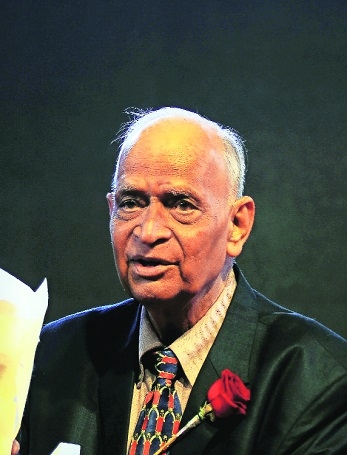
Padma Vibhushan
Dr M M Sharma
By Vikas Vaidya :
“We should encourage young engineers to develop entrepreneurial skills. There should be tinkering and innovation in our laboratories. This will pave way for engineers to go for manufacturing and work in the plants. They should be taught to imbibe and develop creative thinking. They are not expected to go to Indian Institute of Management (IIM) and then take a job of marketing or work in banking or Information Technology sector. Instead, they are supposed to become good engineers,” advised the stalwart of chemical engineering, Padma Vibhushan Prof Dr M M Sharma.
Prof Sharma was in Nagpur recently for the global alumni meet ‘KONNECT 24-25’, organised by the Laxminarayan Institute of Technology Alumni Association (LITAA) at the premises of Laxminarayan Innovation Technological University (LITU).
‘The Hitavada’ spoke to him on various issues related to research, skill development, engineering education etc.
Expressing concern over the inclination of students towards Indian Institutes of Management (IIMs) and Information Technology (IT), Dr Sharma said, “ Engineering has been killed by Indian Institutes of Management (IIMs) and Information Technology (IT). This is a major sociological change taking place in India. 70% intake in IIMs is filled by engineers. All these entrants want more money and less responsibility. This is affecting engineering in a very big way. The problem is they do not want to go into manufacturing. They don’t want hard work which is required for running plants.
They like to sit on the computers, do IT jobs. I find it very distressing. How many chemical engineers are in manufacturing? The answer is not many. They join IIM and get into marketing and banking.”
Pointing at the example of Loksarang Hardas, a proud alumnus of LIT, who is now a successful businessman in the USA, Dr Sharma explained, “Hardas bought brands from renowned companies and is now marketing those detergents in lower income groups. This is entrepreneurship skill. Like Ambani, Jindal, Vedanta promoter Anil Agarwal etc, Hardas too did not have a family business background but he had fire in the belly.” Loksarang Hardas, Founder and CEO of ‘LA’s Totally Awesome’ in the United States. His Awesome Products operates 4 manufacturing plants, and 2 distribution facilities over 6 million square feet across the US.
The annual production from these facilities ranges around 2.5-2.8 billion bottles per year.
Prof Sharma feels, one should go and run plants, sit in the control room and see how things are running. This reflects the sociological problem in India that everybody desires an easy life. There is no penchant for knowledge. “I would say with a heavy heart that knowledge is not the motivation of youngsters. For them, knowledge means googling which means directed reading and ready information. The advantage of going around and fishing in a library is you come across some unrelated subjects. You never know what relevance they have with your research,” Prof Sharma said.
Dr Sharma, a learned and versatile personality who reads journals regularly to update his knowledge, lamented, “Not having the urge to work is a serious problem. People don’t want to work in plants. They stay away from practical work. I experienced it long ago. Many do not
know that the first PhD thesis in India (entirely theoretical and that too with analytical solutions), was by my student Ramachandran and I found that once you give a theoretical piece of work, you lose the skill to do an experiment. I vowed thereafter that I would never give a theoretical subject to anyone. The moral of the story is that practicing engineering is important.”
Former Director of UDCT, Prof Sharma was appointed as Professor of Chemical Engineering at the Institute of Chemical Technology, Mumbai when he was only 27 years old. He is the first chemical engineering professor to take charge as a Director of UDCT.
Prof Sharma believes in brushing up the skills, for which everyone should remain updated. “One needs a different DNA to do something original. Many Indians who have gone abroad, express indignantly why their genes are better expressed in silicon valley and not in India. The reason is we are not providing the right ambience,” regretted Dr Sharma.
People always blame that research does not get adequate funding. But Prof Sharma is of a different view.
“It is not true. In our times we had no funds. Still we did global level research. We had no money at all. It was the situation till early 80s. People used to jump for a meager Rs 10,000 research project of CSIR. We have got patents for several projects at various levels. But how many patents have been commercialised is a million dollar question. We desperately wanted our research to find a place in the journal. We had to strive hard to achieve our goal. We had to go through the cascading effect but that could not discourage us.” expressed Dr Sharma.
In 1990, Prof Sharma became the first Indian engineer to be elected as a Fellow of Royal Society, UK. He was awarded the Padma Bhushan and the Padma Vibhushan. A recipient of several awards, he was honoured with the Leverhulme Medal of the Royal Society, the SS Bhatnagar Prize in Engineering Sciences, FICCI Award , the Vishwakarma medal of the Indian National Science Academy (1985), GM Modi Award (1991), Meghnad Saha Medal (1994), and an honorary Doctor of Science degree from Indian Institute of Technology, Delhi (2001). Swargiya Dadasaheb Kalmegh Dental College of Nagpur made a special mention of him on its website.
The page starts with his introduction.
“My only hope is universities. People in universities are not afraid of doing research. Secondly, appointing committed faculty, another issue which is haunting Indian educational institutes. It can be very demanding and a daunting task even for IITs, IIMs etc getting committed faculties. These institutions need faculties who can pursue academic careers with inner drive,” remarked Dr Sharma.
Those present during the interview were Padma Shri Dr G D Yadav, LITU Vice Chancellor Dr Atul Vaidya, Registrar Dr Neeraj Khaty, Principal Advisor Mohan Pande, LITAA Chairman Madhav Labhe.