Window on vidarbha Bioluminescent mushroom discovered in Pombhurna
| Date :17-Oct-2025 |
By Prashant Bhore :
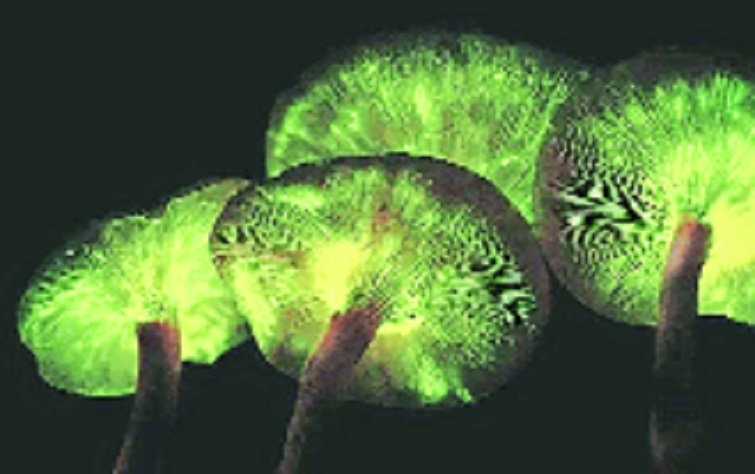
A rare bioluminescent mushroom belonging to the genus Omphalotus-popularly known as the Jack-o’-Lantern for its eerie green glow-has been discovered on the roadsides of Pombhurna in Chandrapur district. The glowing fungus was discovered by Dr Sheetal Choudhary, Assistant Professor at Department of Molecular Biology & Genetic Engineering, Rashtrasant Tukadoji Maharaj Nagpur University, and Prof Shamali Khalatkar, Assistant Professor of Botany at Shri Mathuradas Mohota College of Science, Nagpur. The discovery adds a fascinating chapter to the biodiversity profile of the region adjoining the Tadoba-Andhari Tiger Reserve.
Bioluminescence in fungi occurs through a chemical reaction involving luciferin and the enzyme luciferase, producing a soft green light in darkness.
Such fungi are considered indicators of healthy forest ecosystems, thriving in moisture-rich habitats rich in organic matter.
“This observation not only enriches the biodiversity record of Chandrapur but also emphasises the need for systematic fungal studies in central India,” opined Dr Choudhary. Experts note that Omphalotus species are typically found in the Western and Eastern Ghats and parts of North-East India. Their presence in a dry deciduous landscape like Pombhurna suggests that local microhabitats may support greater fungal diversity than previously thought.
Commenting on the find, Dr Sanjeev Patankar, retired Principal of S S Jaiswal College, Arjuni Morgaon, and former Associate Professor at Guru Nanak College, Ballarpur, highlighted the ecological and economic potential of the region. “The high moisture and organic content after heavy rains creates ideal conditions for fungal growth. Chandrapur and Gadchiroli districts, including Bhamragad and Sironcha, harbour rich biodiversity with untapped mycological and bacterial varieties of economic importance,” he informed.
Dr Patankar added that edible mushrooms, already sold in local markets during monsoon, could be commercially cultivated around the year to provide sustainable livelihoods. He also emphasised on developing entrepreneurial models through rural science colleges under the NEP-2020 skill development framework, encouraging youth engagement in bioresource-based ventures.
“Bioluminescent mushrooms could even be developed as ornamental organisms for gardens,” he suggested, pointing to similar success stories abroad.
Local environmentalists have called the discovery a hopeful sign amid rapid urbanisation and deforestation.
They note that while human expansion and settlement continue to pressure forest ecosystems, the emergence of such rare species reflects the region’s enduring ecological vitality.
The Chandrapur-Gadchiroli belt, blessed with vast forest, mineral and water resources, still faces unemployment and underutilisation of its natural wealth. Experts say that small but innovative steps such as mushroom cultivation, biofertiliser production, nutrition rich algae cultivation for cattle fodder and other nature-based enterprises could open new avenues of livelihood and strengthen rural economies.