DON’T BLAME FIRECRACKERS Air quality comparatively better on Diwali night than morning: CPCB data
| Date :23-Oct-2025 |
By Kaushik Bhattacharya :
- Three of four CAAQMS in city recorded higher AQI during day time as compared to ‘Laxmi Pujan’ night
- City’s Ram Nagar CAAQMS was the only station that witnessed ‘Poor’ air quality with 215 AQI on Diwali night
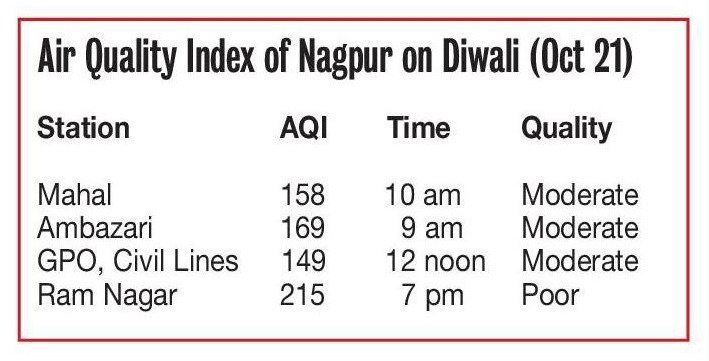
Is the tradition of bursting firecrackers really responsible for deterioration in air quality on Diwali? If yes, then the air quality of Nagpur city should be poor during the ‘evening time’ -- between 7 pm and 11 pm -- when the whole city bursts fire crackers to celebrate the festival. Interestingly, the Air Quality Index (AQI) data of Central Pollution Control Board (CPCB) of Nagpur city on ‘Laxmi Pujan’, which was on Tuesday night, witnessed the air quality of three Continuous Air Quality Monitoring Station (CAAQMS), in Mahal Town Hall, Ambazari and Government Post Office (GPO), which was better as compared to day time air quality on Tuesday morning. Whereas, the data stated that the CAAQMS in Ram Nagar area witnessed the poorest air quality in city on Tuesday with 215 AQI recorded around 7 pm. The CPCB’s website https://airquality.cpcb.gov.in/AQI_India_Iframe/ -- did show data for October 21 (Tuesday) of all four CAAQMS of Nagpur, and it pointed out that vehicular pollution was more significant on Diwali as compared to bursting of firecrackers.
This Diwali, the air quality of Nagpur city was better during evening hours in three CAAQMS, whereas the morning air quality was more poor.
Mahal area, which is a densely populated area in city, witnessed 158 AQI on Tuesday and it was recorded at 10 am whereas, in the peak time for bursting of firecrackers -- 7 pm to 11 pm -- the AQI was 149 (7 pm), 147 (8 pm), 133 (9 pm), 138 (10 pm) and 139 (11 pm).
Ambazari CAAQMS recorded 169 AQI at 9 am on Diwali day, whereas in the Diwali evening, the AQI varied between 164 (7 pm) and 141 (9 pm).
Similarly, GPO-based CAAQMS, marked 149 AQI on Tuesday and it was recorded at 12 noon.
Whereas, during ‘Laxmi Pujan’, the AQI was between 145 (7 pm) and 130 (9 pm). Ram Nagar CAAQMS is the only station which recorded the ‘poor’ AQI on Diwali night with 215 at 7 pm on Tuesday. As per the data, the AQI of Ram Nagar on Diwali was constantly above 200 AQI mark from 3 pm to 3 am.
This year, the Diwali celebration was distributed in two days -- Monday and Tuesday -- and citizens thronged the markets on both days for shopping and all shopping areas, including Mahal, witnessed tremendous rush of vehicles on roads.
Vehicular pollution would be a reason for poor AQI during day time on Diwali. However, this year, the overall AQI of Nagpur city on Diwali was better as compared to previous years.
Except Ram Nagar, all three CAAQMS of Nagpur reported moderate AQI on ‘Laxmi Pujan’.
As per the norms mentioned in CPCB website, AQI of 0-50 is considered ‘Good’ with ‘minimal impact’ on health; 51-100 AQI is considered ‘Satisfactory’ with ‘minor breathing discomfort to sensitive people’; 101-200 AQI is ‘Moderate’ with ‘breathing discomfort to the people with lungs, asthma and heart diseases’; 201-300 AQI is ‘Poor’ with ‘breathing discomfort to most people on prolonged exposure’; 301-400 AQI is ‘Very Poor’ with ‘respiratory illness on prolonged exposure’; 401-500 AQI is ‘Severe’ that ‘affects healthy people and seriously impacts those with existing diseases’.
From the official data, it appears to be a myth that AQI deteriorates only on Diwali due to bursting firecrackers in the city. Rather, the AQI staying ‘Moderate’ or ‘Poor’ even in day time on Diwali day, calls for serious exercise in finding out persisting reasons of unhealthy air quality instead of pinning the blame on only the firecrackers.