3 get Chemistry Nobel for ‘molecular architecture’
| Date :09-Oct-2025 |
STOCKHOLM :
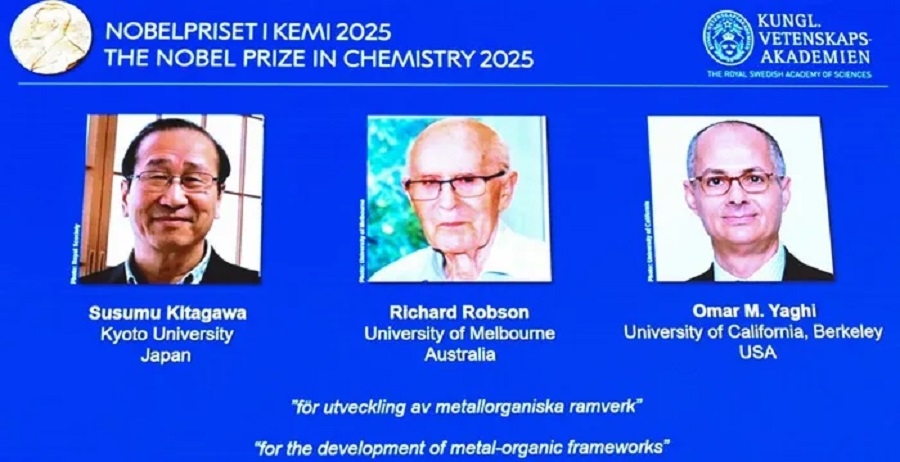
SCIENTISTS Susumu Kitagawa, Richard Robson and Omar M Yaghi won the Nobel Prize in Chemistry on Wednesday for their work in the development of metal–organic frameworks that dates back to 1989.
The Nobel committee said that the three laureates “have developed a new form of molecular architecture”.
“They have created molecular constructions with large spaces through which gases and other chemicals can flow,” the committee said. Hans Ellegren, Secretary-General of the Royal Swedish Academy of Sciences, announced the Chemistry prize in Stockholm. It was the third prize announced
this week.
“These constructions, metal-organic frameworks, can be used to harvest water from desert air, capture carbon dioxide, store toxic gases or catalyse chemical reactions,” the Nobel Committee said in a statement.
Robson, 88, is affiliated with the University of Melbourne in Australia, Kitagawa, 74, with Japan’s Kyoto University and Yaghi, 60, with the University of California, Berkeley.
The chemists, working separately but adding to each other’s breakthroughs with research that dates back to 1989, devised ways to make stable metal organic frameworks — which may be compared to the timber framework of a house.
These structures can absorb and contain gases inside these frameworks, with many practical applications today — such as capturing carbon dioxide from the atmosphere or sucking water out of dry desert air.
“Metal-organic frameworks have enormous potential, bringing previously unforeseen opportunities for custom-made materials with new functions,” Heiner Linke, chair of the Nobel Committee for Chemistry, said in a news release.
Olof Ramström, a member of the Nobel Committee for Chemistry, described the trio’s discovery as similar Hermione Granger’s enchanted handbag in the fictional “Harry Potter” series: small on the outside but very large on the inside.
Kitagawa spoke to the committee, and the press, over the phone on Wednesday after his win was announced.
“I’m deeply honoured and delighted that my long-standing research has been recognised,” he said.
There have been 116 Chemistry prizes given to 195 individuals between 1901 and 2024.
The award ceremony will be held on December 10, the anniversary of the death of Alfred Nobel, who founded the prizes. Nobel was a wealthy Swedish industrialist and the inventor of dynamite.