Nehru prevented Sardar Patel from fully integrating Kashmir into Indian Union: Modi
Date :01-Nov-2025
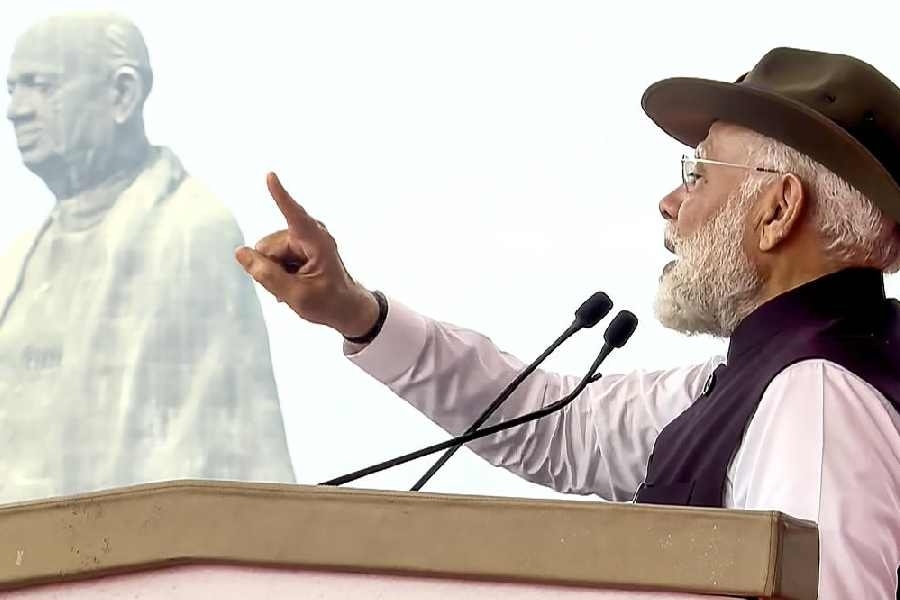
Prime Minister Narendra Modi addresses a gathering during the ‘Rashtriya Ekta Diwas’ programme organised on Sardar Vallabhbhai Patel’s 150th birth anniversary, at the Statue of Unity, Kevadia, in Narmada district of Gujarat. (PTI)
EKTA NAGAR (Gujarat) :
Sardar Patel accomplished the seemingly impossible task of uniting over 550 princely states after independence, says PM Modi
PRIME Minister Narendra Modi on Friday launched a sharp attack on country’s first premier Jawaharlal Nehru, claiming he prevented Sardar Vallabhbhai Patel from fully integrating Kashmir into the Indian Union.
Addressing the national celebrations on the occasion of Sardar Patel’s 150th birth anniversary at the Statue of Unity in Ekta Nagar, Modi asserted the subsequent “mistake” on Kashmir, resulting from the wish of the then-Prime Minister not being fulfilled, led to decades of turmoil and bloodshed in the region.
During his speech, Modi also referenced “Operation Sindoor” declaring the world has witnessed that India will “strike within enemy territory” if challenged, underscoring the country will “never compromise on its security and honour” and a message that “this is the India of the Iron Man, Sardar Patel.” He also raised the issue of infiltrators, calling them a “grave threat” to national unity and the demographic balance. “Many in today’s younger generation may not be aware that Sardar Patel wished for the complete integration of Kashmir, just as he had successfully merged other princely states,” Modi said. He said independent India’s first Home Minister believed one should not waste time writing history but “we should work hard to create history.”
Modi noted the Kashmir region was ultimately divided by a separate constitution and emblem, remarking the initial error “engulfed the nation in turmoil for decades.”
The PM’s address focused heavily on national unity and security, infiltration of illegal immigrants, contrasting the “steely resolve” of Patel with the approach of post-independence governments, which he accused of adopting “spineless” policies. “Due to the Congress’s weak policies, a part of Kashmir went under the illegal occupation of Pakistan, which then fueled state-sponsored terrorism. Kashmir and the country paid a heavy price, yet the Congress always bowed down to terrorism.
The Congress forgot Sardar Patel’s vision, but we have not,” he told the gathering at the Rashtriya Ekta Diwas celebrations. Modi blamed infiltration for disrupting India’s demographic balance, and said that for the first time the country has decided to have a decisive fight against this threat and will remove each and every infiltrator from its soil. He highlighted Patel’s success in accomplishing the “seemingly impossible task” of integrating over 550 princely states after independence. The PM regretted that subsequent governments, following Patel’s demise, did not demonstrate the same commitment to national sovereignty, pointing to Kashmir problems and said due to “weak policies,” a part of Kashmir fell under Pakistan’s illegal occupation. Extending his critique beyond Kashmir, Modi regretted that successive post-Patel governments “did not demonstrate the same seriousness towards national sovereignty,” pointing to challenges in the Northeast and the spread of Naxal-Maoist terrorism as direct consequences. He drew a direct contrast between the past and his government’s tenure, asserting after 2014, the nation “once again witnessed a steely resolve inspired by Sardar Patel.”
PM Modi fulfilled Sardar Patel’s dream of truly unified India by abrogating Article 370: Shah
NEW DELHI,
Oct 31 (PTI)
UNION Home Minister Amit Shah on Friday said that it was Prime Minister Narendra Modi who fulfilled Sardar Vallabhbhai Patel’s dream of a unified India by abrogating Article 370 from Jammu and Kashmir.
Flagging off the ‘Run for Unity’ on the 150th birth anniversary of the country’s first Home Minister, Sardar Patel, at the Major Dhyan Chand National Stadium here, Shah said that after India’s independence, the British decided to leave the country divided into 562 princely states.
“At that time, the entire world thought that it would be impossible to unite these 562 princely states into one nation. However, within a short span of time, Sardar Patel accomplished the monumental task of integrating all 562 princely states, and the map of modern India that we see today is the result of his vision and efforts,” he said.
Shah said regions such as Kathiawar, Bhopal, Junagadh, Jodhpur, Travancore, and Hyderabad made different kinds of attempts to remain separate, but Sardar Patel’s iron will and unyielding determination brought all of them together to form one united India.
“The only task that remained incomplete was Kashmir’s full integration with India due to Article 370, but Prime Minister Modi fulfilled that unfinished task of Sardar Patel — and today, we have before us a truly unified India,” he said.
Shah said Congress governments did not give Sardar Patel the respect he truly deserved; a great personality like him was awarded the Bharat Ratna after a delay of 41 years.
“Neither a memorial nor a
monument was built anywhere in the country. It was only when Narendra Modi became the chief minister of Gujarat that he conceptualised the Statue of Unity and built a grand memorial in Sardar Patel’s honour,” Shah said.
He further added that the foundation stone of the Statue of Unity was laid on October 31, 2013.
Shah said that Sardar Patel’s leadership qualities became evident during the Bardoli Satyagraha of 1928, which was launched against the injustice done to farmers.
Under Sardar Patel’s leadership, the farmers began their movement, and what started in a small town soon grew into a nationwide farmers’ movement, compelling the British to accept their demands, he said.
The 182-metre-tall statue was completed in just 57 months using the iron from the farmers’ tools collected from across the country, he said.
He said that Sardar Patel was a farmers’ leader, and around 25,000 tonnes of iron used in constructing the statue came from melting farmers’ tools.
The colossal statue, made using approximately 25,000 tonnes of iron, 90,000 cubic meters of concrete, and 1,700 tonnes of bronze, has so far been visited by about 2.5 crore people, he said.
Earlier, he offered floral tributes at the statue of Sardar Patel at Patel Chowk here.
In an early morning message posted on ‘X’, Shah paid homage to the ‘Iron Man’ Sardar Vallabhbhai Patel, calling him a symbol of “national unity, integrity, and the empowerment of farmers.”
“Sardar Sahab strengthened the unity and security of the country by integrating the princely states and advanced the nation toward self-employment and self-reliance by connecting farmers, backward classes, and the deprived with cooperatives,” he said in his message.