Election Commission says ‘No’ to VVPAT in local body polls
Date :19-Nov-2025
Staff Reporter :
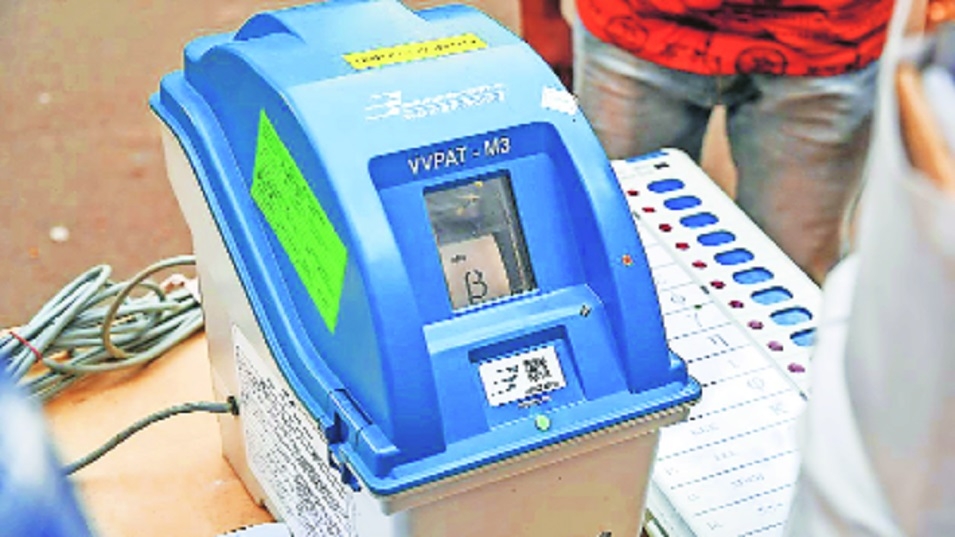
The Maharashtra State Election Commission (SEC) has filed a detailed response in the Nagpur Bench of the Bombay High Court, demanding rejection of a petition that asked to use VVPAT (Voter Verifiable Paper Audit Trail) machines in the upcoming local body elections.
The SEC’s main defence is that it is not legally required to use the paper trail system, and doing so is currently not technically possible. The court received the SEC’s document on Tuesday and postponed the hearing to Wednesday.
The petition was filed by Congress National Secretary Prafulla Vinodrao Gudadhe, who argued that VVPATs or a switch back to ballot papers was necessary to ensure transparency and public trust in the voting process.
The SEC’s Deputy Secretary, K Suryakrishnamurty, filed the reply affidavit, presenting several key legal arguments:
Missing law for VVPAT in local body elections
The most crucial point is that the laws governing local elections in Maharashtra- including those for Municipal Corporations, Zilla Parishads, and Village Panchayats - do not contain any provision that allows the use of VVPATs with Electronic Voting Machines (EVMs). The SEC stated that it is a constitutional body, but its powers are strictly limited by these local laws. It cannot introduce VVPAT technology unless the State Legislature amends these Acts.
Case already
decided in 2017
The SEC argued that the current petition should be dismissed because the same request was made in an earlier case in 2017 (Sunil Sudam Khatale-Patil v Maharashtra State Election Commission) and was already dismissed by the Bombay High Court.
The SEC also claimed the petition is incomplete because the State of Maharashtra -the only authority with the power to change the relevant laws - has not been included as a party in the legal challenge.
EVMs not designed for multi-post elections
Unlike National or Assembly elections where a voter chooses only one candidate, local elections in Maharashtra are mostly multi-member and multi-post. This means a single voter often casts votes for two, three, or four different positions on the same EVM unit. The SEC’s current EVMs are specifically designed for this complex system.
VVPAT incompatibility for multi-post EVMs
The standard VVPAT machines, which are designed for single-post elections, are not compatible with the SEC’s multi-post EVMs. Furthermore, the SEC stated that no approved technical design exists for a VVPAT machine that can successfully work with its multi-post system.
Failed experiment
in 2017
The SEC reminded the court that it had conducted a pilot project using VVPATs in the Nanded-Waghala Municipal Corporation election in 2017. This experiment failed due to multiple technical issues and no recommendation was made for its widespread use afterwards.
The SEC had even asked the Election Commission of India (ECI) to lend its VVPAT-compatible EVMs for the Brihanmumbai Municipal Corporation (a single-post election), but the ECI refused the request.
Requires 1 lakh
ballot baxes
Addressing the petitioner’s alternate demand to shift to paper ballots if VVPATs are not used, the SEC called the idea impractical and impossible to implement. The Commission stated that it currently has no ballot boxes in stock. It would be impossible to approve a design and manufacture approximately 1 lakh ballot boxes before the Supreme Court’s strict deadline of January 31, 2026, for completing the elections.
The SEC maintained that
its decision to proceed with EVMs without VVPAT is a reasoned and legal decision, based on the current law, technical feasibility studies, and logistical constraints. The Commission requested the court to dismiss the petition. Adv Pawan Dahat appeared for the petitioner.