In defence of nonsense
| Date :19-Nov-2025 |
By Biraj Dixit :
Just like that
Nonsense - It has been a word, an exclamation and at times a complete sentence. Though primarily it deals with ideas and actions, people have gone as far as to use it as an adjective to describe a person. Very technically, it may denote lack of sense. Sense, in turn, is the ability to think and act rationally. After thousands of years into human evolution and humongous efforts for its cultivation, the place where we presently find ourselves today makes it amply clear that sense is not a particular human forte. Some may excel at it but by and large people don’t care much about it. And ‘by’ and ‘large’ are the people who rule the world! So, while we admire sense, we absolutely relish nonsense.
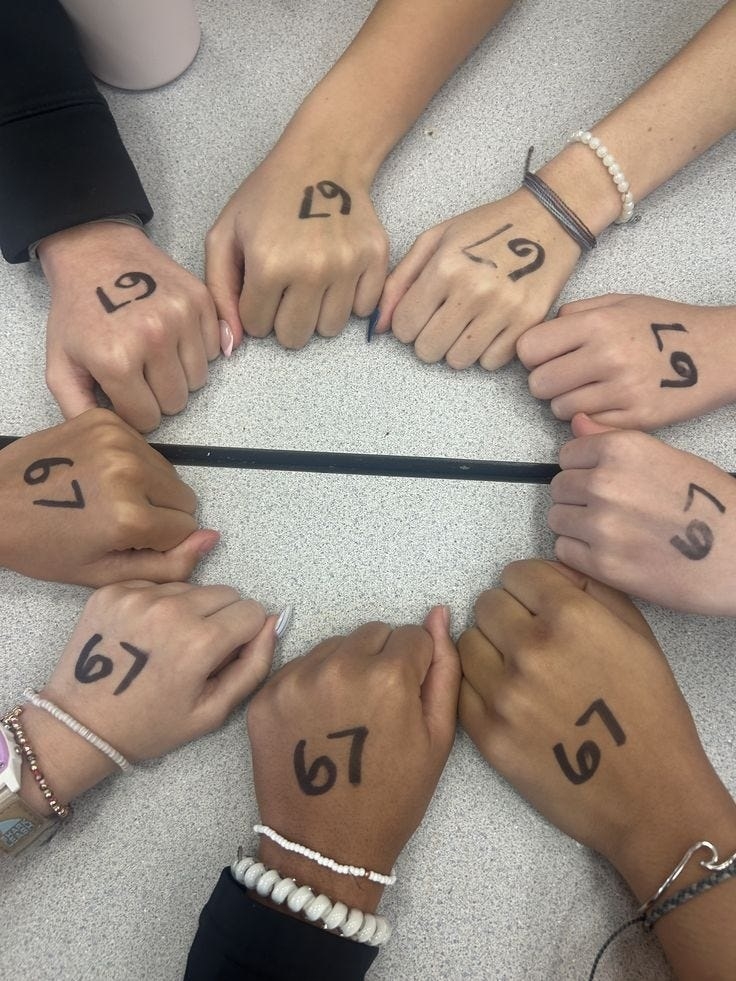
Or why else would a ‘67’ become the word of the year?! Dictonary.com, which has named 67 (pronounced not as the generally accepted old school sixty-seven, but as the ideal form of nonsense -- six seven) says that its most defining feature is that it is impossible to define.
It is a meaningless, nonsensical word…having all the hallmarks of a rotten brain.
The nearest one has come to attach a meaning to the term (if 67 can be called a term!?!), is to say it means so-so or may-be, may-be-not. This is indeed not to be confused with Shakespear’s to-be or not-to-be. While the latter arises due to the depth of the Bard’s understanding about the complex human dilemma, the former is just an on-surface confusion arising from a place where none should exist.
But for Gen Alpha it is something. It makes them feel connected, part of a group.
Now, this wanting to feel connected is a very human attribute, social animals as we are. And we all are well aware how much nonsense one has to suffer just to fit-in.
Remember the last time you showered praises on an absolutely undeserving recipient and sprinkled the red heart emoji across your WhatsApp groups? Or how you joined the silence of the chorus in not hailing what you actually liked fearing the dislike of the like-minded gentry? Social animals that we are, we all live by the spirit of ‘…in Rome do as the Romans do.’ So, if the big herd of humanity adopts idiocy as its salient attribute, it makes a lot of sense to reduce yourself to nonsense, if only to fit-in.
The Germans tried to fit-in to Nazi leaders’ anti-semitic plans. The British convinced half of the world that they were a superior species meant to govern. We still believe we elect our own governments! Have we not been 67ing ourselves for so many years?
Those critical of the selection of this word, which is not even a word, say it is a pretty dumb choice.
The others say it is a cheap trick to garner attention. Together, they mean dumb choices do garner attention. And attention is such a sought-after thing. Look at the choices we have made. People we award, people we reward, the life we choose, the lifestyle we adopt, our priorities, things we neglect – all are so 67.
So, is the 67 slang an attention-seeking device or a mirror to society?
Dictionary.com says, 67 shows the speed at which a new word can rocket around the world as a rising generation enters the global conversation. And after so many generations of developing words, language and skills to communicate, this is the word doing rounds!!!!
They say the word is being used by Gen Alpha as a joke to ‘frustrate elders.’ (…As if elders, living in a fast changing, technology-driven, more and more unnatural world, need any more frustration!)
The worry, however, is what to make of this 67 generation, out to frustrate its own elders! Well, I say, nothing. Nonsense becomes utterly nonsensical when you seek to derive meaning out of it. Remember how that silliness of a rhyme called ‘…ye hamari car hai, ye hum hai, aur yaha hamari party ho rahi hai…’ was ‘trending?’
The ‘what’s trending’ syndrome is also not a recent affliction. It has been prevalent from olden times as another example of mankind’s ability to consume nonsense. The European style of dressing, (those huge unbecoming wigs, suffocating corsets and high heels), was a mark of elegance. And most of humanity readily agreed to wearing those insufferable coats and suits even in the most hot and humid climates. The sensible use of garment was for comfort of a man. It was largely forgotten. Garments, till today, mean style, elegance, presentation and anything and everything but comfort. Even in their own country, the drapers of that very comfortable dhoti are looked down upon. …and that is only till we make dhoti ‘trending.’
The big, fat Indian wedding is another glorious example of how senseless is the most sensible! Because we all desire to fit-in. Long, have we thrived on nonsense only because we did not see much into it.
Now, you may argue, it is perhaps the reason why we find our subsequent generations all the more nonsensical than what we have ever been. I say, growth it is. You do not dumb yourself to remain in the clan. These kids are just out to show us the dead-ends of our own journeys.
…Meanwhile, the Cambridge Dictionary’s word of the year 2025 is ‘parasocial.’ It’s been described as a connection that people feel with someone they don’t know – or even with an artificial intelligence.
What a lovely escape?
n