‘He escaped for the last time’ Ila Arun’s emotional farewell as OCLF honours Piyush Pandey
| Date :24-Nov-2025 |
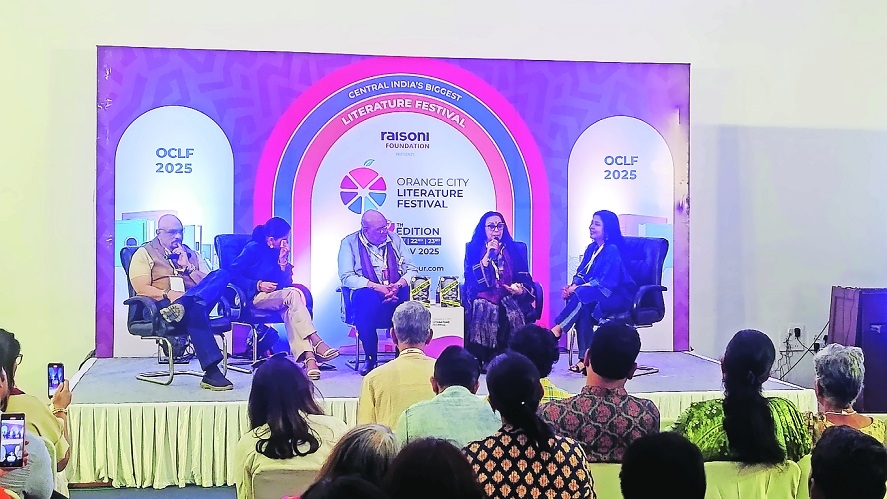
Ila Arun, Bharat Dabholkar, Padamsee Sharon Prabhakar, and Amit Behl with Nandita Puri during the session on Sunday.
Staff Reporter :
Tears welled across the auditorium as renowned singer Ila Arun recalled her late brother Piyush Pandey’s childhood mischief, setting a sombre tone at the Orange City Literature Festival on Sunday. “As children, we would search for him after he slipped out to play once our mother slept. Last month, he escaped for the last time, challenging us to find him again,” she said, her voice unsteady as the audience absorbed the weight of her loss.
The festival hosted a special session titled “Remembering Piyush Pandey: A Tribute to the Man Who Made India Speak Like India,” following the advertising icon’s passing last month.
The discussion, moderated by author Nandita Puri, brought together senior advertising professionals Bharat Dabholkar, Padmasee Sharon Prabhakar and Amit Behl, each recounting Pandey’s influence on both their industry and their lives.
Pandey, widely regarded as the force who shifted Indian advertising from mere product pitches to emotionally resonant narratives, created campaigns that left an imprint on national memory. His body of work includes Asian Paints’ “Kyoki har ghar kuch kahta hai,” Cadbury’s iconic dancing girl, and Fevicol’s unforgettable series of ads such as “Tootega Nahi” and “Sharma Ki Dulhaniya.”
Ila Arun revealed lesser-known facets of her brother:
a gifted sportsman, a master swimmer, adept at javelin throw and cricket, even reaching the brink of Ranji-
level selection. She noted that these traits remained largely unknown even within the
family.
Opening the discussion, Bharat Dabholkar described Pandey as the man who overturned the long-held belief that humour had no place in serious advertising. “He
dismantled the idea that buyers do not buy from clowns. He proved humour could
sell — and sell memorably,” he said. Dabholkar stressed that Pandey “Indianised” Indian advertising, shifting it away from westernised templates to authentic cultural expression.
Amit Behl shared memories of Pandey’s generosity, recalling how the ad-maker offered him crucial work during his early struggles in Mumbai. Prabhakar emphasised the emotional force of his storytelling, saying Pandey “did not just make ads; he burnt emotional retinas,” leaving audiences marked long after the screen went dark.
The session, compered by Anand Joshi, concluded with a collective sense of gratitude for a man whose creativity reshaped the nation’s visual language and whose absence now leaves a quiet but unmistakable void.