Academic institutions play crucial role in shaping conversationsaround digital safety, gender justice, says DNLU VC Prof Sinha
Date :27-Nov-2025
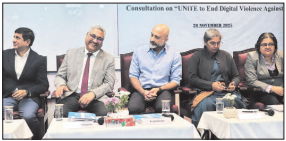
Legal Correspondent :
THE Consultation on ‘UNiTE to
End Digital Violence Against All’
jointly organised by UN Women
India and Vidyaranya- The
Academic Outreach Committee
( AO C ) a t Dh a r m a s h a s t ra
National Law University (DNLU),
Jabalpur, was successfully conducted on Thursday. The event
was organised under the leadership of Professor (Dr) Manoj
Kumar Sinha, Vice-Chancellor,
Dr Praveen Tripathi, Registrar
and Dr Gargi Chakrabarti,
Faculty Advisor AOC and
Controller of Examinations
bringing together Government
officers, senior members of the
judiciary, cyber experts, faculty,
and students to address the
pressing issue of technologyfacilitated violence against
women and youth.
Professor (Dr) Manoj Kumar
Sinha, Vice-Chancellor, DNLU,
in his welcome address, emphasised essential role of academic
institutions in shaping conversations around digital safety and
gender justice. He stressed that
universities must lead the way
in nurturing responsible digital
citizenship and equipping young
people with awareness,
resilience, and legal knowledge
to counter technology-enabled
harm. Justice Vivek Agarwal,
Judge, High Court of Madhya
Pradesh, in his keynote address,
reflected on urgent need for legal
systems to evolve in response to
technology-enabled crimes.
He
emphasised role of judiciary in
ensuring timely justice, strengthening victim-centred legal remedies, and fostering judicial sensitivity to digital forms of violence.
He urged students and youth to
become informed defenders of
digital rights and active contributors to justice delivery.
Mayor Jagat Singh Bahadur, in
his address, discussed growing
complexity of cybercrime and
the challenges that law enforcement agencies face in responding to online harassment, impersonation, and digital violations.
He encouraged young citizens to
stay vigilant, report incidents
promptly, and make responsible digital choices stressed the
city administration’s commitment to creating secure online
and offline environments for
women and youth. He highlighted the importance of community participation and local
governance in driving effective
digital safety initiatives. Joyatri
Ray, State Lead and Policy
Specialist, UN Women India, in
her Remarks, reiterated UN
Women’s commitment to promoting safe, inclusive, and gender-responsive digital spaces.
She highlighted that technology
has the power to empower
women, but only when it is safe,
accessible, and free from violence. She called for collective
action by academia, communities, and law enforcement agencies to strengthen digital governance and protection mechanisms. The consultation featured
an interactive cyber safety workshop led by Gokul Narayan,
CEO, Asian School of Cyber Laws,
along with cybercrime experts
who demonstrated real-time
methods for identifying online
threats, understanding cyber
laws, and securing digital footprints.
A panel discussion on
Strengthening Responses to
Digital Violence was held with
p a n e l l i s t s Ju d g e Na m i t a
Dwivedi, Assistant Director of
MPSJA, Jitendra Singh
(Additional SP, Jabalpur Cyber
Cell), and Dr. Gargi Chakrabarti,
Faculty In-charge, AOC. The discussion focused on prevention,
reporting, redressal mechanisms, and multi-agency coordination for victim support.
The session was moderated by
Utkarsh K Mishra, Assistant
Professor of Law.
The day concluded with remarks from UN
Women India and DNLU, followed by a vote of thanks and a
networking session. The event
was coordinated with support
from faculty advisors Dr Gargi
Chakrabarti and Dr Animesh
Jha, and student coordinators
Rakesh Bhadoria and Gungun
Ajay Khursel.