Covid-19 resurgence: Cases jump to 165, 9 deaths in 6 months
| Date :06-Nov-2025 |

By Simran Shrivastava :
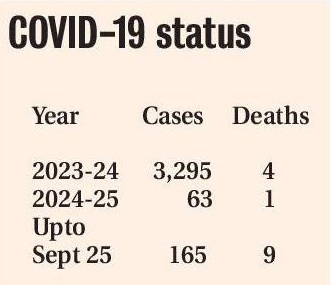
Confirmed cases of Covid-19 in the Nagpur circle have risen sharply to 165 during the six-month period from April to September 2025, according to a response received under the Right to Information (RTI) Act from the Deputy Director, Health, Nagpur Division, to applicant Abhay Kolarkar. The figure marks a steep increase from 63 cases recorded in the entire year of 2024-25.
While total cases in 2023-24 had stood at 3,295, fatalities in that period were just four. Deaths fell to one in 2024-25, but have now increased to nine between April and September 2025 - the highest recorded till date. Covid-19 virus has still not been eliminated totally and a little bit change in weather is going to see its resurgence, say health experts. But, the case load is still quite low.
Still, health authorities and epidemiologists are closely analysing the pattern, as the rise in fatalities over a short span is being viewed as a matter of concern.
Experts note that while the overall number of infections remains far below the levels seen during earlier waves of the pandemic, the rise in deaths, from one to nine in just six months, represents a significant shift.
Health experts say that factors such as increased virus circulation, waning immunity, the emergence of new variants, and delayed medical intervention may have contributed to the increase.
Test-positivity rate climbs 5% from 0.5%
Global surveillance data from the World Health Organisation (WHO) show that the test-positivity rate in the South-East Asia region climbed from 0.5 per cent in epidemiological week 15 of 2025 to 5 per cent by week 19. This rise indicates that even though reported case counts appear low, the actual spread may be wider, particularly in areas with limited testing or a high number of asymptotic cases.
Past analyses in India have revealed that official death counts may be underreported due to gaps in certification practices, rural-urban differences, and delays in registration. This makes year-on-year comparisons difficult, yet the latest increase in fatalities remains notable.
From a public health standpoint, the data suggest several key implications. Increased vigilance is essential, as a rise in deaths despite relatively low case numbers indicates risk to vulnerable groups such as the elderly and those with co-morbidities. Maintaining robust testing, surveillance, and genomic monitoring is critical to detect any emerging variants.
Health experts have also underlined the importance of vaccination and booster coverage, as waning immunity and lapses in booster uptake could leave certain population pockets susceptible. Strengthening healthcare systems, ensuring timely treatment, and improving outpatient detection mechanisms are vital to reduce mortality.
Although the figures should be interpreted cautiously given the potential for under counting, the upward trend in both cases and deaths points to the continuing presence and evolution of the virus.