ndia joins Brazil-led climate fundcalls for stronger ambition 10 yrs after Paris pact
| Date :09-Nov-2025 |
NEW DELHI :
INDIA has said global climate ambition
remains inadequate even a decade after
the Paris Agreement, as it joined Brazil’s
new global fund for tropical forests as an
observer and called for developed nations
to accelerate emission cuts and deliver
promised climate finance.
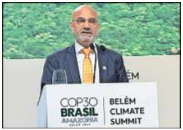
Delivering India’s statement at the
Leaders’ Summit of COP30 in Brazil’s
Belem on Friday, Indian Ambassador to
Brazil Dinesh Bhatia reaffirmed the country’s commitment to multilateralism and
the Paris Agreement, which marks its 10th
anniversary this year.
“India welcomes and supports Brazil’s
initiative in establishing the Tropical
Forests Forever Facility (T FFF), representing a significant step towards collective and sustained global action for the
preservation of tropical forests. India is
pleased to join the Facility as an observer,” Bhatia said.
Launched on Thursday,
TFFF is a Brazil-led global fund to reward
tropical countries for protecting and
expanding forests. It aims to mobilise
around USD 125 billion through public
and private investment, using returns to
pay nations that conserve forests.
India said COP30 is an opportunity to
reflect on the global response to the challenge of global warming and to celebrate
the legacy of the Rio Summit, where the
principles of equity and common but differentiated responsibilities and respective
capabilities were adopted.
Ten years after the Paris Agreement, the
country said global ambition remains
“inadequate” and that “many nations’
NDCs (nationally determined contributions) fall short”. “While developing countries continue to take decisive climate
action, developed countries that have disproportionately appropriated the global
carbon budget must accelerate emission
reductions and deliver the promised, adequate and predictable support,” the ambassador said. India urged developed nations
to reach net zero much sooner than they
have declared and invest substantially in
reaching net negative emissions
While acknowledging the
importanceofmitigation,India
stressed thatitisequallyimportant to focusattentiononadaptation to address climate risks
and vulnerabilities at the local
level, more so in developing
countries.Bhatiasaid access to
affordable finance, technology andcapacitybuildingis vital
for developing countries to
implement ambitious NDCs.
“Equitable, predictable and
concessional climate finance
remains the cornerstone for
achievingglobalclimategoals,”
he said. NDCs are national climate plans under the Paris
Agreement that set targets to
cut emissions and adapt to climate change, guiding global
efforts to limit warming to 1.5
degrees Celsius.
Countries are required to
submit their third round of
NDCs, referred to as “NDCs
3.0”, for the 2031-2035 period
this year. Officials have said
that India could submit its
updated
NDCs ahead or at
COP30 scheduled from
November 10 to 21.
Highlighting India’s domestic progress, Bhatia said the
country has consistently pursued a low-carbon development pathway and achieved
several of its climate targets
ahead of schedule.
Between 2005 and 2020, he
said, India reduced the emission intensity of its GDP by 36
per cent and this trend continues. The ambassador said
non-fossil fuel-based power
now accounts for over half of
India’s total installed capacity,
enabling it to meet its revised
NDC target five years early.
HesaidIndia’sforest and tree
coverhasexpanded to25.17per
cent of its geographical area,
creating an additional carbon
sink of 2.29 billion tonnes of
carbon dioxide, equivalent to
the period from 2005 to 2021.
“With around 200 GW of
renewable energy,Indiaisnow
the world’s third-largest producer of renewable energy,
while ambitious programmes
in solar, wind, green hydrogen
and biofuels are transforming
its energy landscape,” he said.
The ambassador also highlighted India’s leadership in
launching the International
Solar Alliance with France in
2015,whichnowunitesover120
countries topromoteaffordable
solar energy and South-South
cooperation