DRAMA DURING RESCUE: TTC vehicle breaks down, team borrows safety shield
| Date :12-Dec-2025 |
By Kaushik Bhattacharya :
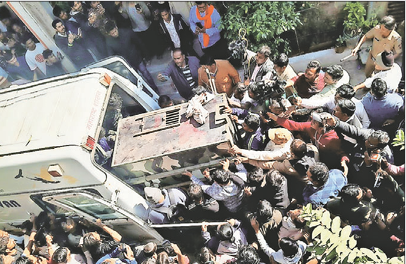
Foresters taking the caged leopard to TTC at Seminary Hills. The
cage was shifted to a borrowed pick up van after the
rescue vehicle developed snag midway.
(Pics by Satish Raut)
THE The proposal for fund allocation for purchase of new cages,
safety equipment, maintenance of vehicles etc. for TTC has already
been forwarded to the ministry. The Forest Minister himself said
today that he will consider the proposal and release fund soon,”
informed Dr Vinita Vyas, Deputy Conservator of Forest, Territorial
to ‘The Hitavada’.Transit Treatment Centre
(TTC), Seminary Hills, which
is the busiest unit of Forest
Department for rescuing wild
animals in Maharashtra, has
to deal with fund crunch for
the last one year when it
came to buying safety and rescue equipment.
The TTC team, which per
formed the daredevil rescue
operation of a leopard which
injured more than half-a
dozen persons at Pardi area in
city on Wednesday morning,
were short of proper safety
equipment and vehicle during that particular operation.
According to a senior official of TTC, the rescue team on Wednesday had no vehicle to
transport the leopard to TTC back and also borrowed safety shields
from deployed police staff during the operation.“We are demanding different rescue equipment like safety
shields, sticks, chest shield, nets, etc. from the department for the
last one year.
The cages were also in poor condition which require
maintenance,” said Kundan Hate, In-charge, TTC told The Hitavada.As per the information shared
by a source involved in the operation, “After rescuing the leopard,
the vehicle which was transporting the big cat to TTC, broke down
mid-way. The team hired a small
pickup vehicle to transport the
leopard to Seminary Hills.”
The TTC has five rescue vehicles, including a fully equipped
ambulance.
However, all the five vehicles
require maintenance and in cur
rent situation, TTC has to hire a
vehicle to transport any wild animal after its rescue.
“We have contractual staff who
participate in such daredevil res
cue operations all the time. They
do work on a very nominal salary
with no benefit of insurance for
such brave rescue works,” said a
senior
officer
of
TTC.
“Government should work proactively for such issues as the front
line staff of the department face such
life threatening events in every rescue activity,” said Hate.