MGNREGA to be reframed as Viksit Bharat- G RAM G bill
16 Dec 2025 11:30:42
NEW DELHI :
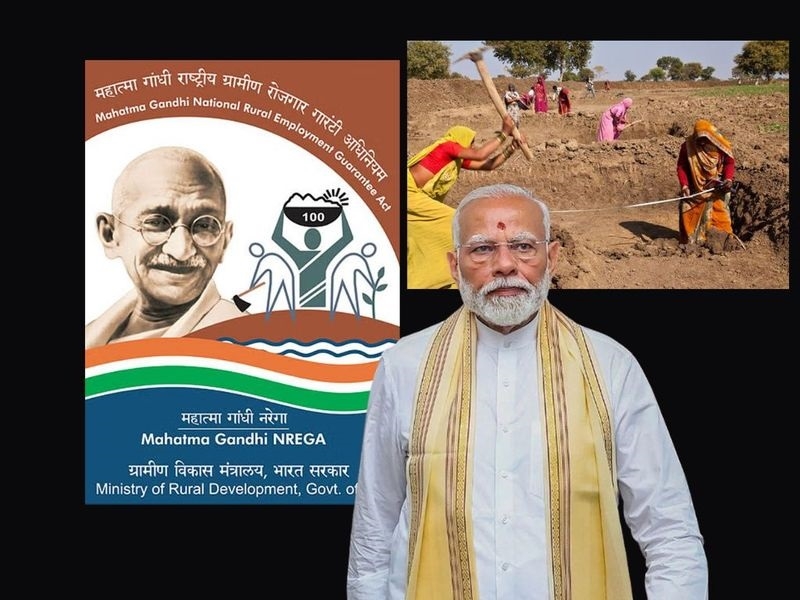
THE Viksit Bharat Guarantee for Rozgar and Ajeevika Mission (Gramin) (VB-G RAM G) Bill, 2025 that seeks to replace the existing rural employment law MGNREGA is set to be introduced in the Lok Sabha during the ongoing Winter session of Parliament.
According to a copy of the Bill, it will provide a statutory guarantee of 125 days of wage employment in every financial year to every rural household whose adult members volunteer to undertake unskilled manual work.
Within six months from the date of commencement of the VB-G RAM G Act, States will have to make a scheme consistent with the provisions of the new law.
Under this centrally sponsored scheme, the financial liability would be shared between the Centre and the State Governments. It would be 90:10 for the North-eastern States and Himalayan States and 60:40 for all other States and Union Territories with legislature. For the UTs without legislature, the whole cost would be borne by the Centre.
The MGNREGA was a 100 per cent centrally sponsored scheme.
While MGNREGA was a demand-driven scheme with the Union Government bound to allocate more money if demand for work was there, under the proposed scheme, the Centre would determine State-wise normative allocation for each financial year. Any expenditure incurred by a State in excess would be borne by the State Government.
The wage rate would be specified by the Central Government through a notification. The Bill says it should not be less than the prevailing wage rates under the MGNREGA.
Until a wage rate is notified by the Centre, MGNREGA wage rates will continue to apply in the areas covered by the new Act.
Unemployment allowance would be paid if an applicant is not provided work within 15 days, which will have to be paid by the
State Government, according to the Bill. The amount should not be less than one-fourth of the notified wage rate for
the first 30 days during the financial year and not less than half of the wage rate for the remaining period of the financial year.
The new Act focuses on four major types of works -- water security (conservation, irrigation, rejuvenation of water bodies, afforestation, etc); core rural infrastructure (activities like construction and upgradation of rural roads, Panchayat Bhawans, Anganwadi, etc); livelihood-related infrastructure creation (creation of assets to enhance rural likelihood like training centres, rural haats, grain storage, etc); and climate adaptation (activities related to disaster risk reduction, climate adaptation).
The Bill also provides for facilitating adequate availability of agricultural labour during peak agricultural seasons, and says the State shall notify a period covering the peak agricultural seasons of sowing and harvesting, during which works under this Act shall not be undertaken.
Rural Development Minister Shivraj Singh Chouhan, in the statement of purpose of the Bill, said MGNREGA has provided guaranteed wage-employment to rural households over the past 20 years. However, “further strengthening has become necessary in view of the significant socio-economic transformation witnessed in the rural landscape driven by widespread coverage of the social security interventions and saturation-oriented implementation of major Government schemes”, he said.